
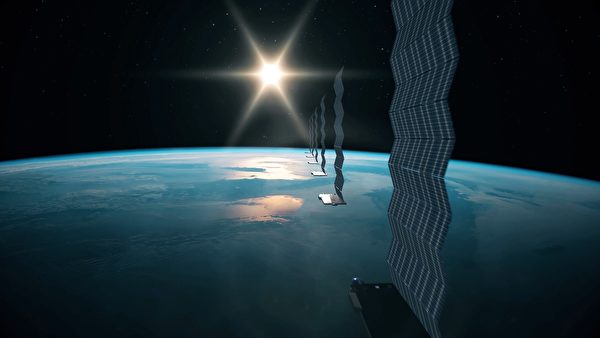
SpaceX, the space exploration technology company, has recently applied to the Federal Communications Commission (FCC) in the United States to launch 100,000 new “Gen3” satellites, operating a low Earth orbit constellation to increase the speed of the Starlink satellite network by 100 times.
According to a report from Space, a top authority website focused on space exploration, astronomy, and scientific entertainment, SpaceX currently operates nearly 18,000 internet satellites in low Earth orbit, with approval to redeploy approximately 4,000 more. If this application is approved, the total scale of SpaceX satellites will far exceed any existing satellite constellation.
Astronomer and satellite tracking expert Jonathan McDowell disclosed SpaceX’s application details through the social platform X on Thursday, July 9.
McDowell explained that each Gen3 satellite weighs approximately between 4,400 and 5,500 pounds (about 2,000 to 2,500 kilograms), with a fully deployed solar panel covering an area of 3,230 to 4,300 square feet (about 300 to 400 square meters).
In comparison, the currently launched V2 Mini version satellites by SpaceX weigh only about 1,760 pounds (about 800 kilograms) each, with a solar panel deployment area of around 1,250 square feet (about 116 square meters).
With the substantial increase in size, it is speculated that the Falcon 9 launch vehicle currently used for deploying Starlink satellites may not be suitable in the future for Gen3 satellites. The future Gen3 satellites may need to rely on SpaceX’s in-development “Starship” super heavy-lift launch vehicle, which will also be responsible for missions such as manned lunar landings and Mars landings.
It is noteworthy that Gen3 is not the largest satellite project planned by SpaceX. The company also plans to establish an artificial intelligence super satellite constellation called “Starmind,” with an estimated scale of 1 million satellites.
Elon Musk introduced this plan in February this year, stating that launching a constellation consisting of 1 million satellites to operate as an orbital data center is the first step towards a “Type II Kardashev Civilization”.
The “Type II Kardashev Civilization” mentioned by Musk is a significant milestone in the evolution of cosmic civilizations. Its core definition is that the civilization can fully control and utilize all the energy released by its parent star, such as our sun, at 100%.
This level of energy utilization typically involves the following core technological stages:
Stellar Energy Capture: Deploying billions of micro solar satellites or giant mirror arrays in space, completely surrounding the sun and collecting its radiative energy.
Interstellar Energy Distribution: Establishing a vast network of lasers or microwave beams to transmit the collected massive energy to planetary colonies, interstellar spacecraft, or deep space probes.
Multi-planet Expansion: Utilizing this almost infinite energy to drive AI computations, advanced industrial manufacturing, and support multi-planetary living with populations in the billions or even trillions.
SpaceX stated that after the deployment of Gen3 satellites, they will provide “ultra-low latency” multi-gigabit symmetrical broadband service, with internet speeds expected to increase by approximately 100 times compared to current levels.
However, a previous test conducted by technology media PC Magazine’s reviewer Brian Westover found that even with Starlink’s highest-grade Residential Max household plan, the actual average download speed was only between 145Mbps and 170Mbps, with upload speeds below 40Mbps, falling short of the advertised 300 to 400Mbps or higher.
Currently, several companies including Amazon’s Blue Origin are constructing or planning to build large low Earth orbit satellite constellations.
Analysts point out that for users living in rural areas with limited broadband infrastructure like fiber optic, the Starlink satellite network service holds significant importance.
However, there are concerns from the astronomical community and related organizations about the increasingly crowded Earth’s orbit, as large-scale satellite constellations may affect astronomical observations, wildlife habitats, the Earth’s atmosphere, and cause disturbances to nighttime sky viewing.