
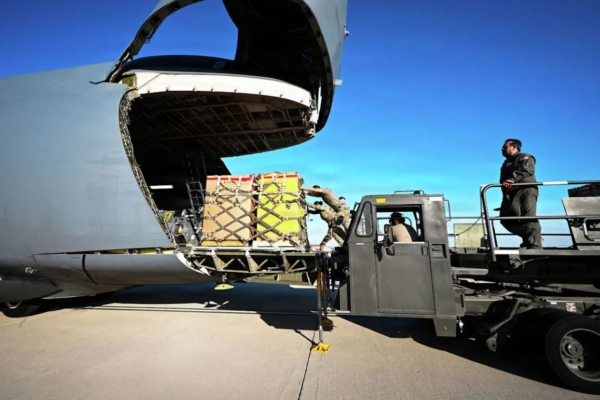
Recently, the United States Air Force used its largest active duty transport plane to transport seized drugs weighing 50 tons from a military facility in California to be destroyed in another state.
According to a press release issued by the US Air Force on July 7th, this mission, codenamed “Operation Burnout,” carried out jointly by the US Air Force and the Drug Enforcement Administration (DEA), is said to be “the largest record drug air transport destruction operation to date.”
From May 18th to 20th, the US Air Force deployed its largest active duty C-5M Super Galaxy transport plane to transport illegal drugs valued at approximately $5 billion, packed in 23 pallets, from an Air Force base in Riverside County, California to another base in Ohio.
With a maximum payload capacity of over 280,000 pounds (about 140 tons), the C-5M Super Galaxy is the strongest transport plane in active service in the US Air Force.
The seized drugs, including fentanyl, cocaine, and crystal meth, were later safely transported to an incineration facility in Indiana for final destruction.
Benjamin Sperring, a US Air Force Lieutenant Colonel and the Northern Command Joint Task Force Airlift Director, stated, “The C-5 gives us greater transport capability, meaning we can transport more seized drugs each time, thereby playing a larger role in reducing crime rates.”
The press release highlighted that by utilizing the C-5M transport plane, the cross-department team significantly reduced the risks of ambush, theft, or logistical errors during transportation, while expediting the drug destruction process.
Rashida Weathers-Hurst, the Director of Laboratory Management and Operations at the DEA’s Forensic Sciences Office, stated, “Without the collaboration with the Air Force, we would have to drive through multiple states for transport, which would consume significant manpower and take several days.”
She added, “Drug evidence is equivalent to currency on the black market, so this is definitely a high-security mission.”
The Northern Command Joint Task Force began planning for this mission months in advance, considering factors such as hazardous materials transportation exemptions, interstate flight routes, and strict ground security measures, with participation from a special DEA response team and the Air Force Security forces.
Gerald Mapp, a Senior Foreign Integration Consultant stationed at the US Department of War for the DEA, stated that the main reason for this operation was the closure of several large drug incineration facilities in California in recent years due to environmental concerns.
In 2022, Governor Newsom signed the AB1857 bill into law, canceling waste disposal credits for municipal solid waste incinerators, paving the way for the closure of the last few incineration facilities in California.
By the end of 2024, the last two major urban waste incineration facilities in California – the Southeast Resource Recovery Facility in Long Beach and the Covanta Stanislaus incinerator in Stanislaus County – had permanently closed.
Mapp commented, “After we seize drugs, we must store them in approved warehouses, but new drugs continue to be seized.”
The domestic air transport mission was carried out by an Air Force crew from Texas.
Captain Ryan Becker, the pilot for this mission, stated, “Our assets are not just for warfare.”
He said, “The DEA, Coast Guard, and local law enforcement agencies are responsible for seizing these drugs from the streets, and we are just assisting them in completing the final stage of this mission.”