
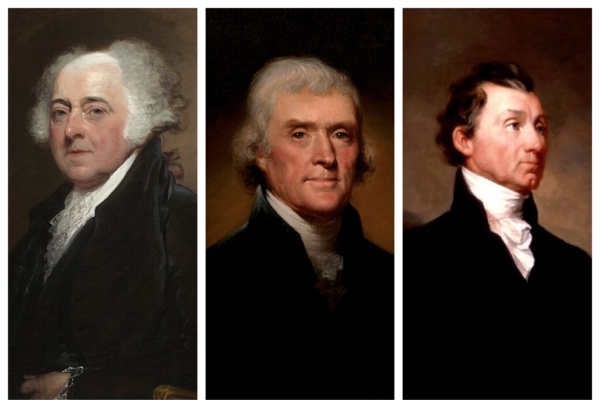
The United States is celebrating the 250th anniversary of the signing of the Declaration of Independence, with grand fireworks, parades, and family gatherings. Amidst the joyous celebrations, people may be surprised by a remarkable coincidence: three founding fathers and former U.S. presidents, John Adams, Thomas Jefferson, and James Monroe, all passed away on the 4th of July, Independence Day, seemingly completing their missions.
On July 4, 1826, at noon, the 3rd President of the United States, Thomas Jefferson, passed away at the Monticello estate in Virginia at the age of 83. A few hours later, the 2nd President, John Adams, passed away at his residence in Quincy, Massachusetts, at the age of 90, with a distance of 700 miles between the two locations. Both were signatories of the Declaration of Independence.
During the 50th anniversary of the nation’s independence, celebrations were in full swing. John Quincy Adams, the 6th President and the eldest son of John Adams, was hosting festivities at the Capitol in Washington D.C., with speeches, parades, and cannon salutes. Quincy Adams wrote in his diary that it was a day filled with joy and celebration for everyone.
According to americanheritage.com, invitations were extended to Adams, Jefferson, the 4th President James Madison, 5th President James Monroe, and the still living signer of the Declaration of Independence, Charles Carroll, to attend the celebrations in Washington D.C. However, none of them were able to attend. Despite their absence, their heartfelt and eloquent responses were published in newspapers across the capital and swiftly spread nationwide.
Jefferson remarked in his response on June 24, “After half a century of practice and prosperity, our fellow citizens acknowledge the wisdom of our original choice, a fact which gives me great satisfaction.” He talked about the independence of the colonies and the establishment of a new nation, emphasizing the rights of individuals to freely express their opinions.
Jefferson added, “It is a truth evident to all observers, that the human race is not born harnessed like horses; and that very few ‘heavenly favorites’ are born wearing spurs and a whip, capable of ruling over others, bringing hope to people.” He expressed his wish for the annual return of this commemoration day to continually remind people of these rights and strengthen their unwavering beliefs in them.
The news of Jefferson’s passing did not reach Washington D.C. until July 6. Jefferson’s health deteriorated on July 2, and on the night of the 3rd, he woke up asking, “Is today July 4th?” Surrounded by loved ones, he never spoke again. Jefferson passed away around 1 PM on July 4.
On the same day, Adams passed away after 5 PM. It wasn’t until July 9 that President Quincy Adams received a letter written by his family in the early hours of July 4, notifying him of his father’s critical condition. Quincy Adams rushed home with his son on the 9th, upon hearing of his father’s passing while stopping for breakfast during the journey.
Earlier, due to his ill health, John Adams had declined an invitation to attend the local 50th anniversary celebration. When asked to provide a toast, he replied, “Independence forever.” Despite needing assistance to board the carriage, he insisted on visiting neighbors the next day. On July 2, feeling extremely unwell, he refused to lie down and sat in his study chair, discussing the anniversary; later in the afternoon, he said, “Thomas Jefferson still survives,” unaware of Jefferson’s passing.
President Quincy Adams noted in his diary that the fathers of the nation departed during the climax of the Independence Day celebration, a peculiar and astounding coincidence. Many believed that the simultaneous passing of the two founding fathers symbolized the end of an era, some interpreted it as a visible and palpable manifestation of “God’s grace.”
During the presidential election of 1796, Adams received the most votes, with Jefferson as the runner-up, leading to their respective roles as president and vice president. Adams was a member of the Federalist Party, founded in 1789, while Jefferson belonged to the Democratic-Republican Party, founded by Jefferson and Madison in the early 1790s.
In the election of 1800, both parties nominated candidates for president and vice president, similar to the current system. Jefferson defeated Adams, becoming the 3rd U.S. President. Political differences, changes in electoral methods, campaign tactics, and media influence led to an estrangement lasting 11 years.
It wasn’t until New Year’s Day on January 1, 1812, that Adams wrote to Jefferson, reigniting their frequent correspondence and friendship lasting until their deaths 15 years later. Jefferson’s final letter to Adams was penned on March 23, 1826, while Adams sent his final letter on April 17. They continued discussing various political matters and remained intellectually sharp in their later years.
At their respective funerals held across the country, Adams and Jefferson were praised for setting expansive examples for future generations. Adams hailed from the north, and Jefferson from the south, naturally having differing viewpoints. Their simultaneous passing on the same day seemed almost divinely arranged, with some remarking that their optimistic hopes had materialized, solidifying a purely republican government that was expanding in strength amidst the joyful cheers and grateful blessings of the people.
On July 4, 1831, the 5th President James Monroe passed away in New York City—an end to the era of founding presidents. Monroe introduced the “Monroe Doctrine” to limit the expansion policies of European powers in the Americas.
Charles Carroll, the sole Catholic signer of the Declaration of Independence, passed away in 1832 at the age of 95, 56 years after signing the Declaration. He was the last living signer to pass away.