
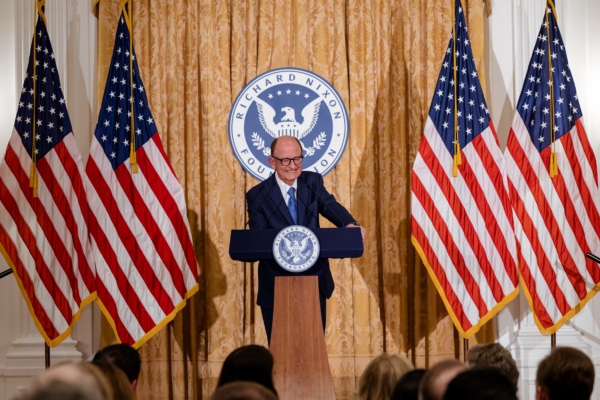
Former University of Southern California (USC) president Max Nikias recently gave a speech at the Nixon Library and signed copies of his new book “American Trojan”, which tells the story of an immigrant achieving the American dream in adversity.
George Leon Argyros, former US Ambassador to Greece, real estate investor, and philanthropist, introduced Nikias as someone who was a lifelong professor of electrical engineering and also taught in the classics department, authored over 275 papers, 3 textbooks, and holds 8 patents. As president, he led USC into the top 20 universities in the US.
Nikias introduced himself, saying he was born in Cyprus and experienced war as a young immigrant to the US, “at the time, I had nothing but talent and a strong belief in the American spirit.”
When the Nixon Library was completed in 2016, Nikias brought USC’s Trojan Marching Band and a copy of first lady Pat Nixon’s graduation certificate from USC. He said, “Among the first ladies of the US, only Mrs. Nixon graduated from USC with distinction.”
“Three former USC board chairs and other board members encouraged me to write a book about USC’s academic rise and the changing landscape of higher education.” Nikias emphasized placing academic integrity above ideological pressure, stating, “The book chronicles my experiences in Greece, the US, and USC, teaching me how to face challenges and hardships and remain optimistic about the future.”
Nikias and his wife lost everything overnight in their early years – family, property, business, precious photos, etc. He quoted the ancient Greek playwright Aristophanes, saying, “A man’s homeland is any piece of land where he can prosper.” And this was the belief America gave him.
“We both took the citizenship exam, she was asked about the US Civil War, while I was busy explaining the differences between the Cyprus Constitution and the US Constitution.” He recalled that taking the oath of allegiance to the US was one of the happiest moments in his life, giving them a sense of belonging.
Nikias hopes to express his gratitude and give back to America through his new book. He believes the American dream is built on ability, responsibility, and gratitude, saying, “When you follow the rules, work hard, and do things the right way, anything is possible.”
For those pursuing leadership, Nikias believes certain qualities are crucial: inspiring others, making difficult decisions under pressure, willingness to take responsibility, and recognizing that the essence of leadership lies in a humble attitude of serving others. Ancient Greek philosopher Xenophon reminds people that leadership requires love for humanity, a love for learning, perseverance, a pursuit of success, and self-restraint.
Nikias points out that the essence of university leadership is handling the unexpected. “You have a compelling vision, develop strategic plans, assemble the best team, start executing, but there are always surprises. You also need to deal with resistance, divestments, sanctions, and pressures from student demonstrations, turning crises into growth opportunities.”
When asked about his proudest achievements and regrets, Nikias mentioned establishing the Keck Medical Center, which saw its operational revenue soar from $400 million to $2 billion in the span of eight to nine years, employing 1,300 physicians. He also mentioned building the US Village student housing and successful fundraising efforts that increased donations from $2 billion to nearly $7 billion.
“For private schools like USC, achieving financial balance is impossible without charitable donations.” He said, “We expanded scholarships from $108 million per year to $336 million, providing assistance to over 70% of students.”
Nikias regrets not being able to establish a biotechnology park, saying, “We made major efforts, but the government gave us an empty promise.” As chairman of the university’s football board, he also criticized the chaos in college sports due to the rise of transfer portals, player trades, and the constant reorganization of traditional leagues.
In his book, Nikias explores how to revive higher education and defend its core values. As the signing of the Declaration of Independence approaches its 250th anniversary, he hopes people realize that the founding fathers received a rigorous classical education, mastered ancient Greek and Roman works, including the thoughts of Aeschylus, Cicero, understanding the advantages and limitations of early Athenian democracy, the Spartan constitution, and the Roman Republic.
This education allowed the founding fathers to measure public affairs with a written constitution, learn from the failures of democratic regimes and the decline of republics, to establish a new system of government. Nikias said, “Universities have long proclaimed themselves as defenders of free speech, but over the past decade, speakers have been increasingly disinvited and attacked.”
“Once leaders submit to external forces beyond the university’s mission, they lose…what seems ‘progressive’ is actually the beginning of regression.” Nikias stated that faculty, especially in the social sciences and humanities, have shifted from creating academic knowledge and disseminating knowledge to becoming self-proclaimed morally superior political activists. The ideological dominance in education has led to a sharp decline in public confidence in higher education.
If America’s research universities no longer celebrate meritocracy, no longer uphold rigorous academic standards, and are no longer the global hub of the brightest minds, they lose not only the universities themselves but also the conveyor belt that continuously produces talent and drives American innovation. Nikias said, “If universities cannot discipline themselves, they will inevitably be controlled by others.”
Francis Bacon warned over five hundred years ago that sometimes the “remedies” to solve problems bring more pain than the “disease” itself. Nikias stated that the key to revival lies in how universities can return to a “neutral space”, firmly believing that “as long as universities can fundamentally change current policies, they have the ability to achieve self-redemption.”
He stressed that universities are not appendages of political parties or domestic and foreign government agencies. Allowing a small group of student organizations to exert pressure, forcing university leaders to take sides on every political issue, is akin to self-destruction.
In his book, Nikias proposes a series of specific measures, including rejecting interference, reclaiming leadership, ensuring neutrality, upholding academic quality, maintaining a high standard of excellence, and defending and promoting critical thinking. He said that a series of congressional hearings is forcing universities to modify their ideological policies and the best choice is “internal reform”, there is no other way. ◇