
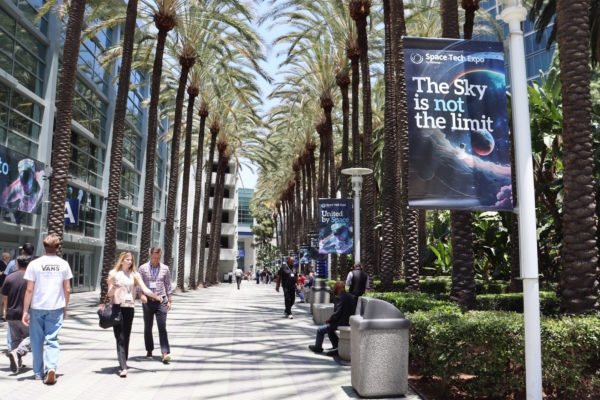
In a significant move, the 14th edition of the Space Tech Expo USA was held this year at the Anaheim Convention Center in Orange County, California from June 2-4. The event saw a new chapter unfold within its grandiose exhibition halls, attracting approximately 5,000 attendees.
The expo director, Gordon McHattie, described it as the largest event of its kind so far, featuring over 350 exhibitors including globally renowned companies and local businesses. The expo covered a wide range of sectors such as electronic components, design services, mechanical parts, as well as security, optics, measurement, interconnect technology, and software. At the Industry Forum and Technology Conference, more than 70 experts gathered to discuss the latest industry challenges and innovative achievements. This year, the addition of the Skill Lab aimed to inspire, promote exchanges, and enhance the professional capabilities of participants through a series of internships, seminars, and master classes.
Established in 2012, the expo was created for aerospace and related industries, government bodies, and academia. After 14 years of deep-rooted presence in California, the relocation to Orange County marked a significant milestone for the event. Anaheim played host to several pioneering companies like Sonfarrel Aerospace LLC, Verus Aerospace, ACRA Aerospace, Cummins Aerospace LLC, as well as being in close proximity to industry giants such as Rocket Lab USA, SpaceX, and Boeing.
The United States Space Force (USSF) also had a presence at the expo, with Colonel Timothy Trimail from the Office of Business Affairs and Colonel Edward Jones from the Reconnaissance Office attending the Industry Forum to address questions from exhibitors.
“It is crucial for businesses of all sizes, regardless of being large, medium, or small, to participate,” stated Trimail. “The Space Force is undergoing a significant cultural shift, aiming not only to establish a ‘business-first’ mindset but also to truly empower junior personnel to take on more risks. They handle the majority of the daily workload, and we empower them and are willing to take responsibility for it.”
Eric Kemp from the Business Affairs Office mentioned, “We are also collaborating with foreign companies operating US projects. Establishing branch offices in the US could be one of the quickest ways for foreign companies to participate and collaborate.”
Jones expressed, “The key lies in results. We aim to gather true insights, including technological innovations, solutions, and the effectiveness of new products, to make our Guardians’ actions swifter, more outstanding, with enhanced capabilities, and in safer conditions.”
The four winners of the “Star Tech Challenge,” rated by Aviation Week, expressed their emotions as “wonderful,” “happy,” “excited,” and “fulfilled.”
When asked about the key to success, their responses varied from “persistence,” “embracing mistakes,” “friendship,” to “consistency.” For the advice to the next generation of innovators, particularly newcomers (or how to get young people to put down their phones or tablets and leave the couch?), suggestions included “participating in the Space Tech Expo,” “embracing innovative enjoyment,” “collaborating,” and “loving what you do.”
Nary, the Senior Regional Manager of Green Tweed, which has been operating for 160 years producing sealing systems used in over 90% of active aircraft today, expressed the hope to set up a booth at the event next year. Simon Krueger, Vice Chairman of the International Association of Astronomical Artists, spoke about the artwork they brought depicting astronomical themes. Handcrafted models of planetary surfaces and scenes featuring astronauts from the “Gemini” or “Apollo” programs were showcased, reflecting his connection with space programs.
Krueger described how the Constellation Foundation, an organization initiated by four astronauts, is promoting the “Overview Effect,” emphasizing that astronauts in space view Earth as a cohesive whole, where everyone is interdependent and must collectively care for this fragile planet.
He highlighted that the longer astronauts stay in space, the more severe the loss of bone mass and vision impairment become. The weightlessness incurs consequences; there was a case where an astronaut temporarily lost the ability to speak. While initially suspected as a stroke, brain scans showed no abnormalities.
Peter Conception, the project lead from the Colorado School of Mines, introduced various disciplines offered by the institution including mechanical engineering, civil engineering, quantum engineering, advanced mathematics, and statistics. With around 8,000 students (approximately 3,000 in postgraduate programs) and a high 88% “positive employment rate,” indicating graduates finding ideal jobs, Conception mentioned companies like BAE Systems, Ball Aerospace, Lockheed Martin, Northrop Grumman, Lawrence Livermore National Laboratory, and Los Alamos National Laboratory as desired destinations for employment.
Three first-time attendees at the space expo shared their experiences. Manufacturing technician Carlos Hernandez said, “I see many career choices and possibilities here, there is not just one path.” Aerospace engineering freshman Alexander Hernandez mentioned, “I am learning about the design process and working in the lab. After consulting with many vendors, I discovered they design based on the processes and needs of large companies, which is fascinating.” Junior software engineer Jessica Barrios expressed, “I have participated in various comprehensive STEM activities, but the aerospace expo is a first for me. I enjoy researching various software systems.”
Emma Stokes, the Managing Director of the expo, stated, “We showcase the latest technology for people to find new suppliers, explore potential new technologies and innovations, connect with peers, and stay abreast of industry trends and market dynamics.” Registration for exhibitors at the 2027 expo has already begun, predominantly featuring US companies, with an expected 400 exhibitors next year.