
Recently, the prices of humanoid robots in mainland China have been rapidly declining. Some entry-level products are now priced below 10,000 yuan; engineering prototypes that needed tens of thousands or even nearly a million yuan for pre-order a year ago are now being bundled and sold at clearance prices of “50,000 yuan per car” on second-hand platforms and dismantling markets.
According to a report by “Jiemian News” on June 4, since 2026, the prices in the mainland Chinese humanoid robot market have significantly dropped. The “Bumi (Xiaobumi)” released by Songyan Dynamics is priced at 9,998 yuan, mainly targeting applications in education and companionship. On e-commerce platforms, the discounted price of this product can even go as low as 9,418.1 yuan after subsidies.
The report stated that the starting price of the Yushu Technology R1 series is 26,900 yuan. Data from its prospectus shows that the unit price of Yushu humanoid robots decreased from 593,400 yuan in 2023 to 260,700 yuan in 2024, and further dropped to 167,600 yuan in the first three quarters of 2025, with a cumulative decrease of over 400,000 yuan in a little over a year. At the same time, the unit cost also decreased from 73,200 yuan in 2023 to 62,200 yuan in the first three quarters of 2025.
According to a report by “Fast Technology” on June 4, some old models and engineering prototypes on the market, including Yushu H1 early research version, Fourier GR-1, and Yunchenchu DR series, were purchased between 300,000 and 800,000 yuan from 2024 to 2025, but now their second-hand market price is only about 30,000 to 60,000 yuan. Engineering prototypes that were priced close to a million yuan and required advanced reservations a year ago are now being cleared out in bulk at the price of “50,000 yuan per car”.
The rental market has also seen a decrease in prices. The report mentioned that at the beginning of 2025, the daily rental fee for using humanoid robots for commercial performances, exhibitions, and celebratory events was once high, but by 2026, the prices have significantly dropped. Some industry insiders mentioned that the rental price has decreased from a peak of 10,000 yuan per day to the current 800 to 1,500 yuan.
A report by “Elephant News” on June 5 stated that although the price threshold of humanoid robots has decreased, the current practical applications are still mainly focused on industries such as industrial, cultural tourism, and education, with a gap remaining before entering ordinary households. The report mentioned that household environments are more complex, requiring higher stability and flexibility for tasks such as folding clothes, cooking, and deep cleaning. Current technological shortcomings still include soft object handling, irregular kitchenware operation, and sudden environmental adaptability.
While Chinese humanoid robot companies are intensively launching new products and prices are declining, local Chinese Communist Party (CCP) governments are still implementing related subsidies and support policies.
In an article reported by “Epoch Times” in March of this year, Longgang District in Shenzhen previously introduced policies to support the artificial intelligence and robotics industry, offering a maximum subsidy of 2 million yuan to related companies. According to the Longgang District Artificial Intelligence (Robotics) Bureau’s draft for soliciting opinions, the local government plans to promote the development of intelligent industries through financial subsidies, open data resources, demonstration projects, and introduce “digital staff application vouchers” to support companies in purchasing or building intelligent solutions.
The report from “Epoch Times” quoted scholars as saying that under the CCP-led economic system, companies often seek subsidies and resources based on policy signals rather than making decisions based on real market demand, which can lead to herd investment, overcapacity, and a new round of bubbles.
Before the price decline, the CCP had previously showcased humanoid robots at various events. During the 2026 CCP Spring Festival Gala, four Chinese humanoid robot companies appeared on stage simultaneously, performing stunts like somersaults and dance. A previous report by “Epoch Times” quoted industry insiders stating that what the audience saw were “demonstration clips” and “capital roadshows” repeatedly trained in small scenes. When put in more complex scenarios without algorithm training or unmanned remote control, robots might still malfunction, resembling puppets.
While multiple robot companies were making high-profile appearances at the Spring Festival Gala, videos of robots holding guns circulated on the internet. In an article by “Epoch Times” in February of this year, Professor Zhang Tianliang from the Department of Humanities at Flying University in the United States believed that the CCP was sending strategic signals of robot weaponization and military-civil fusion on a national stage.
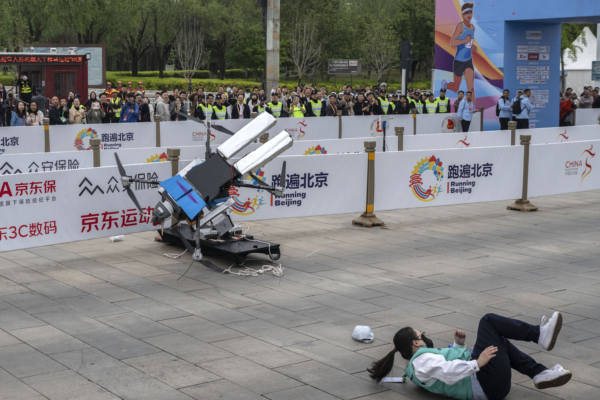
In recent years, the CCP authorities have frequently arranged for humanoid robots to participate in dancing, marathons, boxing, athletics, gymnastics, and football performances, attempting to showcase their strength in the field of robotics. However, there have been incidents of robots falling or malfunctioning during public events. A report by Xinhua News Agency on April 20, 2025, stated that during the Beijing humanoid robot half-marathon, some robots experienced incidents like parts falling off, joints cracking, and falling.