
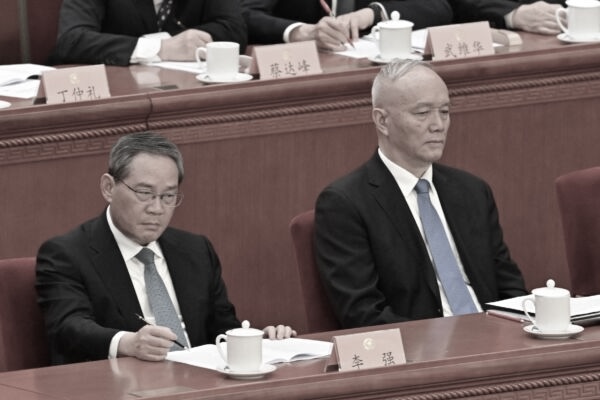
On June 5, 2026, Chinese Communist Party (CCP) Politburo Standing Committee member Cai Qi made his first public appearance as the President of the CCP Central Party School. This move came as Xi Jinping, the CCP leader, had Chen Xi stepping down from his position as the President of the CCP Central Party School, a position he had held for a long time, while also overseeing the Central Organization Department until recent years when he was removed.
According to reports from the CCP’s state media Xinhua News Agency, the CCP Central Party School (also known as the National School of Administration) held the graduation ceremony for the second batch of the 2026 spring semester on June 5, 2026. Cai Qi, the President of the Central Party School (National School of Administration), attended the ceremony and presented graduation certificates to the students.
The reports indicate that CCP Politburo Standing Committee member Cai Qi has taken over from Chen Xi, also assuming the role of President of the CCP Central Party School (National School of Administration).
On May 15, 2026, the opening ceremony for the second batch of the 2026 spring semester was held, and Chen Xi, in his capacity as the President of the CCP Central Party School (National School of Administration), attended the ceremony and gave a speech.
Chen Xi, born in 1953 in Putian, Fujian Province, entered Tsinghua University’s Department of Chemistry as a “worker-peasant-soldier student” in 1975, where he was classmates with Xi Jinping. It is rumored that the two were even roommates sharing bunk beds. Chen Xi later served as the Party Secretary of Tsinghua University, Deputy Minister of the Ministry of Education, Deputy Party Secretary of Liaoning Province, and Executive Vice Chairman of the CCP Association for Science and Technology. After Xi Jinping came to power in the 18th National Congress of the CCP, in April 2013, he appointed Chen Xi as the Executive Vice Minister of the Central Organization Department. At the 19th National Congress of the CCP, Chen Xi became the Minister of the Central Organization Department and entered the Politburo, later also taking over as the President of the Central Party School as per tradition, a position previously held by Politburo Standing Committee member Wang Huning.
In 2018, the National School of Administration, previously under the State Council, merged with the Central Party School, giving Chen Xi the dual role of President and Dean, solidifying his control over this “special school” that trains senior CCP officials.
Following the 20th National Congress, Chen Xi, who was no longer a member of the Politburo or Central Committee, delayed his resignation as the Minister of the Central Organization Department until April 2023. However, he remained as the President of the CCP Central Party School (National School of Administration) in a regular party member capacity until recently stepping down.
In April 2025, Politburo member and Secretary of the Secretariat Li Ganjie served as the Minister of the Central Organization Department for less than two years before switching roles unexpectedly with Shi Taifeng and becoming the Minister of the United Front Work Department. Li Ganjie is a Tsinghua University alumni and was greatly promoted by Chen Xi throughout his career.
During this period, several of Chen Xi’s close associates from the Central Organization Department were either transferred or investigated. Chen Xi’s deputy and former Vice Minister of the Central Organization Department, Zhang Jianchun, was taken down from his position as the Deputy Minister of the Publicity Department in June 2024. Another former associate of Chen Xi, Cao Xingxin, was investigated in September 2024 while serving as a member of the Party Committee and Deputy General Manager of China Unicom.
Additionally, many high-ranking CCP officials who have fallen from grace in recent years were appointed or promoted during Chen Xi’s tenure at the Central Organization Department.
On May 23, 2026, Gong Qihuang, the unusual President of Peking University, was removed from his position. Gong Qihuang’s deputy, Peking University Vice President Ren Yu, had turned himself in back in September 2025. Gong Qihuang’s former leader and partner, former Peking University President and Party Secretary Hao Ping, was relieved of his position as Vice Chairman of the National People’s Congress Standing Committee in October 2025. Gong Qihuang and Chen Xi both hail from the same hometown in Putian, Fujian. During Chen Xi’s tenure as the Minister of the Central Organization Department, Gong Qihuang was successively promoted to Executive Vice President and President of Peking University.
Former President of South Central University, Zhang Yaoxue, was investigated on October 17, 2025, and was expelled on May 21, 2026, consequently having his title as a member of the Chinese Academy of Engineering revoked. Zhang Yaoxue had interactions with Chen Xi during his tenure at Tsinghua University and the Ministry of Education.
Cai Qi, another close associate of Xi Jinping from their time working in Fujian and Zhejiang provinces, has quickly risen through the ranks since Xi Jinping ascended to power. He has held prominent positions such as Executive Vice Director of the National Security Council Office, Deputy Party Secretary and Mayor of Beijing, and a member of the CCP Politburo and Secretary of the Beijing Municipal Committee. After the 20th National Congress, at the age of 67, Cai Qi was promoted to Politburo Standing Committee member and also held positions as the first Secretary of the Central Secretariat, Director of the General Office of the CCP Central Committee, Deputy Chairman of the Central and State Organizational Work Committee, and Deputy Chairman of the National Security Commission. He has been suggested to wield real power or even rank second to the Premier Li Keqiang within the Politburo.
In early May 2025, the British magazine “The Economist” published an article suggesting that Cai Qi, holding multiple crucial positions, may actually be the second most powerful figure within the CCP, rather than Premier Li Keqiang. The speculation was that if Xi Jinping were to suddenly falter, Cai Qi would likely take over. However, the article also expressed concerns that given Xi Jinping’s tendency to sideline or purge his closest allies, Cai Qi’s future might be precarious.
Many analysts pointed out that the article could be a signal of political maneuvering within the CCP leadership ahead of the 21st National Congress, reflecting power struggles at the top level of the party, hinting at the potential threat Cai Qi poses to Xi’s power. As Cai Qi’s influence grows, so does his political risk.
Just a week prior, Dong Guibo, former Party Secretary and Director of the Zhejiang State-owned Assets Supervision and Administration Commission, confessed and was being investigated on May 29, 2026. Dong Guibo was a former colleague of Cai Qi in Zhejiang and had received strong support from Cai Qi when he served as the Organization Minister of the Zhejiang Provincial Committee.