
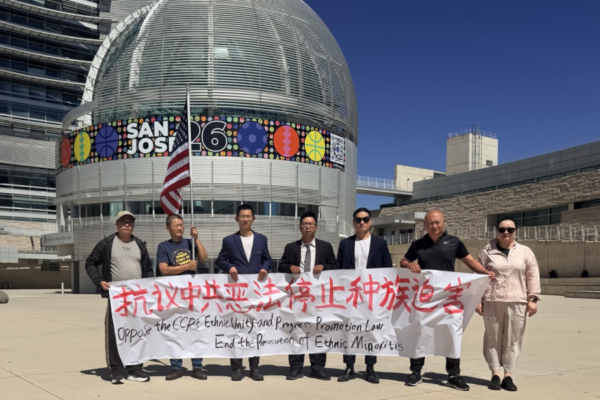
On July 5th last Sunday afternoon, the Chinese Democracy and Human Rights Alliance held a rally in front of the San Jose City Hall to protest against the Chinese Communist Party’s introduction of the “National Unity and Progress Promotion Law” and to mourn the Tibetan Lobga Rangzen who self-immolated in New York recently, calling for international attention to the rights of minority ethnic groups and issues of cross-border suppression.
The event was organized by the Northern California branch of the Chinese Democracy and Human Rights Alliance. Participants held banners, gave speeches, believing that the new law will further strengthen the CCP’s control over minority ethnic groups, religious beliefs, and overseas dissidents.
Li Haifeng, the head of the Northern California branch of the Human Rights Alliance, stated that the event was held not only to protest against the “National Unity and Progress Promotion Law,” but also to mourn Lobga Rangzen. He mentioned that Lobga Rangzen’s self-immolation was a heartbreaking way to express grievances, reflecting the difficulties faced by Tibetans in terms of language, culture, and religious beliefs.
He pointed out that several articles in the new law are vague, not only involving education, internet platforms, and cultural propaganda, but also extending to overseas individuals and organizations, causing concerns about the further compression of the space for speech of overseas democratic activists.
Member of the alliance, Sheng Hu, stated that the “National Unity and Progress Promotion Law” is a further legalization and institutionalization of the CCP’s existing policies. True national unity should be built on the respect for the languages, cultures, and religious beliefs of all ethnic groups, rather than through unified teaching materials and language to promote cultural assimilation.
Democratic figure He Dongling expressed that Lobga Rangzen’s self-immolation was a “cry in despair,” reminding the international community that when a nation’s language, culture, religious beliefs, and basic freedoms are suppressed, it is not just individuals who are harmed, but the entire nation. She called for the cessation of persecution against minority ethnic and religious groups, and respect for every individual’s basic human rights and dignity.
Democratic activist Zhang Yong mentioned that when he participated in a Tibetan commemorative event in March of this year, he was deeply moved by the photos of dozens of self-immolating Tibetans. He believed that culture, religion, and belief are important foundations for the continuity of a nation and led the audience in a minute of silence to mourn Lobga Rangzen.
Alliance member Li Yuanwei stated that the promotion of relevant laws by the CCP does not truly promote national unity, but continues to exercise ideological control through the internet and propaganda machinery. He believed that overseas Chinese should spread news and information to let more Chinese people understand the truth of the events.
Yang Kun expressed that Lobga Rangzen’s choice to draw international attention to the plight of Tibetans with his life demonstrates that even in the face of pressure, there are still people willing to stand up and speak out. He believed that the continued public expression of demands by overseas individuals is inherently significant.
On the evening of July 2nd, in New York, Tibetan activist Lobga Rangzen, who lives in the United States, self-immolated outside the United Nations headquarters in New York to protest against the CCP’s rule over Tibet and the newly implemented “National Unity and Progress Promotion Law,” drawing international attention.