
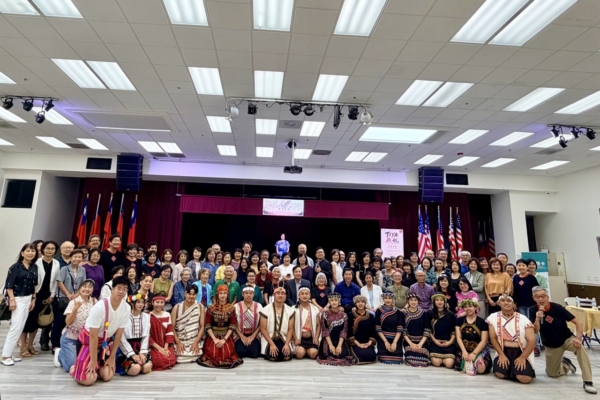
In 2026, the “TIYA Original Voice Embarkation – Bay Area Angel Salon” event took place on July 7th (Tuesday) at the South Bay Overseas Education Center. Before 17 Taiwanese indigenous youth and teachers embarked on an exchange trip to the United States, they gathered with supporters from the Bay Area to express their gratitude through singing, dancing, and cultural performances.
The team consisted of 13 students and 4 teachers from five different indigenous tribes including Bunun, Amis, Paiwan, Rukai, and Tayal. The event was co-hosted by the North American Friends of Original Voices Association, the Taiwan Original Voices Education Association, and the American Wisdom Culture and Education Foundation, with support from the Ministry of Foreign Affairs, Ministry of Education, Overseas Community Affairs Council, and Council of Indigenous Peoples of Taiwan.
The President of the North American Friends of Original Voices Association, Che He-dao, mentioned that many of the youth who came to the U.S. this time were members of the original children’s choral ensemble over a decade ago. They have now either pursued higher education or joined the workforce, evolving from beneficiaries to young individuals who are actively involved in cultural preservation and international exchanges.
Since 2013, the Original Voice program has been leading indigenous youth to the U.S. for exchanges, supporting over 60 individuals in broadening their horizons. This year, the establishment of TIYA (Taiwan Indigenous Youth Alliance) aims to pass the baton to the youth, showcasing Taiwan’s indigenous cultures through cultural performances on an international stage.
For many years, Bay Area compatriots have been moved by the voices of the original children, getting involved in fundraising, hosting, and supporting home-stays for the group, with the members of the original voices referring to their supporters as “angels.”
Hu Li-min, a long-time supporter of original voice education, emphasized the importance of respecting, embracing, and preserving the music and culture of different indigenous peoples, as they hold the most primitive and traditional cultures while striving for peace and diversity in society. She highlighted the significance of indigenous children having the opportunity to engage in international exchanges with young people from around the world as a wonderful development.
Another long-time supporter, Lin Gui-xiang, recalled how a group of high-tech professionals from the Bay Area were initially moved by the angelic voices of indigenous children during a visit to the Yushan area in Nantou, Taiwan. After gaining a deeper understanding of the rural education environment, they began to contribute towards assistance efforts. Over the years, compassionate individuals from the Bay Area have assisted in fundraising, hosting children, and supporting educational initiatives in Nantou.
Lin noted that the significant difference with TIYA now is that the children who were once supported are now grown up and giving back, hoping to cultivate the next generation. She emphasized the importance of passing down traditions and expressed that only with the younger generation carrying on the torch can this cycle of support be sustained.
On the event day, the youth presented cultural performances including the Bunun’s “Burden Song,” Tayal’s “Weaving Song,” Bunun’s “Warrior Song,” Paiwan’s “Friendship Song,” and the Four-step Dance, showcasing the daily life, beliefs, and the relationship between people and nature within each tribe through songs and dances.
Chen Gao-lien, a member of the Paiwan tribe, and Ma Yi-en, a member of the Rukai tribe, expressed during their interviews that apart from participating in UNITY activities in Oklahoma, their U.S. trip also involves visits to various enterprises and universities, engaging in exchanges with American indigenous youth and individuals from different sectors.
They stated that the team presented songs and cultural introductions from five indigenous tribes, with many songs related to welcoming friends, celebrating gatherings, and festivities. The team also planned cultural workshops, including introducing the Rukai tribe’s glass bead culture to allow participants to learn about the history and stories behind the glass beads.
Ma Yi-en emphasized that the primary goal of this trip is to “share the culture of Taiwan’s indigenous people.” By learning from the experiences of American indigenous peoples and bringing back their insights to Taiwan, they aim to share the harvest with more indigenous youth.
From the tender voices of children over a decade ago to the confident young individuals standing on stage today, fluently introducing their tribal names, clans, and cultures in English, the former “original voice children” are stepping into a new phase. As Bay Area supporters bid them farewell with applause, these young individuals will carry their songs and culture to Oklahoma, allowing more people to witness Taiwan on the international stage. ◇