
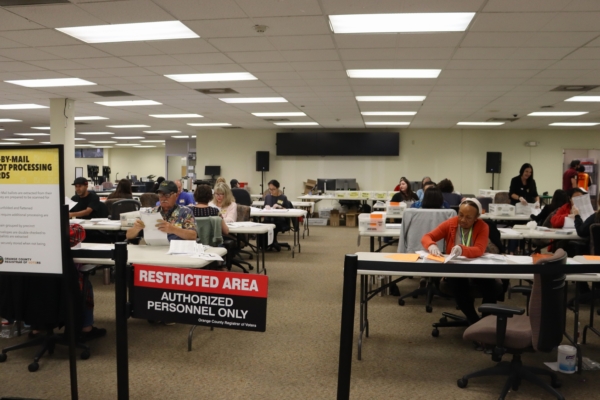
The California primary election, from the deadline for voting on June 2nd to the tally confirmation on July 10th, took more than a month to finalize. Observing the fluctuations in the voting percentages of the Republican (R) and Democratic (D) parties during the 39-day tally period, it was found that the Democratic Party’s voting rate increased in almost all districts, even in areas where candidates of other parties (including Republicans, Independents, and others) had advantages.
According to the Secretary of State’s office, all mail-in ballots postmarked on or before election day must be received by county offices within 7 days after the election to be counted; and counties have about a month to complete the tallying, auditing, and certification work. However, in reality, most counties had already finished counting, and the vote counts no longer increased.
As per regulations, each county was required to submit the official election results by July 3rd, and the Secretary of State was to certify the results by the 10th. Critics argue that California’s slow counting pace is comparable to that of third-world countries, despite its abundance of high-tech expertise and industries.
Currently, the election results displayed on the Secretary of State’s website are up to the afternoon of July 3rd. A significant discrepancy is evident when comparing the voter data confirmed a month ago and the current numbers.
The following table presents partial tally results, listing the results from June 4th and July 3rd. The column labeled “Democratic Party Voting Rate” tallies the voting rates of all Democratic Party candidates in that district, which could serve as a reference for the November elections; the “D Increase” column shows the increase in Democratic Party votes after a month of tallying.
For instance, in the first district, Republican candidate James Gallagher received 47.2% of the vote on June 4th, which decreased to 42.1% by July 3rd, while the Democratic Party vote increased by 5.1%. Gallagher won the special election in June and has been sworn in as a congressional representative, but he faces a tough challenge in November.
After redrawing districts favoring Democratic Party candidates in California, Republicans led in districts 5, 20, 23, and 40; however, over the past month, the Democratic Party has continued to gain votes, albeit at a slower rate than in Democratic-favorable districts.
Looking at the table, a month after the tally, each Republican candidate’s vote count increased, but their voting percentage decreased. For example, in the 5th district, Tom McClintock’s vote share decreased from 63% to 61.3%, while the Democratic Party candidate’s vote share increased from 37% to 38.7%, a 1.7% increase.
In the 40th district, incumbent Republican congressional representatives Ken Calvert and Young Kim were unfortunately placed in the same district. While both won, only one can be elected in November. After a month of tallying, the Democratic Party’s vote share in that district increased from 41% to 42.9%, a 1.9% increase.
In districts 1, 3, 6, 45, 47, 48, and 49, out of seven districts, the results from June 4th indicated potential Republican victories in the November elections, with Democratic candidates securing around 50.1% to 51.7% of the vote. However, by July 3rd, the margin had widened to 3% to 6%.
Incumbent Democratic congressional representative Ami Bera, who was in the 6th district, is now running in the 3rd district. His vote share increased from 33% to 34.3%, while the Democratic Party candidate in that district saw a 5.1% increase in their vote share.
Incumbent Independent congressional representative Kevin Kiley, originally in the 3rd district, was redistricted to the 6th district. His vote share decreased from 26.80% on June 4th to 24.30%, while the Democratic Party vote share in that district increased by 3.10%.
In districts 13, 21, 22, 27, and 50, the Democratic Party’s vote share increased from approximately 55% to 57% to 60% over a month, a rise of about 3% to 4%. Republican candidates seem to face challenges in winning in November.
Incumbent Republican congressional representative David G. Valadao in the 22nd district lost his advantage after redistricting, receiving only 44.5% of the vote on June 4th, which dropped to 40.70% by July 3rd, a decrease of 3.8%. Meanwhile, the Democratic Party’s vote share in that district increased by 3.8%.
Furthermore, in the elections for 20 state senators and 80 state assembly members, the voting trends mirrored those of congressional representatives. After a month of tallying, the Democratic Party candidates’ vote share increased in almost all districts (except single-party candidates’ districts).