
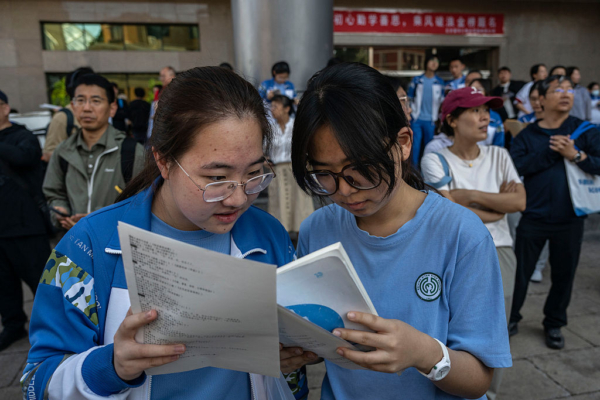
With two months left before the start of the autumn semester in Chinese universities in early September, enrollment registration has already begun in various regions. The tuition fees for medical, science and engineering, “Double First-Class” disciplines, and some special programs have become the focus of price increases, with some majors experiencing a hike of over 30%. This round of tuition fee increases indicates that tight local finances and rising operating costs for universities are putting more pressure on ordinary families.
Recently, the Finance and State-owned Assets Management Office of Fudan University in Shanghai released a notice proposing adjustments to the undergraduate tuition fees for “Double First-Class” disciplines starting from autumn 2026. The tuition fees are set at 7150 RMB for liberal arts, 7700 RMB for science and engineering, and 8140 RMB for medical science. Subsequently, Shanghai Jiao Tong University also listed similar fee standards in its 2026 undergraduate admissions regulations.
A former administrative staff member at Sichuan University, who goes by the pseudonym Wen Ru, told reporters that Chinese universities primarily rely on three sources of funding: government appropriations, tuition revenue, and social donations. For most ordinary universities, social donations are limited, and the main support for school operations still comes from government appropriations and tuition revenue.
“If the number of students does not significantly decrease and tuition fees do not go down, the biggest variable affecting university income pressure is government appropriations. In some places where the government’s finances are tight, teacher performance pay has long been discontinued. Combined with heavy local debt pressure, the money available to universities is becoming increasingly limited. Schools wanting to pay their teachers and provide benefits to themselves will shift some of the pressure to tuition fees, putting the burden on students’ families,” Wen Ru said.
Scholar Qin Jun, who focuses on education issues in Beijing, told reporters that the core reason for the increase in university tuition fees is the overall reduction in the education department’s budget allocation.
He said, in recent years, the financial shortfall in local Chinese Communist Party finances has led to a compression of education funding: “For example, the budget for last year decreased by about 4.7% compared to the actual expenditure in 2024. With no reduction in the number of students, the decrease in appropriations breaks the previous expectation of rigid growth in university funding dependent on government finances.”
In this round of hikes, tuition fees for medical, science and engineering, and “Double First-Class” disciplines are higher. For instance, medical science at Fudan University and Shanghai Jiao Tong University is set at 8140 RMB; the standard upper limit for medical science at Chongqing is 6400 RMB; Gansu’s medical science is 5800 RMB; and Xinjiang’s medical science is 5200 RMB. The School of Nuclear Engineering and Technology at Sun Yat-sen University previously announced that the tuition for the Nuclear Engineering and Nuclear Technology undergraduate classes of 2026 and 2027 would be 45,000 RMB, which would be adjusted to 65,000 RMB starting from the class of 2028.
Qin Jun also mentioned that university tuition fees will not decrease before 2030: “They will continue to rise each year. 2030 will see a peak in the number of participants in the college entrance examination and graduates, as well as an enrollment peak. With a decreasing birth rate in the future, there may be fewer people taking the college entrance exam, and I cannot guarantee whether tuition fees will decrease.”
Screenshots from online platforms in mainland China show that the related news has sparked discussions among students and parents. Some netizens commented, “The tuition fees have increased before we even submit our choices.” “It used to be said that getting into college can change one’s destiny, but now the cost of attending college is getting higher and higher.” There are even suggestions from netizens that “subsidies for international students should be cut, and universities should not be commercialized.”
Apart from Shanghai universities, the Education Department of Henan Province under the Chinese Communist Party released a list of education fees and standards for public universities this year. The tuition fees for undergraduate programs at public universities in liberal arts are set at 4400 RMB, 5000 RMB for science and engineering, 5500 RMB for medical science, and 8000 RMB for arts. Data indicates that the standard tuition fee for science and engineering in Henan was previously 3700 RMB, with an approximately 35% increase to 5000 RMB this time.
Gansu completed the adjustment of tuition fees for undergraduate programs at public ordinary universities this year, with the new rules set to be implemented from the autumn semester of 2026, at 5800 RMB for medical science, 5600 RMB for engineering, and 5200 RMB for science. The adjustment plan released by Xinjiang shows that the standard tuition fees for public ordinary universities for undergraduate programs are proposed to be adjusted to 4000 RMB for arts, 4500 RMB for science and engineering, and 5200 RMB for medical science. “Double First-Class” universities can choose to have certain advantageous majors with a maximum increase of 15%.
Former high school teacher Zhang Xianyang told reporters that for middle-class families in Chinese cities, an increase of one or two thousand RMB per year may still be bearable; however, for rural families and low-income families, the burden is very heavy. He said, “When the government is short of money, it should not pass on the burden to ordinary families. With accommodation fees, living expenses, and transportation costs for children, rural families have an annual income of just over ten thousand RMB. As a result, many families may request their children to change their choice of majors and disciplines.”
Zhang Xianyang believes that in the current situation of tight local finances and rising operating costs for universities, further increasing tuition fees is equivalent to transferring the cost of higher education to more ordinary families.