
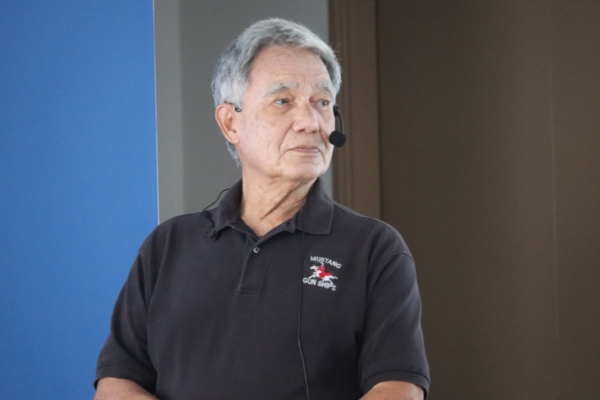
On June 27, Frans VandenBroek, a Vietnam War veteran, was invited to give a speech at the “Hall of Heroes” exhibition hall in Costa Mesa, Orange County, Southern California. VandenBroek had avoided thinking about his experiences in the Vietnam War for about 35 years, keeping those memories buried deep in his heart.
In April 1968, at the age of 19, VandenBroek served as a crew chief in the 68th Helicopter Assault Squadron during the Vietnam War. The squadron, known as the “Wild Mustangs” due to their armed attack helicopters, was responsible for transporting supplies, evacuating wounded and prisoners of war, and carrying out one of the most dangerous missions – releasing smoke screens up to about 3 stories high in front of enemy fire to protect ground troops.
VandenBroek explained the process of releasing the smoke screens, where the aircraft would fly above the treetops and spray oil into the exhaust pipe. The high temperature at the nozzle would create a column of smoke, which when properly coordinated, would fall towards the ground, creating a smoke screen about 30 feet high.
VandenBroek shared a poignant moment captured in a photograph where he was seated in the helicopter’s cockpit holding a machine gun, next to the second machine gunner, with the pilot, Paul J. Hill, a lieutenant, who tragically passed away later.
On May 12th, 1968, VandenBroek’s crew faced a tragic incident after completing a smoke screen mission, resulting in the loss of Lieutenant Hill due to an accident during loading weapons onto the helicopter. The emotional toll of losing comrades was heavy during those intense times of war.
In the following six months, VandenBroek flew almost daily until his service in Vietnam ended in November 1968. Despite the completion of his deployment, VandenBroek chose to extend his service for another six months, a decision understood only by comrades in arms.
During his service, VandenBroek often flew under the command of Chief Warrant Officer Scott Alwin, a skilled and brave pilot who instilled confidence in their missions. The camaraderie and support among the crew members were crucial for survival in the intense combat environment.
In March 1969, a combat mission led to a helicopter crash where VandenBroek suffered a broken arm. Despite the injuries, VandenBroek’s resilience and determination to return home shone through.
Upon leaving Vietnam in July of that year, VandenBroek continued his journey, becoming a proud U.S. citizen in San Pedro, Los Angeles County, a testament to his commitment to his new homeland.
The experiences of war at the young age of 21 transformed VandenBroek, shaping his resilience and perspective on life. His encounters in the battlefield instilled in him a sense of fearlessness and adaptability, qualities that would serve him well in his future endeavors.
Post-retirement, VandenBroek’s pursuit of high-risk activities like motorcycle racing reflected his quest for adrenaline and excitement, yet he eventually returned to education, recognizing his evolving priorities and overcoming fears.
VandenBroek’s journey after the war was supported by disability benefits, enabling him to pursue higher education and provide opportunities for his children to attend college. His dedication to his work in the medical device industry resulted in patents and innovations, showcasing his commitment to excellence and resilience.
As VandenBroek embraced retirement in 2020, his story serves as a reminder of the sacrifices and challenges faced by veterans, underscoring the importance of recognizing and honoring their contributions to society.