
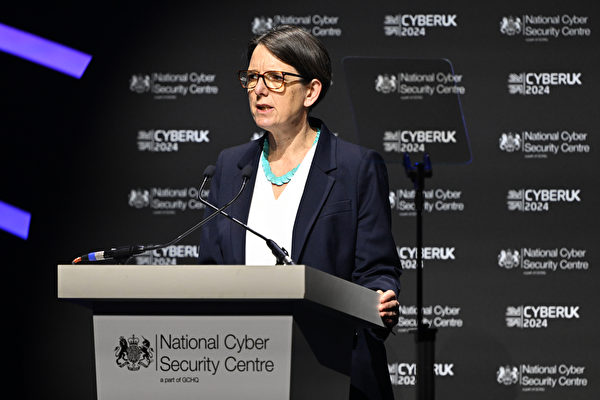
The United Kingdom Government Communications Headquarters (GCHQ) Director Anne Keast-Butler issued her first annual public speech on Wednesday, warning that the UK is at a “critical moment” with security threats intensifying from hostile forces such as the Chinese Communist Party (CCP) and Russia. She emphasized that in the face of CCP’s continuous expansion in technology, artificial intelligence (AI), and cyber capabilities, the UK and its allies must strive to maintain a competitive edge.
Keast-Butler stated in her address that the world is entering a “new era of high uncertainty, geopolitical tensions, and rapid technological changes,” with the risk of misjudgment reaching unprecedented levels. She specifically highlighted the competitive threats posed by the CCP in the fields of technology and scientific research, focusing on the development of capabilities in intelligence, cyber, and military domains. With the rapid advancement of technologies like artificial intelligence, she described the current situation as “the ground shifting beneath our feet,” stressing the necessity for the UK and its allies to stay ahead in the technological race to counter challenges from hostile nations.
Furthermore, Keast-Butler underscored that future cybersecurity and technological competition are not solely the responsibility of government agencies but also require the participation of technology companies, academia, and the general public. She called for increased digital security awareness among everyone, from corporate executives to ordinary citizens, including strengthening password and authentication mechanisms, ensuring supply chain security, and integrating security design at the early stages of new technology development.
The UK’s National Cyber Security Centre (NCSC), under the umbrella of GCHQ, has previously warned that network attacks related to hostile nations continue to rise. Western countries have repeatedly accused CCP-supported hacker groups of launching cyber intrusions and espionage activities against their government departments, businesses, academic institutions, and critical infrastructure. The CCP government has consistently denied these allegations.
Aside from mentioning the technological and cyber threats posed by the CCP, Keast-Butler also highlighted Russia’s escalation of “hybrid warfare” actions against the UK and Europe. She stated that Russia continues to target critical infrastructure, democratic processes, supply chains, and public trust through attacks involving cyber operations, disruptive actions, and intelligence activities to expand its influence.
She mentioned that GCHQ is collaborating with the UK’s defense and intelligence agencies to prevent Russia from accessing Western technology, defend against its network attacks, and safeguard against its disruptive activities and assassination attempts.
Since the outbreak of the 2022 Russia-Ukraine war, the UK has been a staunch supporter of Ukraine. The UK believes that Russia’s hostile actions against Western countries have expanded from traditional military conflicts to include areas such as cyber attacks, misinformation dissemination, espionage activities, and interference with infrastructure in the domain of “hybrid warfare.”
The UK government has previously accused Russia of involvement in several significant cases, including the 2006 assassination in London of former Russian intelligence officer Alexander Litvinenko by radioactive poisoning, and the 2018 nerve agent attack in Salisbury on former Russian military intelligence officer Sergei Skripal. Russia has denied all these accusations.
The Government Communications Headquarters (GCHQ) is one of the UK’s three major intelligence agencies, primarily responsible for communications interception, signals intelligence, and cybersecurity work. Under its authority is the National Cyber Security Centre (NCSC). Keast-Butler’s speech took place at Bletchley Park in the UK, which was the site of Britain’s code-breaking center during World War II and is regarded as a significant symbol of modern intelligence and cybersecurity.