
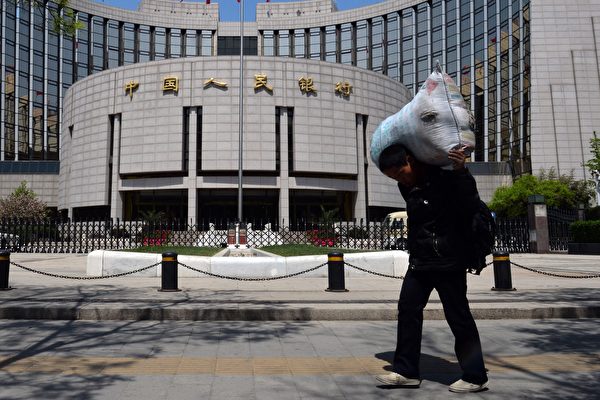
The latest data from the People’s Bank of China shows a significant decrease in household loans in April this year, hitting a record low. The growth rate of household debt in the first quarter recorded -0.4%, marking the first negative growth since the third quarter of 1995. Experts point out that the residents’ reluctance to spend, borrow, and eagerness to repay debts reflect a deep crisis of Chinese residents actively deleveraging and lacking institutional security, leading to pressures such as deposit relocation, plummeting loans, and banks bleeding, making it difficult for authorities to resolve the fundamental deadlock with stimulating policies.
According to a report on May 17 by “First Financial,” the central bank data reveals a net reduction of 100 billion yuan in Renminbi loans in April, an unusual negative value, with a year-on-year decrease of 290 billion yuan. Household loans were the main drag.
The data shows that in April, household loans decreased by 786.9 billion yuan, with a year-on-year decrease of 265.3 billion yuan. Among them, short-term loans and medium to long-term loans decreased by 446.2 billion yuan and 340.8 billion yuan respectively, with year-on-year decreases of 44.3 billion yuan and 217.7 billion yuan. Both figures saw significant drops year-on-year, directly indicating an overall contraction in consumer loans and housing loan demand.
The National Institution for Finance & Development (NIFD) released its “First Quarter Macro Leverage Ratio Report for 2026,” further indicating a negative growth rate of -0.4% in household sector debt in the first quarter, the first occurrence since the third quarter of 1995. Particularly, housing loans have seen 12 consecutive quarters of negative growth since the second quarter of 2023.
Furthermore, for the first time, the growth rate of consumer loans (excluding housing loans) also saw negative growth. Operational loan growth is on a downward trend. The report cites downward pressure on housing prices and slowing income growth as key factors limiting credit expansion, pulling down the household leverage ratio. Industry experts widely believe that the overall real estate market is still in the bottoming phase, with credit demand awaiting repair.
Facing the aforementioned data, the two interviewed experts emphasized that the numbers reflect not only issues of consumer confidence but also a systemic psychological withdrawal.
Sun Guoxiang, a professor of International Affairs and Business at Nanhua University in Taiwan, stated in an interview with Epoch Times, “Mainland Chinese residents do not lack money entirely; rather, they are reluctant to spend, borrow, and even eager to repay debts.”
He indicated that the loan contraction and weak consumption phenomena currently observed in China fundamentally reflect a typical mindset of “balance sheet recession.”
Sun analyzed that the continuous decline in Chinese real estate prices, unstable employment, and weakening income expectations lead households to prioritize “cash security” over consumption.
Wang Guochen, a research assistant at the First Research Institute of the China Institute for Economic Research, approached the issue from the perspective of credit structure. He told Epoch Times, “The reduction in loans actually indicates that as residents deleverage and reduce debts, they also reduce investments; hence, the decrease in loans.”
Wang believes this indicates a simultaneous weakening of consumer and investment sentiment among the Chinese populace, with people lacking security in future economic prospects tending to cut spending and lower debts.
Regarding the longstanding issue of insufficient domestic demand in China, Sun Guoxiang pointed out that the root cause lies not only in people’s unwillingness to consume but also in the skewed income distribution that has favored the government, enterprises, and investment sectors, leaving the household sector with a relatively low income share.
He mentioned that China has traditionally operated under a cycle where “investment drives exports, exports drive local finance, and local finance drives real estate,” rather than an economic circle centered around household income and social welfare. In this context, companies and local governments have obtained vast resources, while ordinary families face long-term uncertainties in education, healthcare, retirement, and housing costs.
“In the scenarios of declining real estate, unstable employment, sluggish salary growth, and inadequate social security, families naturally increase precautionary savings rather than boosting consumption,” Sun said.
In his view, stimulus policies show limited effectiveness in the face of such structural dilemmas. While initiatives like vehicle and household appliance trade-ins may generate some demand in advance, they essentially shift future consumption to the present rather than boosting household incomes.
He emphasized that at the core of China’s current issues lies not a lack of stimulus but a lack of credible institutional security.
While household credit contracts, unusual capital flows within the banking system have further highlighted financial risks.
According to a report on May 19 by CaiXin, household deposits decreased by 1.94 trillion yuan in April, around 550 billion yuan more than the previous year; simultaneously, non-bank deposits increased by 2.47 trillion yuan, with an additional 899 billion yuan compared to the same period last year, both showing significantly larger changes than seasonal fluctuations.
Regarding this, Wang Guochen pointed out that the exceptional scale of this year’s “deposit relocation” is due to regulatory inspections. The Chinese financial system typically undergoes financial scrutiny in March, June, September, and December each year, leading to the appearance of “deposit relocation” in alternate months, where funds from some non-bank institutions and wealth management products temporarily return to the banking system to comply with regulatory checks.
However, he noted that this year’s situation is markedly different. “The scale of relocation is higher than previous years, indicating that banks are in more urgent need of funds, requiring a larger amount to be relocated from external sources. Even so, the overall deposit size this year is still decreasing compared to the same period last year, highlighting more severe problems than apparent.”
Sun Guoxiang, focusing on bank liability structures, mentioned, “The banks will lose a portion of stable, low-cost retail deposits, making them increasingly reliant on interbank funds and wealth management funds, thereby lowering stability.”
He pointed out that if banks raise deposit acquisition costs to compete for deposits or are forced to rely on higher-cost liabilities, it “will further compress net interest margins.”
Wang stated that the long-term rate cuts in China have continuously degraded the profitability of banks. Currently, the interest rate spread between deposits and loans in China’s banking system has significantly narrowed. Using figures, he illustrated the banking profitability dilemma, stating that deposit rates have dropped below 1.8%, hovering around 1.4%. This signifies a narrowing profit margin for banks.
He further indicated that China’s banking industry’s return on assets (ROA) has decreased to around 0.6%, nearing regulatory thresholds.
Simultaneously, due to noticeably higher yields on US government bonds compared to China, many funds tend to flow towards overseas assets. However, he remarked that China’s stringent capital controls and withdrawal restrictions make capital outflows challenging.
According to both experts, the various issues mentioned ultimately point to the same root problem: the economic growth dividends have never truly benefited ordinary families.
Wang Guochen bluntly pointed out that the long-standing presence of elite capital and monopolistic interests within the Chinese Communist system has led to wealth concentration in the hands of a few “red aristocrats,” leaving the vast majority lacking stable income and social security, thereby forcing continuous savings and diminished consumption.
He stated, “Most people struggle with medical care, and saving for retirement is also tough, so they naturally spend less.” Wang believes this is the fundamental reason behind China’s long-term weak domestic demand.
He pointed out that despite China maintaining rapid economic growth for an extended period, ordinary people have always faced poverty and insufficient consumption. This itself indicates that the “fruits of economic growth are not shared by all.” Wang forecasted that if the economy continues to deteriorate, Beijing authorities are likely to introduce another large-scale stimulus package between September and October this year.
However, Sun Guoxiang pointed out that without increasing the share of household incomes, expanding medical and retirement security, addressing inequality in household registration and public services, and stabilizing real estate and employment expectations, “Chinese households will not regain confidence through one-off subsidies.”