
In the era of disposable goods and instant replacements, we often find ourselves surrounded by a plethora of products without knowing their origins. It seems as if these goods sprout out of the shelves magically, leaving us disconnected from the physical world we live in, in a spiritual sense.
The Cooper Hewitt, Smithsonian Design Museum is currently hosting an exhibition titled “Made in America: The Industrial Photography of Christopher Payne,” aiming to reconnect this disconnect. Photographer Christopher Payne focuses his lens on manufacturing scenes across different industries, allowing people to rediscover the origins of these “things.”
Payne states that his photos celebrate “manufacturing” itself. The key to understanding this exhibition might lie in the moment when raw materials are transformed: how humans and machinery collaborate to give a piece of wood, a bundle of wool, or a piece of metal a tangible form and purpose, turning them into useful objects.
The most captivating aspect of this photo series is that they capture moments just before the completion of a product. In the Steinway & Sons factory, curved piano frames stand in rows, resembling elegant arches of small, walkable structures. On the carding machine at the S&D Spinning Mill, the wool, gleaming powder-like, retains its fluffy and rugged texture before turning into hats. Near the lathe at the Zildjian factory, the spinning metal disc gradually takes on the shape of a cymbal, with the operator’s focused expression indicating the seriousness of the task at hand.
In these moments, raw materials visibly take shape and purpose before our eyes. The origins of these “things” become concrete and tangible, revealing the allure of manufacturing itself.
In Payne’s eyes, “Made in America” has not truly declined but rather transformed its existence. His lens captures not only the spectacular assembly of a Boeing 737 MAX fuselage or a GE Healthcare positron emission tomography scanner but also the silicon wafer sorting machine at G-Core and IBM’s quantum computer. The focus of American manufacturing is transitioning from labor-intensive old industries to supporting deep-rooted industries essential for modern life, including healthcare, energy, aviation, semiconductor, and cutting-edge technologies.
Official data corroborates this shift. A report from the National Institute of Standards and Technology (NIST) shows that the U.S. ranks second globally in terms of manufacturing value-added. Data from the Bureau of Economic Analysis (BEA) indicates that in the fourth quarter of 2025, manufacturing value-added accounted for 9.4% of the total U.S. GDP. The Bureau of Labor Statistics (BLS) data for May 2026 shows that there were 12.605 million employees in the manufacturing sector. The notion of the “disappearance of American manufacturing” often refers to the fading trend of old-style manufacturing landscapes.
While industrial automation has indeed reduced many labor-intensive jobs, the pain of this transition is real. Payne believes that as long as a job requires flexible on-the-spot decision-making and intuitive tactile judgment, human hands remain indispensable. The transition process, however, brings about real challenges and transformations for the workforce.
Thus, this exhibition illustrates not only the beauty of industry but also the real situation of American manufacturing: it is nostalgic yet forward-looking, continuously disappearing yet constantly regenerating.
What may be even more touching are the individuals working on the ground. Veterans, new immigrants, seniors, and young people work shoulder to shoulder like a team, striving towards a goal larger than themselves. In an increasingly fragmented era, this sight alone carries a sense of hope.
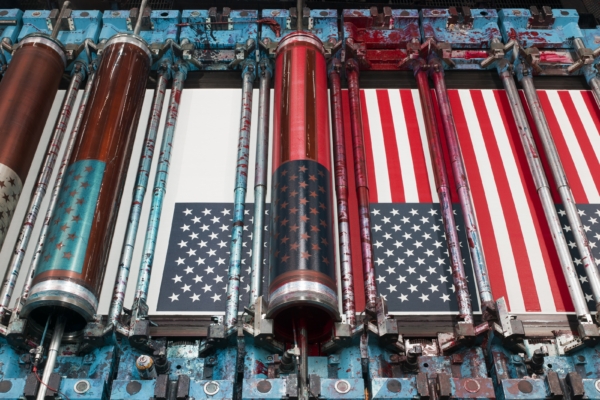
At the end of the exhibition is a production line from the Annin Flag Company: the colors red, white, and blue continuously move forward on the rotary screen printing machine. The flags are not yet complete, yet they already carry more weight than just fabric itself. Payne mentions that all the flags in the factory are hung high and never touch the ground. As he watches, tears almost well up in his eyes.
Perhaps, in that moment, he saw not just the origins of these “things” and the dedicated manufacturers but also a sense of “hope” that endures.
Time: Ongoing until September 27, 2026
Location: Cooper Hewitt, Smithsonian Design Museum
Address: 2 East 91st Street, New York, NY 10128
Official Website: www.cooperhewitt.org