
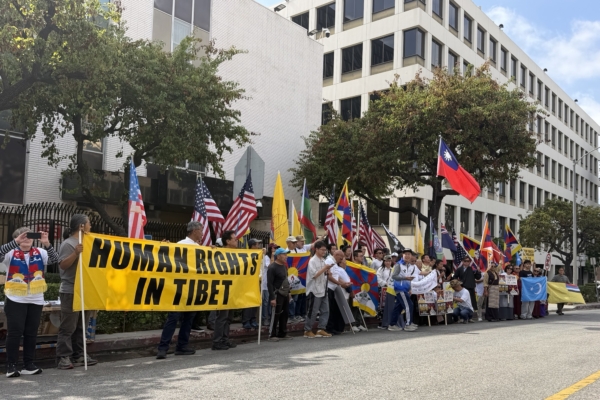
On July 1st, as the Chinese Communist Party celebrated its anniversary, there was a wave of protests from overseas condemning the CCP’s persecution of its people.
Protesters gathered in front of Chinese consulates in several major U.S. cities on that day. In addition to New York, Washington D.C., and San Francisco, nearly a hundred people participated in the protest activities in front of the Chinese consulate in Los Angeles, including Tibetans, Uighurs, Korean Americans, as well as individuals from Hong Kong and mainland China.
Flags of various colors waved in the air, with participants taking turns to speak out against the CCP’s 105-year history of deceiving and suppressing ethnic minority populations. Amidst the recent enforcement of the CCP’s new National Unity and Progress Promotion Law, protesters pointed out that the law could potentially serve as a legal basis for transnational suppression by the authorities.
Critics have condemned the National Unity Law, claiming that under the guise of promoting unity, it actually undermines diversity and provides a cloak of legitimacy for persecution.
“This National Unity Law is not about promoting multiculturalism, but rather an attempt to erase it,” said Pema Choden, Vice President of the Tibetan Association of Southern California (TASC). She emphasized that the law would destroy many unique traditions, languages, and beliefs of ethnic groups, forcing assimilation and restricting freedom, constituting a direct violation of cultural heritage and human rights.
Choden noted that since the CCP invaded Tibet in 1959, over 1.2 million Tibetans have been slaughtered, with 159 recent cases of self-immolation protests against CCP persecution. She called on the international community to stand with Tibetans and Uighurs in demanding the CCP abolish the law.
Namgyal Wangdu, President of TASC, stated during his speech, “The freedom we enjoy in the United States is not experienced under CCP rule.” He believes that the implementation of the National Unity Law shows the CCP’s determination to eradicate the languages, religions, cultures, histories, and traditions of all ethnic groups within China, advocating for resistance against these atrocities and the destruction of civilizations.
The law has faced criticism for potentially criminalizing minority advocacy activities and suppressing dissent. Tao Tenzin Dhamcho, representing the International Tibet Network (ITN), highlighted multiple provisions in the law that could have detrimental effects, such as facilitating transnational repression and imposing Mandarin as the primary language in kindergartens.
Furthermore, Mutalip Kurban of the Uyghur American Association (UAA) in Los Angeles emphasized that true peace cannot be coerced but arises from respecting and protecting individual rights. He condemned CCP’s attempts to conceal ethnic differences and extend control over people, vowing to continue speaking for those silenced and resisting oppression.
Danzen Dorjee, former Chair of the U.S. Commission on International Religious Freedom (USCIRF) and a professor at California State University, spoke against the law’s detrimental impact on minority rights advocacy under ambiguous definitions, urging the U.S. State Department to sanction CCP leaders and officials responsible for enforcing the law.
Following the enactment of the National Unity Law, the U.S. State Department has condemned the law for its extraterritorial reach, with bipartisan resolutions introduced by members of Congress to denounce it.
As one of the organizers, the Chinese Democratic Party International Alliance (CDPIA) and Hong Kong groups had several members present at the protests in Los Angeles.
Representing CDPIA, Jieli Jian remotely told reporters about the “Carrying the Coffin” activity they brought to the CCP’s birthday celebration in New York. He emphasized the need to dismantle the CCP to free the Chinese people from further persecution, stressing that the CCP is not a normal political party but an ideological brainwashing and criminal group that suppresses people’s lives from birth to death.
Regarding the National Unity Law, he criticized it as spreading terror domestically and internationally and misusing global law enforcement, akin to the National Security Law in Hong Kong, with blurred definitions used to suppress voices advocating for Chinese democracy.
Within the Los Angeles protest, Chinese Democratic Party member Min Liu expressed his deep emotions seeing people of various ethnicities protesting against the CCP, stating: “The CCP is not a conventional political organization, but a cult-like group that maintains power through ideological indoctrination, information control, and violent purges.”
A Hong Kong resident in his seventies, Uncle Zhou, lamented, “Never believe what the Communist Party says.” He reflected on the changes in policy and freedoms in Hong Kong, recalling the more relaxed atmosphere and prosperity before 1997, expressing his desire to restore the city’s previous vibrancy and people’s well-being.
The protest persisted for two hours with all speeches in English, featuring the spray-painting of a mock CCP flag and chants demanding “End the CCP,” “Let Tibet be free,” “Let Uighurs be free,” and “Let China be free.”