
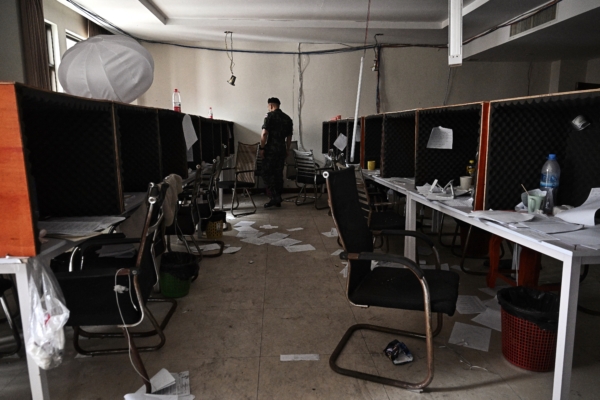
Vietnamese police announced on Friday (June 12) the successful dismantling of a transnational criminal group attempting to establish a large-scale fraud center in Vietnam. Authorities intercepted the operation of the center before it started and arrested multiple core members, including a Chinese man, seizing a large amount of computers and communication devices.
Vietnamese authorities stated that the police in Phu Tho Province had arrested four suspects, namely Chinese national Zhao Wei Zhong and three Vietnamese accomplices Nguyen Thanh Long, Tran Thi Thu Huong, and Pham Dinh Nam.
The investigation revealed that the group had rented multiple resorts, farmhouses, and villas in Hanoi, Lao Cai Province, and Phu Tho Province as bases, frequently changing locations to evade police surveillance.
During the search operation, police confiscated 73 desktop computers, 134 mobile phones, 34 USB storage devices, 20 Wi-Fi transmission devices, 3 SIM cards, 5 laptops, and 2 tablets.
Furthermore, hundreds of sets of desks, chairs, bunk beds, and mattresses were found on-site, indicating the group was preparing intensive accommodation and work environments for a large number of personnel.
The Ministry of Public Security of Vietnam stated in a declaration that this operation successfully prevented the formation of a large-scale transnational high-tech fraud center in Vietnam, contributing to national security and protecting the assets of citizens.
This case indicates that the telecommunication fraud hub is shifting from Cambodia to neighboring countries. According to police investigations, many members of the group had prior work experience in telecommunication fraud hubs in Cambodia and attempted to replicate the “closed hub” model with specialized teams for victim hunting, investment promotion, money transfer guidance, and fund management.
Apart from the case in Phu Tho Province, the police in Ho Chi Minh City also discovered 83 Chinese nationals who illegally entered from Cambodia this week, suspected of preparing to establish a fraud center in the area.
Telecommunication fraud hubs in Southeast Asia rapidly emerged during the COVID-19 pandemic in 2020. With countries implementing travel restrictions and Cambodia’s gambling ban, numerous casinos and resorts were left unused, subsequently converted into closed fraud bases by transnational criminal groups led by Chinese nationals.
These criminal groups engage in cross-border human trafficking and forced labor under the guise of “high-paying overseas recruitment” to control victims, utilizing AI technology and cryptocurrencies for global fraud. This phenomenon has evolved from regional crime into a significant global threat, resulting in billions of dollars in illegal money laundering annually and causing bankruptcy for hundreds of thousands of families.
On Wednesday, FBI Deputy Director Andrew Bailey warned in a video briefing that such fraud hubs are “one of the most significant threats facing the world today” and emphasized their rapidly growing influence in Southeast Asia at an “exponential rate.”
Despite ongoing efforts by multiple governments to combat these activities, a report released by Amnesty International on Monday, June 8, indicated that there may still be dozens of global fraud hubs operating within Cambodia.
(Translated and revised news)