
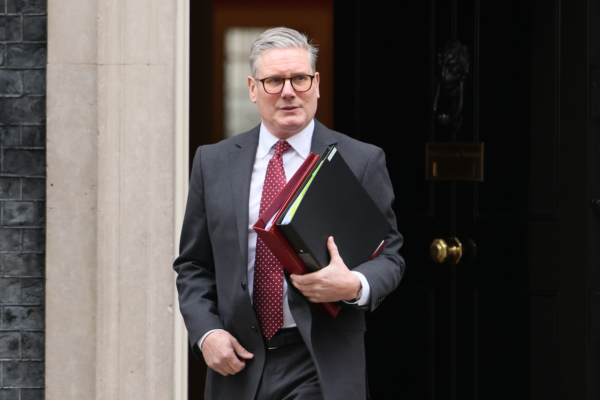
British Prime Minister Keir Starmer stated on Monday, June 8th that large tech companies operating in the UK must take measures to prevent minors from sending and receiving explicit images on their mobile phones. If companies fail to implement these measures within the specified deadline, the government will enforce regulations through legislation. Currently, the government’s demand for tech companies to take direct legal responsibility for adolescent online safety has become a global trend.
In his speech at London Tech Week on June 8th, Starmer emphasized, “Today, I am calling for tech companies operating in our country to implement device controls to prevent children from sending and receiving explicit images. This is not an impossible challenge.” This announcement is the latest action taken by Starmer to protect children from the negative impact of technology. Additionally, The Times reported that Starmer is considering legislation to prohibit minors under the age of 16 from using certain social media platforms.
The UK government stressed that banning explicit content for minors is crucial, as many criminal groups and sexual predators lure, blackmail, and sexually exploit minors by obtaining explicit photos. These individuals may share these photos with others or use them to intimidate minors. The government believes that technically, these measures are feasible and can be rapidly implemented.
Currently, an average of one child sexual abuse case is reported in the UK every five minutes, with 91% of the images being self-produced by children. Investigators note that in the cases they handle, abusers manipulate victims, encourage self-harm or suicide, and even coerce them into participating in abusive live broadcasts.
The UK government plans to require tech giants like Apple and Google to establish or enable technology solutions in smartphones and tablets to block explicit content by default, and these measures must cover third-party applications. Adults will still be able to capture, share, or view explicit content through age verification procedures.
The UK government further stated that if these tech companies do not take action within three months, the government will propose legislation for enforcement, and non-compliant tech companies may face fines or even criminal liability for their top executives.
In May, the UK media regulator Ofcom stated that platforms like TikTok and YouTube had not implemented meaningful measures to protect children from harmful online content infringement. The UK has consulted on stricter regulatory measures, including potentially prohibiting children under the age of 16 from using social media platforms.
The UK is not the first country to consider prohibiting children from using social media. Australia implemented the world’s first social media ban for minors under the age of 16 on December 10, 2025. The ban includes platforms such as Facebook, Instagram, YouTube, Snapchat, TikTok, Reddit, X, and the newly added Twitch. If these social media platforms do not prevent minors from using them, they could face fines of up to 49.5 million Australian dollars (approximately 32.9 million US dollars).
A survey in November 2024 showed that 77% of Australian adults supported the implementation of this ban. A report by the Australian Office of the eSafety Commissioner in 2025 indicated that 1.3 million children aged 8-12 (80%) had used social media in 2024.
The trend of governments requiring tech companies to take more direct legal responsibility for adolescent online safety has become a global phenomenon.
Republican Senator Ted Cruz, Chairman of the Senate Commerce Committee in the US, announced on May 12 that he would support the Kids Online Safety Act (KOSA). Cruz stated, “We will get it through the Commerce Committee, and we will get it through the Senate.”
The Senate Commerce Committee is a crucial committee for reviewing technology, communications, and online legislation. Despite bipartisan support for the Kids Online Safety Act, which was overwhelmingly passed by the Senate in the previous Congress, Cruz has not yet scheduled an official committee vote in the current 119th Congress. Without committee approval, a bill usually cannot proceed to a full Senate vote. Therefore, Cruz’s statement in May signifies that the bill has finally overcome one of its significant procedural hurdles.
The Kids Online Safety Act requires social media companies to exercise “reasonable duty of care” when designing features that could harm minors. This differs from the existing Children’s Online Privacy Protection Act (COPPA), which prohibits companies from collecting personal information of children under 13 without parental consent.
The European Council officially signed and approved the Digital Services Act (DSA) on October 19, 2022. The act took effect on November 16, 2022, and is fully implemented as of February 17, 2024. The DSA mandates that platforms ensure “high levels of privacy, security, and protection for minors,” reduce harmful content, ban behavior-targeted ads towards children, assess algorithmic risks, and provide age verification and parental control tools; however, it does not directly specify the age at which children can use social media or whether minors should be entirely prohibited from using it.
In November 2025, Denmark announced plans to ban children under the age of 15 from using social media platforms, with parental authorization allowing teenagers over 13 to use certain platforms.
The French National Assembly passed a bill in January that prohibits children under 15 from using social media, responding to growing concerns about increased cyberbullying and mental health risks. The bill still needs approval from the Senate before returning to the National Assembly for a final vote.
A senior government official in Greece stated on February 3 that Greece was “very close” to announcing a ban on children under 15 from using social media.
The ruling party in Poland announced on February 27 that they are preparing new legislation to prohibit children under 15 from using social media and mandate age verification by social media platforms.
In Germany, minors aged 13 to 16 can use social media with parental consent. Child protection advocates argue that the current regulatory measures are insufficient.
In Italy, teenagers under 14 require parental consent to register for social media accounts, while those over 14 do not.
Norway proposed in 2024 to raise the age for children to use social media independently from 13 to 15. If children are below the age threshold, parental consent would be necessary. The government in Norway is also considering legislation to establish a minimum age of 15 for social media use.
In Slovenia, Deputy Prime Minister Matej Arcon announced on February 6 that Slovenia is drafting a law to ban children under 15 from using social media.
Spanish Prime Minister Pedro Sanchez stated in February that children under 16 would be prohibited from using social media, with platforms required to implement age verification systems.
A special investigation commissioned by the Swedish Ministry of Social Affairs recommended on June 2 to set the minimum age for social media use at 15. Investigator Lisa Englund Krafft stated at a press conference with Minister of Social Affairs and Public Health Jakob Forssmed that platforms should take responsibility for age verification.
In addition, the EU is developing the Digital Fairness Act (DFA). The public consultation for the DFA was completed in 2025, and it is currently undergoing impact assessments, with the formal proposal expected later in 2026. The DFA primarily targets addictive design and unfair digital practices, including those aimed at children.
Feel free to reach out if you need more information or assistance.