
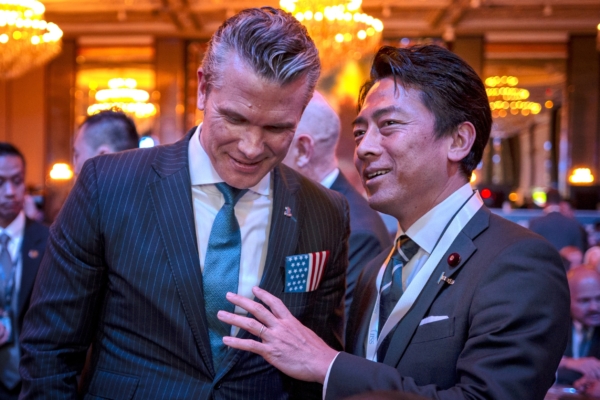
The Asia Security Summit (Shangri-La Dialogue), held in Singapore from May 29th to 31th, attracted various high-ranking officials, including U.S. Secretary of Defense Pete Hagseth and Japanese Defense Minister Taro Kojima. However, the absence of Chinese Minister of National Defense Dong Jun for the second consecutive year has sparked speculation and discussion among observers.
The Shangri-La Dialogue, organized by the International Institute for Strategic Studies (IISS) based in London, is the most important annual defense and security summit in the Asia-Pacific region. It gathers ministers, military leaders, and security experts from around the world.
Dong Jun first attended the Shangri-La Dialogue in 2024 as the Chinese Minister of National Defense. This year, the Chinese delegation was led by 65-year-old Major General Meng Xiangqing from China’s National Defense University, as Dong was once again missing from the summit.
During a special session on May 30th, Meng Xiangqing emphasized the need for constructive strategic stability between China and the United States. He criticized Japan for attempting to amend its pacifist constitution and abandon its three non-nuclear principles, accusing Japan of potentially increasing the risk of nuclear proliferation by inviting allies to deploy nuclear weapons on Japanese territory.
In response, on May 31st, Japanese Defense Minister Taro Kojima refuted China’s claims, stating that Japan does not possess nuclear weapons or strategic bombers, and criticized the notion of Japan promoting a new militarism as absurd.
Last year, the Chinese delegation was led by Major General Hu Gangfeng when Dong Jun was absent from the Shangri-La Dialogue. While Meng Xiangqing and Hu Gangfeng hold the same rank, media and commentators have pointed out that this year’s Chinese delegation had the lowest rank since 2007, suggesting Meng lacks real authority.
Dong Jun’s consecutive absence from the Shangri-La Dialogue has caught the attention of Chinese netizens. Some speculate that due to lingering concerns following the U.S.-China summit and warnings from Hagseth on Chinese military threats, the Chinese avoided sending Dong to directly engage with the U.S. Secretary of Defense.
Others believe recent subtle shifts in Singapore’s stance towards China have had a significant impact. There is also a perspective that China is not fond of the Shangri-La Dialogue led by Western countries, focusing instead on its own Xiangshan Forum held in the fall.
A recent analysis by Nikkei Asian Review suggests while these viewpoints hold merit, they overlook a crucial factor due to China’s strict censorship: the ongoing internal purge within the Chinese military.
Dong Jun’s absence from the Shangri-La Dialogue for two consecutive years coincides with a severe anti-corruption crackdown within the Chinese military, with senior military leaders falling from grace.
In November 2024, Miao Hua, a member of the Central Military Commission and head of the Political Work Department, was unexpectedly removed from his position. Miao Hua, a close associate of Xi Jinping and seen as Xi’s representative within the PLA, played a key role in Dong Jun’s rise to the position of Minister of National Defense due to his naval background and service.
In the spring of 2025, He Weidong, one of the Vice-Chairmen of the Central Military Commission, disappeared from the public eye, leading to global speculation. He Weidong was later expelled from the Party and the military, having served as a close military aide to Xi Jinping. The chaotic situation within the Chinese military at the time prevented Dong Jun from attending the previous year’s Shangri-La Dialogue.
Over the past year, a wave of purges has swept through the ranks, intensifying turmoil within the PLA. On May 7, two former Chinese Defense Ministers, Wei Feng and Li Shangfu, were sentenced to death with a two-year reprieve for corruption. Both Wei and Li had attended the Shangri-La Dialogue during their terms.
Before their suspended death sentences, Wei and Li were stripped of their Party membership, paving the way for Dong Jun to assume the role of Minister of National Defense in December 2023. While Wei and Li also held positions as State Councilors and members of the Central Military Commission, Dong Jun has not been appointed to such high-ranking positions.
Prior to Wei and Li’s sentencing, in January of this year, Zhang Youxia, a Vice-Chairman of the Central Military Commission and a longstanding ally of Xi Jinping within the military, was investigated for suspected serious violations of discipline and law, with his punishment pending.
Given this landscape, sending Dong Jun to international forums such as the Shangri-La Dialogue, where China cannot fully control the narrative, poses significant risks for the Chinese government. Dong may face uncomfortable questions concerning the ongoing military purges, and as a non-member of the Central Military Commission, he lacks the authority to address such politically sensitive issues, potentially prompting China to opt out of his attendance.
The Chinese National Defense University has also been entangled in the military purge. Last summer, Zhong Shaojun, who served as director of the General Office of the Central Military Commission for an extended period, was confirmed to have taken on the role of political commissar at the National Defense University but subsequently disappeared, with his whereabouts currently unknown.