
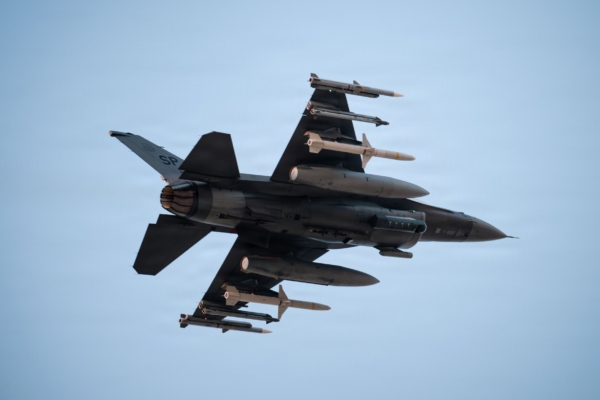
In the “Midnight Hammer” operation by the US military in June 2025, F-16 “Falcon” pilots flew this non-stealth fighter deep into Iranian airspace to provide cover for the B-2 stealth bombers. These “Falcon” fighter jets penetrated Iranian airspace for hundreds of kilometers, destroying enemy air defense systems. They “evacuated with almost exhausted fuel,” and as a result, six pilots were awarded medals.
In May 2026, the US Air Force awarded six F-16 pilots from the 55th Fighter Squadron the Distinguished Flying Cross, to recognize their bravery or outstanding achievements during the “Midnight Hammer” operation flights.
Combat aircraft range data is complex, but official US Air Force data shows that the F-16 has a combat radius of 400 nautical miles (compared to 570-690 nautical miles for the F-22, F-35, and F-15E).
A report from “Business Insider” on May 30 revealed that the pilots ventured nearly 300 miles (260 nautical miles) into Iranian air defense zones. The F-16 aircraft “used multiple AGM-88 ‘HARM’ (High-Speed Anti-Radiation Missile) suppression weapons at the most vulnerable stage over the target, effectively countering enemy threats.”
The citation added that the F-16 aircraft, not being low observable, penetrated Iran’s complex integrated air defense network. They flew beyond the coverage of friendly personnel rescue forces, meaning that rescue would be difficult if they were shot down.
The F-16 is a reliable fourth-generation fighter favored by many pilots. However, lacking stealth technology, it cannot evade enemy sensor detection like the F-35 or B-2 bombers, making it more vulnerable to enemy air defense system attacks. Compared to other aircraft, its range is limited.
“On radar, this fighter will be ‘extra conspicuous’,” said John Waters, former F-16 pilot and former commander of the Air Force F-16 “Viper Demo Team.”
During the previous “Midnight Hammer” operation, some aircraft taking off from rudimentary airfields encountered mid-air refueling tanker malfunctions for unknown reasons, resulting in some tankers inadvertently being unusable.
Waters stated that for jet fighter pilots, tanker reliability issues immediately escalate to fuel and time problems, forcing them to make complex decisions quickly.
Due to refueling delays, two F-16 pilots had to perform mid-air refueling at speeds “far exceeding usual F-16 flight speeds” to ensure providing acceptable air combat capability to Iran.
Subsequently, the F-16 aircraft completed the escort mission under “severely limited fuel.”
“Business Insider” cited John Venable, a senior researcher at the Mitchell Institute for Aerospace Studies, saying that tanker malfunctions during the operation forced pilots to readjust plans in-flight.
Venable mentioned that some pilots claimed, on the way back, that some aircraft were in an “urgent fuel situation” only when meeting the tanker. Other pilots stated they couldn’t contact the tanker and had to divert to “unusual locations.”
In such circumstances, the F-16 aircraft completed the escort mission under “extremely limited fuel.”
The commendation order for Senior Officer Christopher Beckett read, “even with severely limited fuel, he steadfastly escorted the formation safely, ensuring each aircraft got out of danger, and then executed a high-risk mid-air refueling formation with critically low fuel.”
Other pilots awarded medals, including Major Matthew Croghan, Major Alexander Trembly, Captain Megan Langas, Captain Abigail Maio, and Captain Daniel Dodson, were commended for persistently escorting the formation to safety with critically low fuel and then executing a dangerous mid-air refueling formation with critically low fuel.