
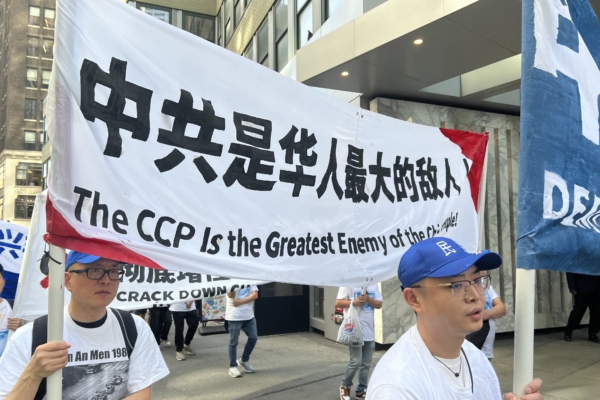
On the occasion of the 37th anniversary of the June 4th crackdown in 1989, U.S. Secretary of State Rubio issued a statement commemorating “Six Four.” Diplomatic missions in China and consulates in Hong Kong from various countries publicly mourned “Six Four.” Several cities worldwide also held various events to commemorate “Six Four.” It has been 37 years, and the Chinese Communist Party has tried to make people forget “Six Four.” As two chairmen of the Congressional-Executive Commission on China (CECC) in the United States stated, “The CCP can occupy the square, but it cannot control people’s conscience; it can censor history, but it cannot erase memory.”
Dr. Wang Juntao, who was accused by the Chinese Communist Party of being an “important criminal commanding counter-revolutionary turbulence” after the June 4th crackdown in 1989, appeared on the NTD television show “Times Observer” to share insights. He mentioned that on June 9th, 1989, five days after the crackdown, Deng Xiaoping chaired a meeting with military cadres involved in the suppression, saying that the turmoil was inevitable and determined by international and domestic climates.
Dr. Wang Juntao, the current Co-Chairman of the National Committee of the China Democratic Party, holds a Bachelor of Science in Nuclear Physics from Peking University, a Master’s degree in Public Administration from Harvard University’s Kennedy School of Government, and a Ph.D. in Comparative Politics from Columbia University. After the 1989 “Six Four” incident, he fled domestically. On December 4, 1989, he was accused by the People’s Daily of inciting, organizing, and commanding counter-revolutionary turmoil. He was arrested and sentenced to 13 years in prison on charges of subverting the government and inciting counter-revolutionary propaganda.
The occurrence of “Six Four” was closely tied to the broader context of the 1980s. Internationally, Ronald Reagan assumed office as U.S. President, leading to a flourishing environment for freedom and democracy globally, while the international communist movement faced challenges. The Soviet Union’s decline was evident, and Eastern European countries were on the verge of toppling communist regimes. Internally, after Mao Zedong’s death, China experienced a thawing period with initiatives such as the “Democracy Wall” in the public space and the “Theory Work Conference” led by Hu Yaobang within the authorities. At the top levels of the CCP, Hu Yaobang and Zhao Ziyang were attempting economic and political reforms. Intellectuals began engaging with Western modern political and philosophical ideas.
With the influx of Western ideologies, affluent and socially prominent individuals began demanding more rights and freedom from the government. In 1989, there were three significant anniversaries – the 30th anniversary of the CCP’s founding, the 200th anniversary of the French Revolution, and the 70th anniversary of China’s May Fourth Movement. Scholars began preparing to openly discuss China’s modernization issues, believing that China had reached a point necessitating political reforms.
The death of Hu Yaobang in 1989 ignited the “Six Four” student movement that hoped for political reform. Hu Yaobang had shown sympathy and understanding towards students, as seen during the “Eighty-Six Student Movement” in 1986. Deng Xiaoping, however, criticized him several times, urging him to take a firm stand and suppress the movement. Despite the pressure, Hu Yaobang tried to resolve the situation peacefully without resorting to force. Eventually, he was accused of mishandling the student movement and was forced to resign his position as General Secretary.
The outpouring of grief and support for Hu Yaobang led to demands for a fair assessment of his legacy. The setbacks faced during the period of reform and opening up contributed to a sense of discontent among university students regarding political reform. This discontent culminated in the “Six Four” student movement of 1989.
Following Hu Yaobang’s death on April 15, Zhao Ziyang visited North Korea on April 23. During his absence, Li Peng briefed Deng Xiaoping on April 25, resulting in the characterization of the student movement as turmoil. This led to the publication of the April 26 editorial in the People’s Daily.
Many speculated on whether a different outcome could have emerged if Zhao Ziyang had not left during this critical moment. Wang Juntao noted that while Zhao Ziyang distanced himself from Deng and disagreed with the crackdown, he did not choose to confront Deng directly. Even as students mourned Hu Yaobang, Zhao Ziyang contemplated whether to stay, but Deng eventually facilitated his departure. At the airport, Zhao Ziyang instructed Li Peng to continue handling the students according to the decisions made in political meetings, emphasizing conciliatory and guidance strategies.
Continued…