
On Tuesday of this week (26th), the Board of Supervisors of Yuba and Sutter counties in Northern California voted 4-0 (with 1 absent) and 5-0 respectively in support of a proposal to split California into two separate states.
The AJR-23 proposal, initiated by Republican State Assemblyman James Gallagher in August of last year, had six other State Assembly members and one State Senator as co-sponsors. The proposal aims to divide California into one state comprising 23 counties near the coast, including many densely populated counties, and another state consisting of 35 counties in the inland, mountainous, and rural areas.
The reasons cited in AJR-23 include California’s population being nearly six times the average of 50 states, with a high concentration in major cities and coastal regions, especially Southern California. As the third largest state in the U.S., California’s area is over twice that of an average state, and its economy is highly complex due to spanning across various sectors. The proposal argues that the state government is heavily influenced by a small portion of legislators from certain regions, leading to significant areas not receiving adequate services and struggling to achieve fair political representation.
Residents from the northern and inland regions have long been dissatisfied with California’s laws and regulations, many of which are driven by voters in densely populated coastal cities, such as Los Angeles County with a population exceeding 9.8 million and over a quarter of the state’s total registered voters.
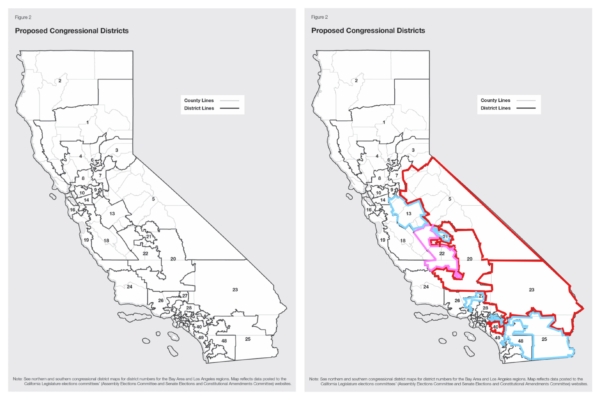
AJR-23 is directly related to California’s “gerrymandered” redistricting of electoral districts.
In November of last year, California voters approved Proposition 50 with 64.4% support, endorsing the state legislature’s redistricting of electoral districts. The newly drawn districts give the Democratic Party an advantage in 48 out of 52 congressional districts, potentially securing around 92% of seats, despite Republican voters accounting for about 35% of California’s registered voters, along with numerous third-party and non-affiliated voters.
In January of this year, the Central District of California Federal Court upheld the validity of Proposition 50; in February, the U.S. Supreme Court rejected challenges from California Republicans, the Department of Justice, and some voters opposing the redistricting, allowing California to use the redrawn districts in the elections of 2026, 2028, and 2030.
According to the Northern California local newspaper “Appeal-Democrat,” Johanna Lassaga, the Republican Party chair of Yuba County, stated in an interview that splitting California into two states “is not a bad idea,” and that “division is not a negative thing.” She criticized Proposition 50 as being “awful,” highlighting that congress members elected based on the new districts may not truly represent the voters’ wishes.
Lassaga emphasized that the separated states would not be isolated and could maintain cooperation with neighboring Oregon and Nevada, stating that the split does not mean they cannot work together to solve issues and get things done.
However, AJR-23 has yet to advance to group discussions in the State Assembly and was resubmitted to the Rules Committee in January this year.
Bill High, the Democratic Party chair of Yuba County, bluntly stated that the chances of the proposal passing in the State Assembly are almost zero. Democrats hold an overwhelming majority in the California legislature, and the redistricted districts favor Democratic candidates.
Since California’s admission to the federal government in 1850, there have been over 220 legislative attempts to divide California into two states. In 1859, California voters overwhelmingly supported the split, but Congress did not take action.
Historical records show that even before California joined the Union, there were attempts to split the state. Agoston Haraszthy, a resident of San Diego, wrote to the U.S. Senators requesting support for dividing California, stating that without division, the people of Southern California would fall into poverty and be forced to leave their homes.
Over the past decade, besides Sutter and Yuba counties in Northern California, several counties such as Siskiyou, Modoc, Glenn, and Tehama have expressed a desire to form a new state. In 2022, San Bernardino County, the largest county by area in Southern California, passed a resolution supporting its elected officials to “research and advocate for all methods, including secession from California, to obtain fair state government funding and resource allocations.”