
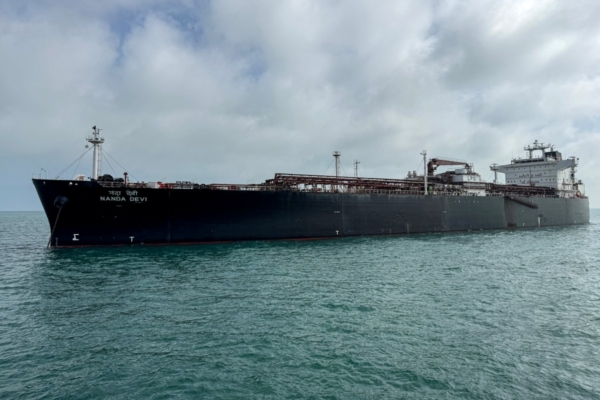
Over the past weekend, both the United States and Iran have released signals of “nearing an agreement” and are preparing to resume traffic in the Strait of Hormuz. This has led to significant market reactions, including a 5% decrease in global oil prices. Some large oil tankers and liquefied natural gas (LNG) carriers that had been stranded in the strait for an extended period of time have successfully departed. However, experts estimate that it may take up to a year for global oil prices to return to pre-Middle East conflict levels.
While negotiations are ongoing, a small number of vessels have still been passing through the Strait of Hormuz. Recently, an oil tanker and an LNG carrier have passed through the strait. However, shipping companies are maintaining a high level of caution and have not yet resumed normal operations.
On Monday, May 25th, an LNG carrier successfully sailed out of the strait towards Pakistan, while another super tanker carrying Iraqi crude oil destined for China and stranded in the Middle East Gulf for nearly three months departed on the 23rd.
These vessels are among the few super tankers permitted to pass through the Strait of Hormuz this month. Previously, three very large crude carriers (VLCCs) loaded with 6 million barrels of crude oil were heading to China and South Korea.
According to data from the London Stock Exchange Group (LSEG) and Kpler, a liquefied natural gas carrier flying the flag of the Bahamas, the Fuwairit, loaded liquefied natural gas at the Ras Laffan Port in Qatar around March 28th.
Owned by Japan’s Mitsui O.S.K. Lines (MOL), the ship had been stranded in the Strait of Hormuz for nearly two months before officially departing on May 25th, with an expected arrival in Pakistan for unloading on May 26th.
Additionally, the super tanker “Eagle Verona” sailed out of the strait on Saturday, May 23, and is expected to reach the Ningbo Port in China for unloading on June 12. This vessel, flying the flag of Singapore, is leased by China’s state-owned Unipec to the Malaysian state-owned shipping company MISC and loaded nearly 2 million barrels of Basra crude oil from Iraq on February 26.
As of now, there has been no response from the companies that own these two vessels.
Following the announcement by both the US and Iran, Brent crude futures prices fell by about 5%, hovering around $95 per barrel, while West Texas Intermediate crude futures dropped by over 5%. Most stock markets in the Asia-Pacific region saw an increase.
However, Hamad Hussain, a commodity economist at Capital Economics, told the Wall Street Journal that due to damaged oil facilities in the Persian Gulf, production disruptions, and lingering shipping risks, “oil prices are likely to remain elevated for some time.” It is expected that it will not be until 2027 when the global energy supply and demand balance significantly improves that oil prices will start to visibly decline.
Data from the International Energy Agency (IEA) based in Paris shows that global fuel inventories plummeted by 250 million barrels in March and April of this year. If the US and Iran reach an agreement, while it may alleviate energy supply shortages, countries will still need to replenish depleted storage space afterwards.
In a forecast by the US Energy Information Administration (EIA) in May, if shipping volumes in the Strait of Hormuz recover in June, Brent crude prices are estimated to fall to around $89 per barrel by the end of this year, compared to $60 per barrel at the beginning of the year, and to reach $79 per barrel by 2027.
Recently, the chief executive of ADNOC, the state-owned energy company of the United Arab Emirates, also admitted that even if the conflict ends immediately, it will take at least four months to restore energy transportation in the Strait of Hormuz to 80% of pre-conflict levels. Full recovery is not expected until the first or second quarter of next year.
(Content reference: Reuters and The Wall Street Journal)