
On the afternoon of July 4th, a few hours before the fireworks in celebration of the 250th anniversary of the founding of the United States, a long line had already formed outside the security checkpoints along the East River in New York.
This year’s Independence Day was particularly hot, and people had been waiting in line for over three hours. Despite the increasing length of the queue, everyone remained calm and patient. Some chatted quietly with family and friends, others scrolled through their phones, while some simply waited in silence. There was no loud noise, no cutting in line, and no pushing or crowding.
During the long wait, the reporter struck up conversations with people from different countries and cultural backgrounds. As the crowd slowly made their way towards the fireworks display area, a common theme emerged: how were these people from around the world able to interact so naturally? What did they see in America?
The celebrations for the 250th anniversary of the founding of the United States were grand this year. A police officer on duty informed the reporter that there were noticeably more people in attendance compared to previous years.
As the crowd slowly entered the viewing area, a woman noticed a set of keys on the ground. She picked them up and raised them high above her head, loudly asking, “Whose keys are these?” Those around her stopped to help find the rightful owner. In a matter of seconds, a brief episode added a touch of genuine kindness and trust among strangers.
James Lee, a young Chinese-American born in the United States, told the reporter, “I am American.” To him, America was his country.
He chuckled when talking about his parents. “They don’t know English at all.”
Despite living in the U.S. for many years, his parents still spoke Chinese and led a Chinese lifestyle, always considering themselves Chinese.
During international sports events, James supported the American team while his parents rooted for the Chinese team. When it came to China vs. America games, the family sat together, cheering for their respective teams. Different identities never affected the harmony within the family.
James pointed out that although his parents didn’t speak English and still identified as Chinese, they were happy and content living in America.
Speaking about Independence Day celebrations, he said, “I am American, and I want to work hard and contribute to this country.”
Tony Ha, a Vietnamese-Chinese immigrant who arrived in the U.S. around 1980, shared a similar yet different life experience.
Having grown up in America, he had been married to a Chinese wife for over twenty years and they had two sons.
He mentioned, “There is a lot of freedom here. You can live independently, just be yourself. No matter where you are from or what your background is, as long as you work hard, you have the opportunity to live well here. That’s what I love most about this country.”
A Chinese international student from Texas told the reporter that what attracted him most to America was not the economy but the inclusivity.
“I think the biggest feature of America is its inclusivity. Every culture is accepted here, and people are not quick to judge others. Each culture can retain its uniqueness and has room for development. Here, you can be yourself, maintain your cultural identity, and have access to more resources and opportunities for growth,” he said.
A Pakistani businessman who frequently commuted between China and America shared his perspective from a different angle.
He mentioned that America was very free, allowing people to live life according to their own terms without many regulations or the need to follow government directives. “You can live the way you want to live.”
When discussing China, he used the term “organized.” He observed that there were surveillance cameras everywhere and many regulations, and people seemed more concerned about others’ opinions. When asked if this made people feel “oppressed,” he replied, “Yes.”
A three-generation family of four from the Philippines was visiting America for the first time. The mother remarked, “This place is wonderful. Americans are like this, they can talk to anyone, and everyone is friendly.”
Her daughter, Rachel, added, “Everything here is so good.”
When asked if America was better than what they had imagined, Rachel nodded without hesitation, saying, “Yes.”
Among the crowd of onlookers, two American girls stood out with their hair dyed in red, white, and blue – the colors of the American flag. One of the girls named Morry humorously told the reporter, “This is our way of expressing love for America, and it’s also a way for us to feel proud of our country.”
However, the most impressive individual the reporter encountered was Mrs. Cai, a retired elderly woman from China.
She visited the U.S. for two months every summer to visit her daughter, who had studied, worked, and settled here. She expressed wonder at a phenomenon she had noticed over the years.
“Many elderly Chinese people do not speak a word of English, yet they have lived in America for many years and still lead comfortable and contented lives. I have always felt that this is truly remarkable. To not know the local language and still live so comfortably, I think that’s a form of freedom,” she said.
As night fell, fireworks lit up the sky over the East River, casting a radiant glow on the smiling faces from around the world.
As the fireworks faded away, the crowd slowly dispersed.
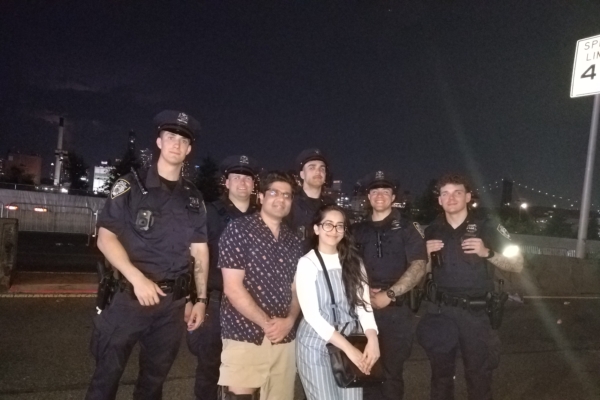
Several police officers lined up patiently, taking photos with tourists and locals; a tall African-American man dressed in American flag-themed attire kept smiling as people requested photos with him; a Latina woman walked away singing, with the passing crowd responding enthusiastically, and the police officers smiling in return.
People of different skin colors, languages, and cultural backgrounds naturally blended in with each other on this night.
After a whole night of interviews, the responses varied. Some talked about opportunities, others about inclusivity, some mentioned friendliness, while others discussed identity.
Yet, what struck the reporter the most was not the repeated mention of “freedom” but the shared lifestyle that everyone exhibited – the ability to live according to their own way regardless of their origin, language spoken, cultural preservation, or whether they considered America their country, all while respecting each other.
When the final burst of fireworks dissipated into the night sky, what lingered in people’s hearts was not just the brilliance of the holiday but a sense of ease, inclusivity, and order that didn’t need to be explicitly promoted yet was palpable throughout.
Perhaps, this is why even 250 years later, America continues to attract people from around the world, offering a space where individuals can live as they choose while respecting one another’s cultural and identity differences, finding a way to coexist harmoniously. The fireworks may fade, but the gratitude they instill in people’s hearts endures.