
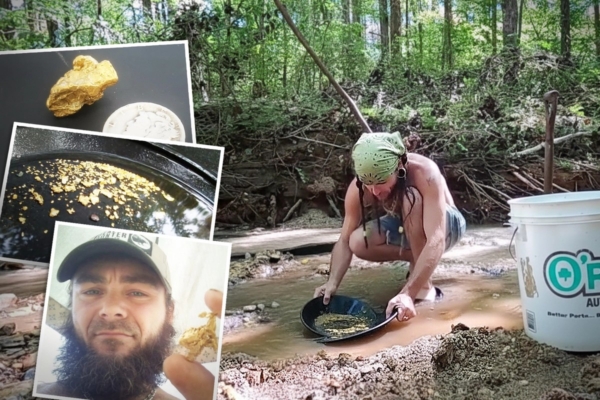
Barefoot and alone, Justin Denig stands in a small creek in South Carolina. He is searching for riches – gold – in this peaceful and beautiful land.
At the age of 42, Denig primarily makes a living by selling precious metals or minerals he has found underground or in riverbeds. His tools are simple, just a shovel, a gold pan, and a rudimentary sorting device called a “sluice.”
He recalls being fascinated by “pirate treasures” since he was young. Growing up, he would pan for gold in a small creek near his grandfather’s cabin in the mountains of Tennessee. The winding creek formed a horseshoe bend around the cabin.
“He (grandfather) gave me a gold pan as a birthday gift,” Denig told The Epoch Times, “When I was 12, I found gold in the creek on our property.”
As he grew older, he transitioned from a kid selling fossils, shells, and crystals door-to-door with a cardboard box to a young prospector roaming America in search of gold and gemstones. This solitary profession not only provided him with income to cover expenses but also earned him a reputation. Denig has appeared on the Discovery Channel’s independent gold prospector TV show.
Today, Denig is settled in the suburbs of Greenville, South Carolina. He keeps his gold panning equipment there along with a bus converted into a mobile boutique for selling his goods nationwide. However, most of the time, he is out exploring – sometimes panning in the Appalachians, sometimes in California riverbeds, or operating in Colorado mines. He has panned for gold in almost every state of the contiguous USA.
Lately, Denig’s motivation for gold panning comes from the unprecedented rise in gold prices. 2026 has seen nominal price records shattered due to factors like geopolitical tensions, trade frictions, currency inflation, and unstable banking systems. This makes the relatively cheap gold panning equipment more cost-effective now, as the value of gold extracted from rivers has significantly increased. Even a small piece of gold today is worth much more than in 2010.
For Denig, gold panning has always been sufficient to sustain himself. He needs around $800 a week to cover expenses, and just finding about one to two ounces of gold a month is enough to live comfortably. Denig started in harsh conditions, hitchhiking across states in search of gold panning opportunities. With his wealth of experience, he has guided many newcomers in the industry and built a name for himself. One day, he received a call from connections in the gold panning community that led to appearances on multiple episodes of “American’s Backyard Gold” on the Discovery Channel.
Having gained some recognition in the niche field of gold panning, Denig established his social media accounts to help newcomers. Gold panning is becoming increasingly attractive to many middle-class individuals in the current economic climate. He advises that gold panning may be simpler or more challenging than imagined, depending on individual circumstances. For many family-oriented people, this activity often requires more time and effort.
Denig states that history can provide clues for beginners to find gold. Former gold rush regions like South Carolina and California still hold many opportunities. Ore once considered “low-grade” and discarded by early miners may now hold substantial value at current gold prices. Additionally, scattered gold nuggets and estimated unmined gold worth $10 billion may still lie in the Carolina Slate Belt alone, where an estimated $4 billion in gold was mined during the Carolina gold rush period. Denig spends most of his time panning in the winding streams along the Slate Belt.
He often reviews old maps to study past mining activities and assess potential areas that may still hold promise. Before starting to dig, he checks local regulations to ensure that using a shovel for excavation is legal in the area.
“There’s government land and public lands managed by the Bureau of Land Management,” Denig says, “Some places are open for mining, others aren’t.” He believes that ultimately, if a prospector has valid reasons to believe in their mining rights, they shouldn’t easily retreat due to opposing opinions.
“It’s easier to ask for forgiveness than permission,” he says. He stresses that rather than waiting for others to grant rights, it’s better to proactively uphold and exercise legal rights.
Some beginners assume gold panning requires expensive equipment. Denig simply chuckles at this notion. He mentions making a classifier using a milk crate lined with metal mesh purchased for $15. (He notes that a kitchen colander at home would work just fine.) This way, larger rocks get sieved out, leaving smaller stones, sand, and silt – where gold is most likely to be found – easily sorted.
As for the sluice, Denig uses a scrapped metal sheet salvaged from a demolition site. “It was originally a wire duct for fiber optic cables,” he explains. It can’t get any cheaper than that. He has even used similar scrap from discarded home appliances like refrigerators.
This trough-like sluice is placed in the creek to let water flow along a narrow channel with protruding barriers at the bottom. Then, he scoops possible gold-bearing sand and gravel from upstream into the sluice. The water washes away lighter rocks and sediment, while denser gold particles settle and stay at the bottom of the trough with the barriers. This process mimics the natural river washing and gold deposition principles.
Gold in rivers is a result of quartzite rocks hosting gold veins undergoing long-term weathering erosion, being carried downstream by floods or river currents. When the flow slows down and the river starts meandering, gold gradually accumulates. Gold, being over ten times denser than sand, tends to collect on the inside bends of the river – a common knowledge among prospectors.
However, over the years, Denig found that nature doesn’t always adhere to these rules.
“Gold is where you find it,” he says.
He has sometimes found gold outside the inner bends of river curves, while nearby prospectors in the inner bends found nothing. Gold might be on the surface of sandbars or buried in dry gullies where rivers once flowed. You can never predict.
Nuggets of river gold have a unique appeal, often fetching significantly higher prices than gold bars. Gold embedded in quartz or crystal structures presents a distinct “nugget appearance,” commanding higher values in the collector’s market compared to pure gold, with buyers willing to pay several times the price.
“If gold is in quartz, it commands a premium,” Denig explains, “Some nuggets, I can sell for twice or even ten times the value of the gold itself.”
He emphasizes that living a “decent life” through gold panning is entirely plausible. He adds that he has always wondered why more people haven’t entered the industry. “The money is there, I’m sure. I have proven it time and time again.”