
In New York, driving for ride-sharing services is a job with low entry barriers. Unlike working in restaurants or doing renovation work, there are no language or identity requirements, and no specific skills needed. This has attracted many new immigrant drivers to the industry. However, there is a prevalent issue of overwork among them. According to Zhang Hui, a Chinese representative of the Independent Drivers Guild, ride-sharing drivers commonly face long hours of sitting, overnight shifts, irregular eating habits, and high mental concentration, which are all part of the typical work conditions for ride-sharing and taxi drivers. The excessive fatigue and sudden illnesses stem from the high-intensity and high-pressure nature of the entire industry.
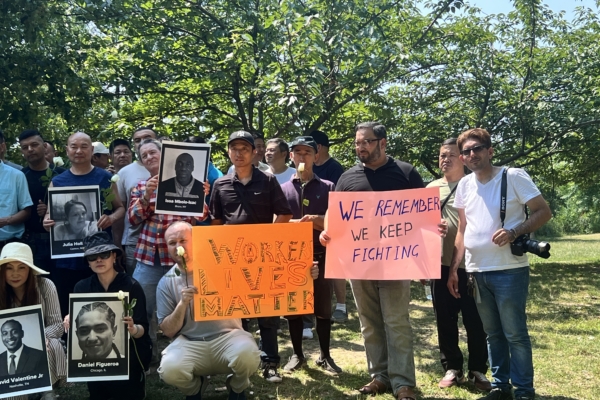
On July 1st, at a memorial event held in Columbus Park to commemorate the drivers who died on duty, Chinese drivers shared their experiences, shedding light on the hidden occupational hazard of “overwork” for the public to see. They called on platforms, companies, and management departments to pay more attention to the physical and mental health of drivers.
One driver, Chen, mentioned that the systems of companies like Uber and Lyft specify that drivers should not spend more than 10 hours a day driving passengers. However, the platform calculates this time only when passengers are in the car, excluding the time spent on tasks such as waiting for orders, driving to pick-up locations, and other non-passenger related activities.
“Many people need to work fifteen or sixteen hours a day to accumulate enough driving time clocked in those ten hours,” Chen explained. Prolonged driving not only drains physical energy but also increases the risk of traffic accidents. He hopes that the government and platforms will reassess the system, establish working hours that are manageable for the human body, and increase the minimum income guarantee so that drivers do not have to rely on overtime to make a living.
Chen also pointed out that along with declining income, drivers have to bear significant operating costs. “Just the commercial insurance costs over six thousand dollars a year, along with expenses for fuel, vehicle maintenance, regular inspections, and other expenditures that pile up as fixed monthly costs.”
He added that in slow business periods, many drivers may not earn enough to cover their costs even after driving for more than ten hours a day. With rising oil prices and inflation, drivers often find themselves extending working hours just to make ends meet, some working fifteen or sixteen hours a day in hopes of getting more orders.
According to Chen, platform companies should not only benefit from the revenue generated by the drivers but also take on more responsibilities, including providing better safety measures, fair income opportunities, and a feasible appeal system.
Driver Wang emphasized that many people mistakenly believe that working for ride-sharing services offers flexible hours. However, for many drivers who need to support their families, the reality is that “no work means no income.” He highlighted that under the pressure of high living costs and expensive insurance, even when physically exhausted, drivers feel compelled to keep accepting orders. “It’s not that we are willing to be exploited, but life forces us to keep working.”
Nevertheless, Wang pointed out that if drivers work long hours, they may lose balance in their bodies and emotions, leading to fatigue driving and dangerous behaviors on the road. This not only affects the drivers but also jeopardizes the overall traffic safety of the city.
In recent years, ride-sharing platforms have implemented more AI management mechanisms. Wang mentioned that the platform analyzes driving conditions through the mobile system; drivers are restricted in actions like listening to music, as the system may deem them risky, affecting the driver’s rating and potentially leading to account suspension, which adds stress for many drivers.
Huang, who has been working in the ride-sharing industry for nine years, shared that coming from previous jobs in restaurants and renovation work, he joined the industry in 2017 due to the perceived stable income. However, with the increasing number of drivers and the influx of new immigrants after the pandemic, the market competition has become more intense.
Drivers spend long hours sitting behind the wheel each day, which takes a toll on their bodies. Huang admitted that prolonged sitting had caused him back and spine pain, leading him to seek massage therapy at clinics.
In addition to health issues, he expressed that drivers now face growing pressure due to rising living costs. “The income remains almost the same as before, but fuel prices keep rising along with the prices of goods and food. Just when you start making a little extra, it all goes into fuel expenses.”
He described the current ride-sharing market as a situation where the “cake is getting smaller,” with full-time drivers facing increasing pressure to sustain their livelihoods.