
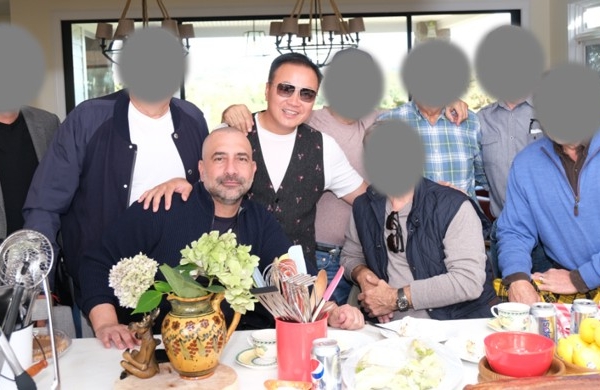
New York hotel and real estate developer Andy Zhu (formerly translated as Zhu Yanbo) has become a focal point of attention in both the New York political arena and the Chinese community after being federally indicted for allegedly bribing former Mayor Adams’ Chief of Staff, Frank V. Carone, with $120,000 to secure a $6.82 million emergency immigrant shelter contract in New York City.
However, as more public information, court documents, and corporate information emerge, Zhu’s real estate development over the past twenty-plus years in the United States has gradually garnered external attention. The data indicates that his leadership in various major development projects involves Chinese funding, cross-border investment structures, and structural financing operations, prompting further examination of his business footprint and funding sources.
According to Zhu’s company, the East Times Group, he has led projects in commercial, warehouses, mixed-use, and residential properties with a total development area exceeding 5 million square feet and completed projects valued at over $3 billion, spanning across the United States and China.
The company positions itself as a “diversified investment and family office platform,” covering private equity, venture capital, structured finance, cross-border investments, and collaborating with institutional partners, private investors, and family offices on investment projects.
These corporate profiles, seemingly abstract, raise an intriguing question: how did Zhu, who arrived in the United States at the age of 17 in 1992, manage to establish a development portfolio valued at over $3 billion across China and the United States within thirty years? Some answers may be found in the numerous real estate transactions and civil lawsuits he has been involved in over the past decade.
In 2022, a Chinese-language media report titled “Mr. Andy Zhu’s ‘Sanjin Group’ Successfully Acquires Prime Location in Brookville, Long Island” highlighted Zhu’s plans to develop a project combining villas, golf courses, tennis courts, and a large leisure and entertainment center, described as one of the largest projects in the history of Chinese real estate in New York.
While Zhu was depicted as a real estate entrepreneur with “over twenty years of development experience” who collaborated with “several strong companies in New York” to establish mutually beneficial relationships, a civil lawsuit filed in Nassau County, Long Island in December 2020 presented a different picture. In this case, Zhu acted as the plaintiff, suing the seller. Due to travel restrictions for Chinese visitors to the US during the COVID-19 pandemic, the actual signatory could not come to the US to complete the transfer, leading the plaintiff to request the court to prevent the seller from closing the property during this period.
The outcome of this lawsuit is not the focus of this discussion, but rather the facts revealed in the complaint, which both parties agreed upon. The lawsuit indicated that Zhu himself was not the actual buyer of the land but represented the plaintiff as a “natural person”; the three actual buyers involved in the transaction — Triple East Queens Tower LLC, 29-12 LIC LLC, and Triple Gold Development LLC — were predominantly owned by Chinese nationals residing in China.
According to the complaint, the transfer documents, per the Purchase and Sale Agreement (PSA), required the personal presence of the Chinese investors in the US for signing; however, due to the pandemic restrictions, the transfer process was hindered, leaving Zhu powerless to resolve the situation.
Notably, section eight of the complaint explicitly states that the defendants were informed that the aforementioned three LLCs were “predominantly owned by Chinese nationals residing in China.” This indicates that even the sellers of the New York land knew that Zhu was merely a representative and that the actual buyers were Chinese investors, with both sides acknowledging this fact.
In 2015, Zhu claimed to Chinese media that Times Properties, Samsung Real Estate, and Beijing Tianrun Land Group jointly invested $91 million to purchase the former Asian Plaza in Flushing for $36 million, with plans to invest an additional $360 million to develop a large-scale project spanning 660,000 square feet, comprising residential, hotel, commercial, and office spaces.
However, this project quickly turned contentious. In a 2017 lawsuit, Zhu’s business partner Hansen Realty, representing Samsung Real Estate, accused Zhu of “gross mismanagement,” including unauthorized expenditures, undisclosed conflicts of interest leading to false commissions, erroneous business operations resulting in escalated costs, and questioned his ability to manage such a large development project; whereas Zhu counteraccused his partner of “lacking US development experience.”
It is worth noting that in his counterclaim, Zhu admitted to holding only a 25% management partnership interest, with the remaining 75% owned by the cooperating investment party; per the company agreement, major decisions required the approval of other major shareholders. Additionally, the down payment for the sale project was deposited into a trust account managed by the Industrial and Commercial Bank of China.
The case was ultimately settled by the end of 2021, with a joint statement from both parties’ attorneys stating, “Had Hansen accurately and fully understood the facts, the lawsuit would not have been brought.”
Based on the litigation records, Zhu primarily played a role in managing, executing, and communicating externally for the US side in that major real estate development project, while the funding sources and decision-making authority involved Chinese investors.
Furthermore, data from the information service company PincusCo indicates that Zhu’s Long Island city apartment project received loans from the Industrial and Commercial Bank of China, including approximately $13 million in March 2020 and around $11.4 million in December 2025.
Overseas loans from Chinese state banks typically exhibit distinct features: the borrowers are often Chinese enterprises or projects involving Chinese funding; loans must pass through approval processes within China, and the banks verify a substantive connection between the ultimate beneficiaries and Chinese funding. These conditions align with Zhu’s company’s claims of “cross-border investments,” “family office platform,” and “structural financing,” suggesting a potentially closer cooperation and dependency between his US real estate projects and Chinese funding.