
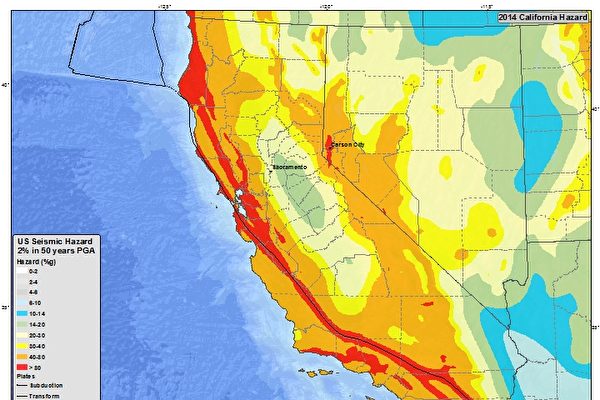
On the same day that Venezuela was hit by two consecutive deadly earthquakes, a magnitude 5.6 earthquake also struck Northern California. At the same time, a new study warns that the risk of strong earthquakes in California has significantly increased.
While California experiences over 10,000 earthquakes on average annually, the looming threat of a “devastating major earthquake” continues to hover over the heads of Californians like an invisible sword. Especially following the deadly earthquakes in Venezuela on Wednesday, which claimed at least 920 lives as of the 26th, concerns about earthquake risks have intensified.
The Los Angeles County Sheriff’s Department (LASD) warned the public that earthquakes could occur without warning and have significant impacts, highlighting the importance of disaster preparedness for residents of Los Angeles County and Southern California.
The California state government stated in an announcement, “As people often say, the next major earthquake is not a question of ‘if’ but ‘when.'”
California is known for its complex network of seismic fault lines, including the Cascadia Subduction Zone in Northern California and the San Andreas Fault and San Jacinto Fault that run through Southern California.
On Wednesday, a magnitude 5.6 earthquake struck Northern California with a depth of approximately 5 miles (about 8.1 kilometers). The epicenter in Mendocino County rural area, about 125 miles (approximately 201 kilometers) from San Francisco, was felt strongly by many nearby residents, with over a million people receiving earthquake alerts on their phones. Officials emphasized the need for California to be prepared for potential disasters at all times.
Both the San Andreas Fault and San Jacinto Fault, running through Southern California, are among the most active seismic fault zones in Southern California. The latest research warns that the stress levels on these two major geological faults have reached their highest levels in about a thousand years, increasing the risk of strong earthquakes significantly.
This new research, led by earth scientists from the University of Hawaii at Mānoa, was published in June in the Journal of Geophysical Research: Solid Earth.
The study found that the entire fault system is currently in a “critical stress state,” and the Cajon Pass northeast of Los Angeles could trigger simultaneous ruptures on two fault lines.
In the event of a cross-fault joint rupture, the magnitude is expected to reach at least 7.4 to 7.8 on the Richter scale, affecting densely populated areas including Los Angeles, San Bernardino, Riverside Counties, and the Coachella Valley.
Californians have long been preparing for such a “big event.” The California Governor’s Office of Emergency Services (Cal OES) advises residents to prepare an “emergency kit” in advance, containing essentials like food, water, documents, important medications, power sources, and water supplies.
“All California residents should also download the MyShake app to be earthquake-ready,” said Caroline Thomas Jacobs, Director of the Governor’s Office of Emergency Services, emphasizing that such early warnings can help people take life-saving actions before the quake strikes.
“MyShake” is a free earthquake alert application provided by the state government that can issue earthquake warnings in advance. Governor Newsom stated, “I encourage everyone to download MyShake and activate the emergency alert function on their phones.” In the event of an earthquake, protective measures should include “Drop, Cover, and Hold On.”
Let’s remember, preparedness is key, especially when living in areas prone to seismic activity.