
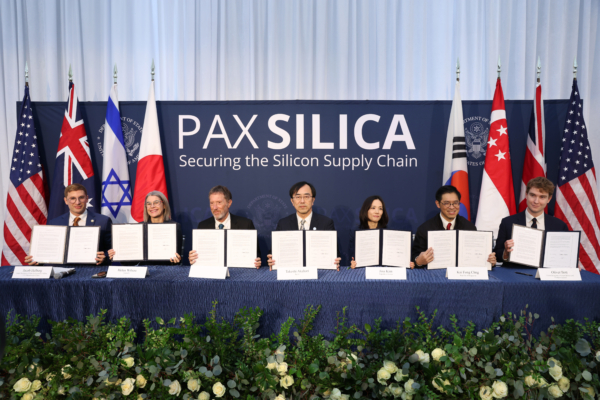
The European Union, the Netherlands, Germany, and Greece have become the latest US allies to join the “Pax Silica” initiative led by the United States. This effort aims to strengthen technology supply chains related to AI in response to increasing competition from China.
Starting on Thursday, the US State Department will host a two-day “Pax Silica” summit in Washington, D.C. The meeting, chaired by Jacob Helberg, the Deputy Assistant Secretary of State for Economic Affairs, aims to enhance global artificial intelligence (AI) supply chain security by establishing trusted tech partnerships and reducing strategic reliance on China.
Helberg stated that Argentina, Chile, Costa Rica, Kazakhstan, and Panama will also join this week, bringing the total number of member countries to 24. Taiwan, a leader in semiconductor technology, has been invited to attend as a non-signatory and guest.
The establishment of “Pax Silica” was deemed necessary as existing mechanisms like the G7 or G20 are insufficient to address the economic transformation driven by AI, according to Helberg. He emphasized the concept of “innovation sovereignty” to differentiate from the UN promoted “digital sovereignty.”
Helberg highlighted the importance of building a trusted partner network to establish an AI ecosystem in over twenty countries that are expected to sign a joint statement this week.
When asked about persuading countries that see the US leveraging “Pax Silica” for its own interests, Helberg cited Israel, Singapore, and the UAE as successful examples of using US technology to build thriving local tech businesses.
To ensure the supply of AI essential resources, the US and Kazakhstan will announce the establishment of an “Economic Security Zone” in the Central Asian country to expand cooperation opportunities in critical mineral security and provide legal certainty and predictability for investors.
In terms of the global AI supply chain landscape, Taiwan and the Netherlands play crucial roles. Helberg emphasized the importance of trusting partners to manufacture chips, power AI, and safeguard technologies that will shape the future.
Regarding Taiwan, while not officially signing the “Pax Silica Declaration,” it has expressed clear support for the initiative.
Helberg previously praised Taiwan’s valuable contributions at the first summit and expects Taiwan to continue participating in relevant discussions, with the US engaging in discussions with Taiwan on supply chain security cooperation.
The Representative Office of Taiwan in the US stated that they will explain the personnel arrangements for Taiwan’s attendance at an appropriate time.
Since the first “Pax Silica” summit in December 2025, with the signing of the “Pax Silica Declaration” by the seven founding members—US, Japan, South Korea, Singapore, UK, Israel, Australia—other countries like the Netherlands, UAE, Greece, Qatar, India, Sweden, Finland have joined the initiative. Recent additions include the Philippines, Norway, the EU, and Germany, with Argentina, Chile, Costa Rica, Kazakhstan, and Panama set to join this week. Others like Canada, Taiwan, and the OECD participate as observers or in dialogue format.