
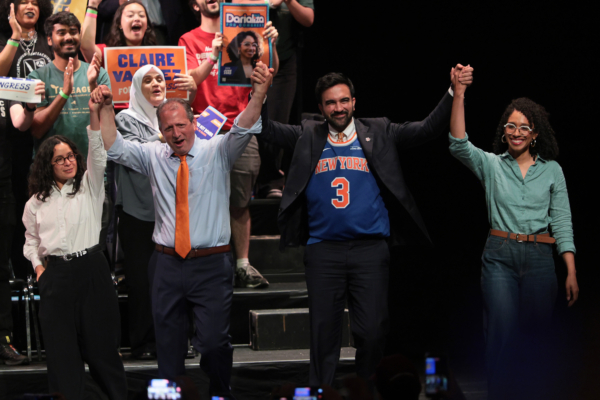
On the evening of June 23rd, the primary elections for several congressional seats were seen as a crucial indicator of the Democratic Party’s future direction. Particularly, the competitions in the 7th, 10th, 12th, and 13th districts garnered significant attention, reflecting the power struggles between the establishment faction, moderate progressives, and the more left-leaning Democratic Socialists of America (DSA) within the Democratic Party. The endorsement of Mayor Mamdani proved influential, with candidates receiving his support emerging victorious, indicating that the political influence of this mayoral dark horse extends beyond local governance to congressional elections.
Candidates supported by the DSA made breakthroughs in the 7th and 13th districts, signaling a continued shift of power within the New York Democratic Party towards the younger generation and the socialist left. Mamdani and his allies have shown that young progressives have the capability to challenge the existing order, but to truly lead the New York Democratic Party and possibly the national Democratic Party in the future, they will still need to confront the continued resistance from the establishment faction and local political machinery. For many political observers, this primary election not only determines who will head to Washington but also serves as a significant barometer for observing the political direction of the Democratic Party in 2028.
The 7th district, spanning across the western Queens and northern Brooklyn, saw a vacancy following the retirement of veteran Congresswoman Nydia Velázquez, making it one of the most emblematic Democratic primaries nationwide.
This area is not only one of the most concentrated districts for millennials (those aged between 30 to 45) and renters in America but is also considered the core of the New York “socialist corridor” by some political analysts. Over the past few years, these young, highly educated, primarily renter voters have gradually become an essential base for the expansion of the DSA.
This election is widely regarded as a showdown between two leftist ideological paths. Last night, Mamdani and DSA-supported State Assemblywoman Claire Valdez defeated Antonio Reynoso, who had the backing of unions and the old progressive faction, with 36,782 votes (56.15%). This victory is seen by many observers as a generational shift within the New York left-wing camp.
The election in the 12th district, covering the core Manhattan areas, is seen as a final test of local political organizational strength.
After veteran Congressman Jerrold Nadler’s retirement left a vacancy, multiple Democratic candidates entered the race. However, the real competition was primarily between State Assemblywoman Micah Lasher and Alex Bores. As of last night with 94% of the votes counted, Lasher secured 39,255 votes (39%), supported by heavyweights like Nadler, former Mayor Bloomberg, and Governor Hochul, representing the traditional liberal political network of Manhattan. Bores, with 35,277 votes (35%), symbolizes the emerging new generation political force, having successfully garnered attention and funding from the national tech and AI industries, unexpectedly turning this local election into a nationwide discussion on AI regulation and technological influence.
Nevertheless, many observers believe that the 12th district remains one of the few areas in New York dominated by local clubs, community organizations, synagogues, and long-standing Democratic supporters. In such an environment, national recognition and external resources may not be sufficient to overcome deeply rooted local political networks. Hence, this election is viewed as a showdown between the national political wave and traditional local political machinery.
The 13th district, encompassing parts of Upper Manhattan and the Bronx, is considered by some progressives as the battleground most likely to spring a surprise.
71-year-old incumbent Congressman Adriano Espaillat, with five consecutive terms, is a representative figure of New York’s Dominican political power and was the first formerly undocumented immigrant to eventually enter Congress. His challenger, 32-year-old Democratic socialist Darializa Avila Chevalier, backed by the DSA, Mamdani, and the “Justice Democrats,” aims to replicate the pattern where AOC defeated Democratic heavyweight Crowley.
Supporters believe that the demographics of the 13th district are rapidly changing, with a significant increase in young renters and working-class voters, potentially turning it into the next “socialist corridor.”
Several weeks ago, many progressives believed that Chevalier had a chance for a historic upset victory. Despite a full mobilization by the Democratic Party establishment, with a flood of external funds and advertisements, many observers initially thought this challenger wave was slowly fading. However, the results revealed that Chevalier defeated the five-term incumbent with 32,100 votes (49.3%) against 29,929 votes (45.99%), making it one of the most impactful outcomes of this primary election.
This victory not only signifies the DSA’s first successful takeover of a traditionally Latinx political stronghold but also indicates that this progressive wave is no longer confined to communities primarily inhabited by young white voters, but is expanding to encompass a more diverse range of ethnicities and socio-economic groups within New York City.