
The Chinese agritainment industry, often jokingly referred to as “pseudo-rural economy,” once enjoyed great popularity but has been collectively declining in recent years, raising concerns about the underlying reasons.
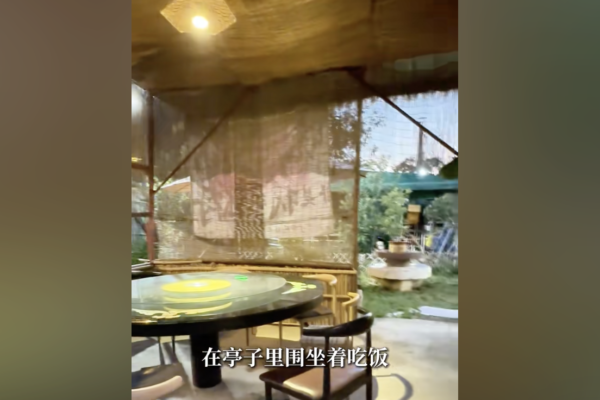
On the mainland, a blogger went driving to the outskirts in search of agritainment facilities, driving over twenty kilometers along mountain roads only to find almost every place closed. Eventually locating one still in operation, they found the entire yard occupied by just one table of customers. A decade ago, without advance booking on weekends, getting a seat was nearly impossible, and cars had to park at the village entrance.
Formerly bustling agritainment facilities at highway exits now have faded signs, with notices of “business transfer” on the glass doors. It is said that in a street in one’s own neighborhood, more than half of the twenty-plus agritainment stores have closed down.
Tang Mei (pseudonym), a female boss with 13 years of experience running agritainment in Qingyuan, Guangdong, told reporters that due to poor business, she had transferred her previous establishments and now runs the fourth one in partnership with someone else. She mentioned that nowadays, investing in promotions and hiring internet influencers is necessary to keep the business running.
“I hired a team for promotions and for Douyin, I had someone do promotions for over 10,000 RMB each time, from ordinary influencers; for famous ones, a single video costs over 17,000 RMB. Without these promotions, there’s nothing left to do now,” Tang Mei commented.
She explained that the current environment is challenging, with changed consumer attitudes where even those with money refrain from careless spending. Tang Mei further cited economic struggles, high unemployment rates, and shifting consumer mindsets as contributing factors to the industry’s decline.
“With eleven employees, I’ve been operating at a loss these past few months, but because I have a partnership and don’t pay rent, I’m still holding on. Just think, even without paying rent, we’re in the red,” she said.
Once rich in rustic charm, agritainment around cities became a favorite destination for urbanites. Offering activities like fruit picking and farming experiences, along with meals cooked over wood fires, these places used to be packed on weekends and holidays, with reservations required in advance and long waiting times common.
According to mainland media data, in the ten years leading up to 2020, the number of registered agritainment-related companies in China surged from 26,000 to 200,000, nearly a tenfold increase.
Several agritainment venues in places like Guangzhou’s Conghua, Nansha, and Luogang, such as Hongyang Agritainment, Xibian Agritainment, and Zhicheng Agritainment, are either closed or deregistered.
A netizen from Bobai County, Guangxi, shared that about 90% of the commercial agritainment venues in the area were operating at a loss, with most of them having a lifespan of only about two years.
In April this year, the owner of Loudi Lulin Mountain Villa in Hunan lamented online about the business struggles, expressing concern over dwindling patrons and mounting operational costs.
This boss, who previously anticipated a stable life after investing millions, now finds himself in a dilemma: either closing the place or persisting despite losses. The 3 million investments represent twenty years of effort, along with the expectations of friends and family. However, carrying on means losing money daily.
In February 2026, a female agritainment owner in Xuzhou made a video seeking advice from friends, showcasing her aunt’s multi-million-dollar agritainment business which was now yielding only 1,000 RMB a day – raising questions on sustainability.
Another video depicted the closure of a multimillion-dollar farmhouse due to economic downturn.
Agritainment, in reality, has historical and cultural roots in China. During ancient times, many officials and intellectuals retired to pastoral lifestyles similar to modern agritainment settings.
The 1980s saw the rise of agritainment in China, with registered agritainment venues soaring by 492% from 2015 to 2019. Typically located 30-50 kilometers from urban centers, these venues catered to city dwellers seeking relaxation close to home, combining leisure and work seamlessly. Initially, these venues prioritized reputation, using fresh ingredients and offering activities like fishing and fruit picking.
The surge in agritainment venues in the past was driven by urbanites seeking stress relief. Nonetheless, these trends are now in the past, as industry prospects look discouraging.
While many self-media platforms discuss the wave of agritainment closures, official reports on agritainment closures are scarce, lagging behind – with national data showing over 80,000 agritainment venues deregistered by the end of 2024.
Online analyses regarding the reasons for the agritainment downturn mainly revolve around issues like excessive homogeneity and commercialization. Many venues offer identical menus and activity schedules, leading to dwindling customer interest and negative reviews on the “pseudo-rural experience.”
Critics attribute the decline to a rush for profits, leading to the exploitation of customers. Additionally, varying levels of culinary expertise among chefs and deceptive practices have caused customer dissatisfaction.
Most notably, traditional agritainment once praised for its authenticity now faces accusations of being the epitome of “pseudo-rural economy.” What used to be a genuine farm-to-table experience has now transformed into a marketing facade, with menus boasting free-range chicken but serving frozen legs instead, among other deceptive practices.
Tang Mei, an agritainment owner in Qingyuan, Guangdong, acknowledged that some venues indeed opt for wholesale produce, emphasizing the balancing act between quality and affordability, as cheap prices compromise quality, affecting customer satisfaction.
She emphasized changes in overall consumer attitudes and market conditions, stressing the need to maintain an adequate portion size at moderate prices instead of excessive profiteering that alienates customers.
Food safety concerns have plagued the agritainment industry. Recent reports revealed the illegal sale of a potent fish bait made from the sedative drug “Diazepam,” which is strictly forbidden in aquatic industries. This highlights the rampant disregard for regulations, compromising food safety standards, which has contributed to the industry’s decline.
China’s food expert Li Linyi pointed out that prevalent use of harmful chemicals in food production, along with declining moral standards, has exacerbated food safety concerns, contributing to the pervasive fabrication and subsequent downturn of the agritainment industry. Economic downturn and consumer downgrade during the past few years have further compounded the industry’s troubles.
Since the onset of the COVID-19 pandemic in late 2019, strict containment measures have hampered agritainment businesses. However, Tang Mei, an agritainment operator in Guangdong, emphasized that the downturn began post-pandemic, adding that during the pandemic, there were still opportunities for business.
After three years of pandemic restrictions, China’s continuing economic decline and sluggish domestic demand have become widely acknowledged facts.
Despite the grim outlook for the industry, many individuals feeling pressured in urban areas continue to flock to rural regions, determined to venture into agritainment.
A middle-aged businessman from Zunyi, Guizhou named Huang expressed his intention to start an agritainment venture, having spent over a month renovating his house in the countryside. Having previously worked for top 500 companies in Shenzhen and Beijing, the burden of urban life prompted him to seek solace in his hometown. Planning to give himself a year to establish an agritainment business and sell local produce, if successful in sustaining himself, he intends to continue operating locally.
Huang noted the absence of agritainment venues in his town, with several establishments having closed down. He believed the reported over 80,000 closures represented just a fraction, underscoring the broader economic challenges. He highlighted the higher closure rates of traditional brick-and-mortar businesses like clothing stores. He emphasized a gradual investment approach, aiming for a comfortable retreat within his self-constructed compound, even in times of low business.
Despite the challenges, those like Huang are optimistic about their agritainment ventures, hoping to make a sustainable living while embracing rural life.