
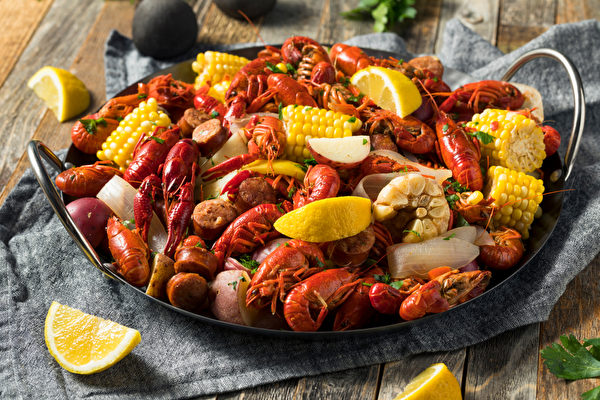
In recent news from May 27, 2026, the price of Chinese crayfish has dropped significantly compared to previous years, with 500 grams costing only eight to nine Chinese Yuan, a price decrease that came a month earlier than usual. Industry insiders speculate that the current price may still have room to decline further.
This year, the prices of crayfish across China have reached astonishingly low levels. According to a report from “BT Finance” under the Beijing Linkvision Times Cultural Media Co., Ltd., crayfish prices in Hubei have stabilized at 8-9 Yuan per 500 grams, while wholesale prices for small green shrimp in Zibo, Shandong have fallen below 10 Yuan per pound.
Traditionally, crayfish prices at this level are not seen until the middle to late June when the rice field harvesting season begins. However, this year, it seems that the market has settled on these prices as early as mid-May. Experts in the industry anticipate that with the full scale of the harvest season from the end of May to June, crayfish prices may not have hit rock bottom yet.
Indeed, signs of the crayfish price drop were evident when crayfish first entered the market this year. On April 1st, the wholesale price for smaller crayfish at Beijing Xinfadi Wholesale Market was only 17.5 Yuan per pound. Comparing this to data from “China New Economic Latitude,” in 2025 when crayfish were first available, the wholesale price for smaller crayfish at Xinfadi was 28 Yuan per pound, and for larger crayfish, it was 49 Yuan per pound. This year, upon entering the market, prices had already seen a significant decline from the previous year, even slashing nearly in half.
Within just a month, crayfish prices began to plummet. Official data from Beijing Xinfadi’s website showed that on May 8th, the wholesale price for smaller crayfish was 15 Yuan per pound, while larger crayfish were at 21.5 Yuan per pound, marking declines of 23.1% and 10.4% respectively from a month prior, and 3.2% and 8.5% compared to the same period last year.
Xu Lifeng, a researcher at the One-Acre Field Industry Research Institute, stated to “China New Economic Latitude” that based on their large-scale data, overall crayfish prices have dropped by 30% to 40% compared to the same period last year, with larger crayfish prices almost halved.
There are multiple reasons contributing to this situation, with the primary one being an oversupply of production capacity. As reported by “BT Finance,” the unusually warm winter and spring this year led to early market entry of early shrimps from Hainan and Sichuan, advancing their arrival by one to two months compared to previous years. Additionally, the expansion of shrimp farming areas, with shrimp seedlings from Jiangsu being introduced to Hainan, allowed for off-season production during the winter. These factors, combined with the already excessive production capacity of crayfish, were catalyzed by the warm winter, leading to a concentrated outbreak of production in May and breaking the price defense.
Moreover, the peak demand season in the market has not yet arrived. Crayfish are primarily consumed at outdoor food stalls and gatherings during hot summer nights. As the weather has not yet significantly heated up, the peak season for nighttime markets has not arrived, resulting in an imbalance between supply and demand, forcing crayfish prices to drop in order to sustain market activity.
Xu Lifeng remarked, “Looking at the demand side, the main consumption scenes for crayfish are in nighttime markets and food stalls, and currently it is not the peak season for nighttime markets. The mismatch between supply and demand has affected the prices of crayfish.”
The continuous decline in crayfish prices has deeply impacted aquaculture farmers the most. In the previous years when crayfish demand and prices were high, an influx of capital and aquaculture farmers entered the market, pushing production capacity limits higher. However, this year, a combination of weather conditions and technological advancements has burst the price bubble earlier than anticipated.