
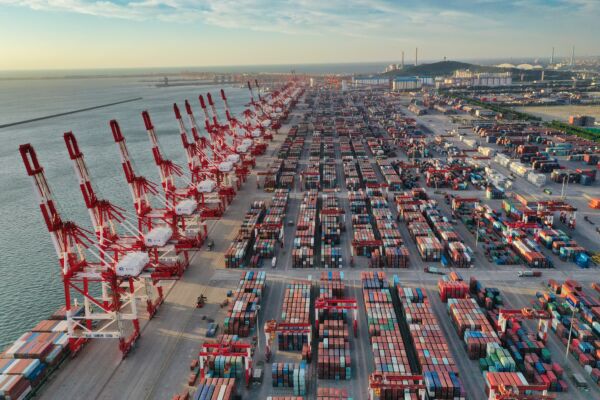
The European Union is considering the establishment of a new regulation that may require European companies to source key components from at least three different suppliers when making purchases, and these suppliers cannot all come from the same country. This is aimed at reducing the EU’s reliance on supply chains from China. A spokesperson for the EU has confirmed that relevant discussions will take place on May 29.
According to the Financial Times, two EU officials have revealed that the EU is considering the implementation of a new regulation to reduce dependence on supply chains from China. The new regulation is expected to set procurement limits from a single supplier, estimated to be around 30% to 40%; in addition, components must come from at least three different suppliers and cannot all originate from the same country.
It is reported that this new regulation will focus on several key industries such as chemicals and industrial machinery. In recent years, these industries have complained that the influx of cheap imports from China has impacted their normal operations. On the other hand, the regulation could also serve as a response to China’s restrictions on the export of key technologies.
Another official pointed out that this is not only targeting China, as the supply of certain raw materials or chemical inputs is currently highly concentrated in a few countries. For example, helium mainly comes from the USA and Qatar, while cobalt primarily originates from the Democratic Republic of the Congo and Indonesia.
EU officials have disclosed that the plan is still in the early stages, but will be proposed at a meeting of the EU Commission dedicated to discussing China-related issues on May 29. If approved by the commissioners, the detailed proposal may be discussed at the EU summit in Brussels, Belgium, from June 18 to 19, to obtain approval from EU member states’ leaders.
EU trade spokesperson Olof Gill has confirmed that discussions will be held on May 29 but refused to comment on the content of internal negotiations, stating that such discussions do not imply that formal proposals have been adopted.
EU officials have stated that EU Trade Commissioner Maroš Šefčovič aims to reduce the EU’s daily trade deficit of up to €1 billion (approximately $1.1 billion) and protect businesses from the impact of China’s “weaponization of trade.” Due to the EU’s high dependence on China for key raw materials supply, China has repeatedly exerted pressure on the EU by restricting exports of rare earths and other vital materials.
For example, in April 2025, China imposed export controls on seven rare earth-related items, essential for electric vehicles, wind power, and military equipment. This led to some European automotive production lines being forced to halt operations. Six months later, in October 2025, China further tightened these export controls to include rare earth-related products, processing technology, and downstream materials in the supply chain.
Despite temporarily relaxing some restrictions following the 2025 US-China Kusan Summit in November 2025, experts believe that the situation is still not under control. In response, the EU has started pushing for further decoupling of supply chains from China and establishing raw material platforms.
EU officials further revealed that Šefčovič plans to impose a series of punitive tariffs on Chinese chemical and mechanical products to stem the impact of increasing low-priced goods from China on European manufacturers.
Both EU officials have noted that traditional anti-dumping and countervailing tools are time-consuming, and implementation under World Trade Organization (WTO) rules may take up to two years due to extensive investigation processes. Additionally, tariffs can only address the extent of damage caused by imports, and Chinese companies, benefiting from lower operating costs and government subsidies, may still profit from sales even with tariffs in place.
The WTO investigation process is meticulous, as it requires the opportunity for evidence submission, response to accusations, participation in hearings, and on-site audits by exporters, importers, and foreign governments. The EU Commission’s trade defense team is facing significant pressure due to a surge in complaint cases. The Financial Times reports that the number of complaints in the chemical industry has reached a record high, with an industry leader even stating that the sector is “on the brink of collapse.”
To address the impact of low-priced Chinese exports on global markets, EU officials often refer to the International Monetary Fund (IMF) report released in August of last year titled “Industrial Policy in China: Quantification and Impact on Misallocation.” The report estimates that the fiscal cost of China’s industrial policy tools, including cash subsidies, tax incentives, subsidized credit, low-cost land, and other forms of preferential treatment, amounts to about 4% of China’s GDP.
The report highlights that excessive official subsidies from China have led to misallocation of resources and global overcapacity, resulting in Chinese companies lowering export prices and expanding exports, thus pressuring global manufacturing industries.