
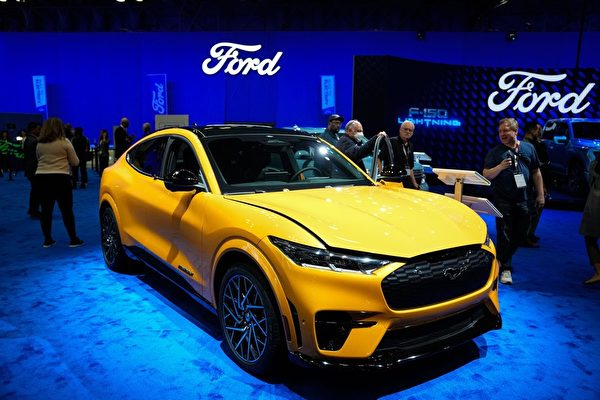
On Monday, May 18th, American automaker Ford announced that it will be launching seven new vehicle models in Europe by 2029 with the aim of revitalizing its weak passenger car sales, facing head-on the fierce competition from low-cost Chinese car manufacturers and securing its leading position in the commercial vehicle market on the European continent.
The increasing number of competitors in the current market is severely eating into market share, and Ford’s plan is to significantly expand its market share. Jim Baumbick, President of Ford Europe, stated in an interview with Reuters, “We must stand out in the fierce competition.”
Among the new vehicle models planned by Ford, five are passenger cars, including a small electric car and a compact electric SUV, both of which will be produced using Renault’s technology at their factory in northern France. Additionally, three SUV models will be offered in both hybrid and fully electric versions.
The second-largest U.S. car company is also critical of the push for electric vehicles (EVs) in Europe. Ford believes that “carbon reduction goals must reflect consumers’ actual needs,” and legislative bodies should increase support for plug-in hybrid electric vehicles (PHEVs) and range-extended electric vehicles (EREVs) rather than solely promoting fully electric cars.
To restructure and increase efficiency in its European operations, Ford has previously closed its Saarlouis plant in Germany and is currently reducing staff at its Cologne plant in Germany.
According to data from the European Automobile Manufacturers Association (ACEA), just a decade ago, Ford was the fourth-largest car manufacturer in Europe with annual sales exceeding one million vehicles across the continent. However, last year, the company’s passenger car sales in Europe had shrunk to just over 426,000 vehicles, ranking it eighth and trailing behind Mercedes-Benz.
While Ford is attempting to reverse its decline, Chinese car manufacturers such as BYD and Chery, backed by unfair subsidies provided by Beijing for a long time, are significantly impacting the mid-to-low-end market in Europe with their extremely low prices and seemingly rich technological features. This pricing strategy, driven by non-market factors, has prompted the EU to launch an anti-subsidy investigation into Chinese electric cars.
Despite the EU’s efforts to erect barriers through tariffs, Chinese brands continue to exert significant pressure on traditional European flagship car companies like Ford, both in terms of sales and market share. While Ford’s sales in Europe only grew slightly by 0.1% last year, BYD saw an increase rate in Europe of nearly 270%.
In the commercial vehicle sector, where it still holds traditional advantages, Ford remains among the top European brands. The company announced on Monday that it will immediately introduce the Ranger Super Duty pickup truck in the European market, catering to emergency services, forestry, mining, military, and other specialized fields.
Furthermore, Ford will also launch an all-electric Transit van designed for city logistics later this year.