
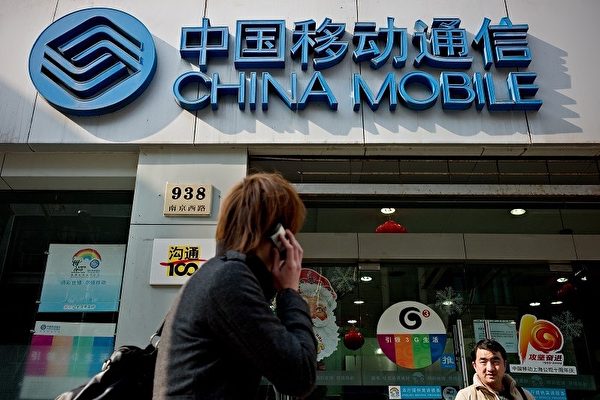
In the past month, at least six executives from the Chinese telecom giant, China Mobile Group, have been under investigation. Among them are Gao Zhixing, former Vice President of Guangdong Mobile, and Fang Li, former chairman of China Mobile (Suzhou) Software Technology Co., Ltd. China Mobile is known as the territory of interest for Jiang Mianheng, the eldest son of the former leader of the Communist Party, Jiang Zemin, who was once called the “Telecom King of China.”
On May 12, 2026, “Qingfeng Heze” reported that Liu Lujun, former Vice Chairman of the Labor Union of China Mobile Communications Group (China Mobile) Shandong Company Zibo Branch, and Li Guojie, former Deputy Manager of the Government-enterprise Customers Center of the Government-enterprise Customers Department, are suspected of serious violations of discipline and law and are under investigation.
According to the report from the public account “Operator Observation,” Liu Lujun previously worked at the Heze Post and Telecommunications Bureau and later transferred to Heze Mobile, where he served as Deputy Manager of the Marketing Department. After 2012, Liu Lujun switched to the labor union, serving as Vice Chairman, overseeing the daily work of the union for a long time. Rumors suggest that he was involved in shady dealings in areas such as materials procurement, project partnerships, and allocation of aid funds, benefiting affiliated businesses and receiving perks.
Li Guojie previously worked in the county company under Heze Mobile, responsible for government-enterprise work. After 2022, he switched to the Government-enterprise Customers Center of Heze Mobile, serving as Deputy Manager.
On May 11, 2026, the official website of the Central Commission for Discipline Inspection and the National Supervision Commission of the Communist Party of China reported that Gao Zhixing, former Party Committee Member and Vice President of Guangdong Mobile, is under investigation for serious violations of discipline and law.
According to public records, Gao Zhixing, born in 1962, graduated from Beijing University of Posts and Telecommunications (now Beijing University of Posts and Telecommunications) as a senior engineer. He previously worked at the Guangdong Provincial Post and Telecommunications Administration and joined China Mobile Guangdong Company after its establishment in 1999. He held positions such as General Manager of the Marketing Department, General Manager of the Shenzhen Branch, and Vice President of Guangdong Mobile since 2005. Around 2020, Gao Zhixing retired due to age reasons.
As a core provincial-level company within the China Mobile system, Guangdong Mobile has seen several executives investigated in recent years.
On June 21, 2023, Ge Lei, a member of the Party Committee and Vice President of Guangdong Mobile, was investigated, and in December 2023, he was dismissed. Ge Lei, born in 1972, had previously served as Vice General Manager of Yunfu Branch, General Manager of Heyuan Branch, and General Manager of Guangzhou Branch before being promoted to a member of the Party Committee and Vice President of Guangdong Mobile in 2020.
On June 2, 2024, Wei Ming, former Party Secretary and Chairman of Guangdong Mobile, was investigated, and in December 2024, he was dismissed. Wei Ming had served as Chairman and General Manager of Shanxi Mobile, Chairman and General Manager of Henan Mobile, and General Manager and Chairman of Guangdong Mobile.
According to a report by the Southern Metropolis Daily, as early as 2013, Xu Long, former Chairman of Guangdong Mobile, was investigated and later sentenced to life imprisonment, revealing a glimpse of the corruption case at Guangdong Mobile. Subsequently, several other high-ranking executives at Guangdong Mobile, including Zheng Chuan, former Vice General Manager, and Liang Chunhuo, former Party Secretary of the Guangzhou Branch Company, fell one after another. The individuals involved in the scandal ranged from the provincial company to the city branch company at various levels, with the amount of misconduct and violation of laws and regulations amounting to billions. The fields of project bidding and equipment procurement became hotspots for corruption.
Gao Zhixing had long been employed at Guangdong Mobile and had connections with the above-mentioned dismissed executives.
On the day Gao Zhixing was investigated, on May 11, 2026, Cao Jianghong, former General Manager of the Infrastructure Engineering Office of China Mobile Sichuan Company, was also investigated.
According to public records, Cao Jianghong, born in March 1966 from Anhui Wangjiang, had previously worked at Sichuan Post and Telecommunications Design Institute and the Provincial Post and Telecommunications Administration. In May 2002, he joined China Mobile Sichuan Company and held various positions within the company before assuming senior roles in project management starting in December 2022.
On April 13, 2026, Fang Li, former Party Secretary and Chairman of China Mobile (Suzhou) Software Technology Co., Ltd. was investigated.
Public records show that Fang Li, born in 1973, had worked at the China Mobile Design Institute for many years before assuming positions such as Deputy General Manager of the Government-enterprise Customers Department and the Government-enterprise Customers Branch Company of China Mobile. In 2021, Fang Li was transferred to become the Deputy Secretary of the Party Committee of Jiangsu Mobile. In August 2022, he was appointed Deputy Secretary of the Party Committee and General Manager of China Mobile Software Technology Co., Ltd. (China Mobile Cloud Capability Center), and by the end of 2024, he was appointed Secretary of the Party Committee and Chairman.
On April 16, 2026, Hong Xiaoqin, former Party Secretary, Chairman, and General Manager of China Mobile Internet Co., Ltd. was also investigated.
Public information indicates that Hong Xiaoqin, born in 1964, a senior engineer, had held leadership positions at Guangdong Mobile and Inner Mongolia Mobile. In September 2015, Hong Xiaoqin became the General Manager of the Internet company (Chou) (now China Mobile Internet, Ltd.), and later served as its first General Manager.
According to reports, from the second half of 2025 to date, several other high-ranking executives from China Mobile have also been investigated.
On January 21, 2026, Li Yannian, former General Manager of the Development Strategy Department of China Mobile Qinghai Company was investigated.
On November 28, 2025, Yuan Jianguo, former Party Secretary, Chairman, and General Manager of China Mobile Henan Company was investigated.
On August 19, 2025, Han Wei, a member of the Party Committee and Vice General Manager of China Mobile Inner Mongolia Company, was investigated.
On August 1, 2025, Sun Chao, a member of the Party Committee and Vice General Manager of China Mobile Yunnan Company, took the initiative to cooperate while in office.
According to a report by the Southern Metropolis Daily on May 11, 2026, in recent years, the cleansing storm of the three major telecom operators (China Mobile, China Unicom, China Telecom) has continued to escalate, covering multiple levels from group headquarters, provincial companies, city branch companies, and specialized subsidiaries. According to incomplete statistics, since 2025, at least 16 executive officers of telecom operators have been investigated, including Vice General Managers of the group and General Managers of provincial companies.
In February 2025, Cao Xingxin, former Vice General Manager of China Unicom Group, was dismissed; in June, Zheng Chengyu, former General Manager of China Telecom Sichuan Company, was also dismissed. In January 2026, Wu Yufan, former General Manager of Changde Branch Company of China Unicom, was investigated; in February, Sun Chao, former Vice General Manager of China Mobile Yunnan Company, and Han Wei, former Vice General Manager of Inner Mongolia Company, were dismissed; in April, Jiang Zhaofeng, former General Manager of China Electric Wanwei Ltd., and several other executives were investigated successively.
It is worth noting that China Mobile and even the China Telecom system are the territories of interest controlled by Jiang Mianheng, the son of former Communist Party leader Jiang Zemin.
According to the book “The Man Jiang Zemin,” as early as 1994, Jiang Mianheng used millions of RMB in “loans” to buy the Shanghai Lianhe Investment Company (Shanghai United Investment Company), worth over a hundred million yuan from the Shanghai Economic Commission, and became its chairman and legal representative, starting his “Telecom Kingdom” career.
Shanghai United Investment Company appeared to be a state-owned enterprise, but in reality, it was Jiang Mianheng’s private property. As he was Jiang Zemin’s son, he had money and power, and he made profits without losses in business dealings, attracting overseas Chinese and Western businessmen to visit or collaborate with him. Within a few years, Jiang Mianheng had built his extensive “Telecom Kingdom.” In November 1999, an article in The Wall Street Journal referred to Jiang Mianheng as a “revolutionary in the telecom market.” By 2001, Shanghai United Investment and its affiliated companies had grown to more than ten, such as Shanghai Information Network, Shanghai Cable Network, and Wincom.
Before the establishment of China Telecom (Great Telecom), Jiang Mianheng was the “Telecom” boss. In the 2002 restructuring of the China Telecom industry, Jiang Zemin personally ordered China Telecom to split into two parts, dividing it into “Northern Telecom” and “Southern Telecom,” and transferred the fixed assets of the “Northern Telecom” in ten provinces to “Telecom.”
In 2008, China Unicom merged with China Telecom to establish a new Unicom company, comprising Great Telecom and Unicom’s personnel.
Through his management of Great Telecom, Jiang Mianheng established extensive capital and business interactions with China Unicom, China Mobile, and other telecom operators during the restructuring, deeply controlling the China Telecom system, earning him the title of the “Telecom King of China.”
Furthermore, while serving as Vice President of the Chinese Academy of Sciences, Jiang Mianheng was responsible for high-tech research and development. The research institutions and enterprises under the Chinese Academy of Sciences (such as Sugon) established long-term technical support and service cooperation with the three major telecom operators, with China Mobile being an important data center and equipment procurement customer.
During Jiang Mianheng’s term at the Shanghai Branch of the Chinese Academy of Sciences and his promotion of “collaboration between the academies and the municipalities,” the Chinese Academy of Sciences, the Shanghai municipal government, and the three major telecom operators (including China Mobile) jointly laid out significant research infrastructure such as the “Shanghai Internet of Things Center.”
Due to their expertise and monopolistic nature, executives of the three major telecom operators often rotated positions interchangeably. Jiang Mianheng’s former colleagues from Great Telecom were scattered across the three major telecom operators. For instance, in December 2009, Zhang Chunjiang, Party Secretary and Vice President of China Mobile, who was later dismissed, had served as General Manager of Great Telecom and led the integration and restructuring of Great Telecom with Small Telecom and Jitong Company. In December 2015, Chang Xiaobing, Party Secretary and Chairman of China Telecom, had long served as the Chairman of China Unicom. Both Zhang Chunjiang and Chang Xiaobing were close confidantes of Jiang Mianheng.
The current General Manager of China Mobile, Chen Yangfan, had long worked at China Unicom, assuming positions such as General Manager of the International Business Center at Shanghai Branch of China Unicom, General Manager of the Information Security Department at China Unicom, General Manager of the Internet Operations Department at China Unicom, General Manager of the Industry Internet Products Center at China Unicom, and Party Secretary and General Manager of China Unicom Guizhou Branch.