
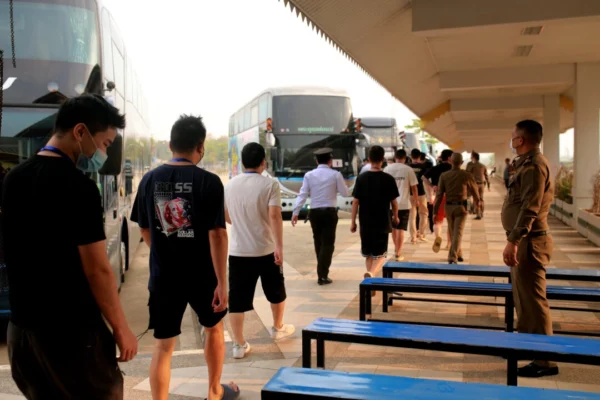
The Chinese authorities on Thursday (January 29) announced the execution of 11 individuals linked to the Myanmar “cyber fraud garden” scam group. Taiwanese legislator’s on-site investigation of the “cyber fraud garden” revealed that the fraud group is driven by Chinese Communist Party (CCP) forces.
According to reports from Chinese state media, on September 29, 2025, the Intermediate People’s Court in Wenzhou City, Zhejiang Province, sentenced 11 members of the Ming family criminal group, including Ming Guoping, Ming Zhenzhen, Zhou Weichang, Wu Hongming, Wu Senlong, and Fu Yubin, to death for charges such as intentional homicide, intentional injury, illegal detention, fraud, operating illegal gambling establishments, among others.
These 11 individuals were found guilty of killing 14 Chinese citizens and running a telecommunications network fraud and gambling operation exceeding 1 billion yuan (approximately 140 million USD).
After the first trial, the defendants appealed, but the High People’s Court of Zhejiang Province rejected the appeal on November 25, 2025, upheld the original ruling, and reported to the Supreme People’s Court for approval.
On January 29, the Intermediate People’s Court of Wenzhou City issued a statement announcing that after approval from the Supreme People’s Court, the executions of the 11 individuals were carried out.
Among those executed, were Ming Guoping and Ming Zhenzhen, members of the Ming family, who were identified by the court as leading the fraud and gambling operations. Other crucial members included Zhou Weichang, Wu Hongming, and Luo Jianzhang.
These members were arrested by the authorities in Myanmar in November 2023. Subsequently, members of the Ming family were handed over to the Chinese side.
In recent years, fraud groups have rapidly expanded in Southeast Asia, establishing large-scale operations, particularly concentrated in Myanmar, Cambodia, and Laos, known as “cyber fraud parks.” These parks utilize deceived, kidnapped, trafficked, and voluntarily supplied labor to carry out telephone and online fraud on global victims, involving scams related to false romantic relationships, cryptocurrency investments, and more.
Initially targeting Chinese-speaking populations, these fraud groups have expanded to multiple languages, stealing amounts reaching billions of dollars.
The United Nations Office on Drugs and Crime estimates that the global scam industry employs hundreds of thousands of people, with the sector spreading from Southeast Asia to South America, Africa, the Middle East, Europe, and the Pacific region.
Testimonies from released workers reveal that within these heavily guarded parks, violence such as beatings and torture is commonplace, and many foreign workers are trafficked and forced to work.
The Ming family is one of the main criminal families in the Laukkaing area of Myanmar, transforming the town from a poor border town to a hub for gambling, red-light districts, and online fraud centers. Their empire collapsed in 2023 when ethnic armed groups clashed with Myanmar’s military, controlling Laukkaing where members of the Ming family were arrested and handed over to the CCP. Family patriarch Ming Xuechang attempted suicide while trying to evade arrest the same year.
The Supreme Court of the CCP stated that the Ming family’s fraud and gambling operations generated over 10 billion yuan in revenue from 2015 to 2023. Apart from the 11 individuals executed, over 20 other Ming family members were sentenced to five years to life imprisonment last September, while five were sentenced to death with a two-year suspension, and another 23 were imprisoned.
The Ming family members are the first major Myanmar fraud leaders that the CCP has executed, but they might not be the last. In November last year, five members of the Bai family were also sentenced to death for similar crimes; the trials involving the Wei and Liu families are still ongoing.
A report released in November 2025 by the U.S.-China Economic and Security Review Commission (USCC) revealed that Chinese criminal groups have established vast cyber fraud parks in different parts of Southeast Asia, with Myanmar being a highly affected area. The CCP utilizes Myanmar’s fraud parks to expand its diplomatic and security influence and access personal sensitive data of Americans.
Taiwan Democratic Progressive Party (DPP) New Taipei City Councilor Lin Bingyou recently conducted an on-site investigation at the notorious Myanmar Myawaddy “cyber fraud garden” and posted multiple photos on Facebook. In an interview with the Epoch Times, he stated that behind the cyber fraud garden is the involvement of CCP forces, as local residents informed him that the fraud group is driven by the CCP’s “Fujian Gang.”
Lin Bingyou previously mentioned on Facebook that the “cyber fraud industry involves China (CCP) and is a product of China’s (CCP) geopolitical exports.” “From China’s (CCP) ‘Belt and Road’ exports, ultimately it all becomes ‘China’s (CCP) backyard’,” ultimately resulting in so-called “cyber fraud heaven.”