
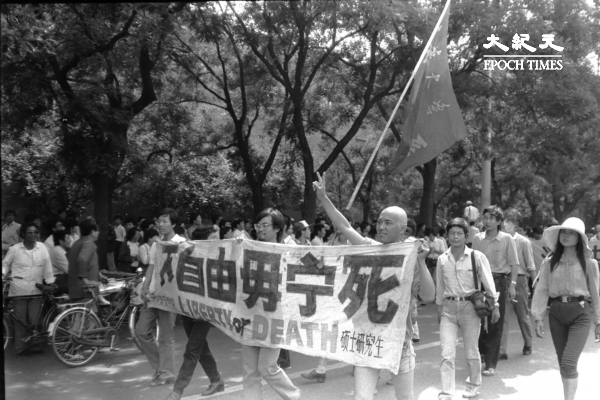
On the eve of the 37th anniversary of the June 4th Tiananmen Square massacre, various security personnel in mainland China have initiated political stability measures. Dissidents in Beijing, Hunan, Guizhou, and other areas have had their freedom restricted, with some individuals being asked to leave their residences for a “vacation” while others are being kept under surveillance. Meanwhile, the “Tiananmen Mothers” issued a statement on the 37th anniversary of the June 4th incident, reiterating their demands for truth, compensation, and accountability.
Entering the year 2026 marks the 37th anniversary of the June 4th tragedy that occurred in Beijing on June 3rd and 4th, 1989. This event, ordered by the few in power at the time and carried out by the military, involved the suppression of peaceful demonstrators, including students and civilians. As victims of the June 4th tragedy, the “Tiananmen Mothers” appeal to the government to resolve the lasting trauma and issues from that year in a peaceful and rational manner through legal means, and to provide justice to each family of the deceased.
Dissidents in many areas of China have reported that since late May, national security personnel have visited or called them in advance, instructing them not to go out, gather, or accept interviews from overseas media around June 4th.
A dissident in Beijing, Mr. Liu, mentioned, “In recent days, the police have been following me closely. Wherever I go, they follow. The national security personnel told me not to participate in gatherings during the June 4th period and not to publish anything online. They said, ‘Please cooperate with us,’ claiming they have no choice.”
Mr. Liu stated that many people have been put under surveillance this year, with few being sent away for “vacation.” He added, “I heard that even the national security personnel wanted to go on vacation, but due to budget constraints, only prominent figures directly related to June 4th, such as Gao Yu, were allowed to ‘travel.’ Others are being kept under surveillance.”
Being “put under surveillance” is a common method within the mainland’s stability system. Public security, national security, street officials, community workers, or security guards monitor the subjects near their residences, restricting their movements and social activities.
A rights activist in Beijing, Mr. Chen, said, “I was put under surveillance a few days ago, and it started early. Two security guards sit in the corridor around the clock. Whenever I go out, they follow. They claim to care, but in reality, they just keep an eye on you. They are most afraid of anyone mentioning the events of June 4th or people gathering to discuss it. They are fearful and guilty about June 4th.”
A rights activist in Hunan, Mr. Huang, mentioned that national security agents have called multiple times recently, instructing individuals not to leave the area and not to meet with friends from other places. He said, “I heard from friends in Guangxi, Chengdu, and Chongqing that the national security personnel made it clear not to wander these days and to be “invited for tea” on June 4th to keep people under control. Previously, they used to take people out for a few days at this time but it’s not the case anymore.”
“Being sent on ‘vacation'” is another common stability measure around the time of June 4th. Public security or national security personnel take dissidents, rights activists, or eyewitnesses of June 4th away from their homes under the pretext of traveling, recuperating, or having discussions until after June 4th. In recent years, some places have resorted to on-site surveillance to cut down on accommodation and transportation costs but without loosening control over the individuals involved.
Members of the China Democracy Party in Zhejiang, who were suppressed by authorities in the past as an “illegal organization,” have become high-priority control targets for national security. A dissident, requesting anonymity, revealed that Xu Guang, a former leader in the June 4th movement newly released from prison, along with Chen Shuqing, who was released last year, are among those whose freedoms are being restricted by the authorities: “Chen Shuqing, Mao Qingxiang, Xu Guang, Lu Gengsong, and me – around ten people have been under control. The national security personnel said not to use VPN recently and not to speak in group chats. I said that speaking is a citizen’s right; the constitution guarantees freedom of speech. The national security personnel replied, ‘Don’t lecture me on principles; this is not a place for reasoning. The Communist Party decides.'”
On the 37th anniversary of the June 4th incident, the Chinese Communist Party has not publicly explained the security arrangements leading up to June 4th. Rights activists in Shanghai and Chengdu mentioned that they have been restricted from their freedoms starting this week, with community workers informing them that normal activities will resume only after June 5th.