
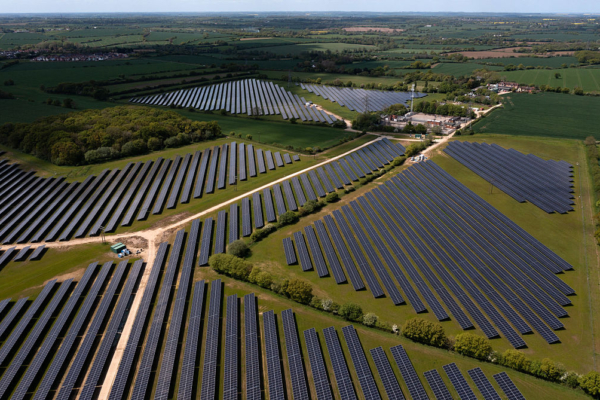
On Monday, June 22, Julia Tréhu, the Technology Project Manager and Researcher at the German Marshall Fund of the United States (GMF), published an article emphasizing the importance of Europe reducing its reliance on China in order to develop its own renewable energy technologies. Tréhu highlighted that Europe’s pursuit of true energy independence and reclaiming its former industrial leadership position hinges on breaking away or lowering dependence on China.
Tréhu pointed out how China, through massive national efforts and generous domestic subsidies, has rapidly expanded global markets for solar energy, wind energy, electric vehicles, heating and cooling systems, grid technologies, and batteries. Currently, approximately 80% of global solar energy capacity, 76% of batteries, 64% of wind power products, and 75% of electric vehicles come from China. Consequently, some European countries view China’s cheap exports of renewable energy technologies as a shortcut to rapid decarbonization.
However, Tréhu warned that overreliance on these technologies not only poses network and national security risks to Europe but also damages the continent’s domestic manufacturing sector, weakening Europe’s energy sovereignty and public support for energy transition.
To bolster Europe’s competitiveness, expedite decarbonization, and enhance security, Tréhu stressed the need for substantial investments in cutting-edge technologies related to energy production, distribution, and storage within Europe.
For instance, in Europe’s renewable energy systems like solar and wind power, the converters responsible for converting direct current to alternating current, as well as their control software, primarily originate from Chinese suppliers. The digitization of grids has resulted in significant network security vulnerabilities, with imported equipment possibly containing undocumented communication devices. Concerns abound that these elements could be exploited by China to manipulate Europe’s electrical grids, given China’s military-civil fusion approach with its companies and requirements for cooperation in espionage and united front work.
In response to this challenge, Tréhu suggested that solar projects subsidized by public funds under the “Industry Acceleration Act” must utilize “Made in Europe” inverters, highlighting such targeted policies as crucial steps to reinforcing European industry and security.
Furthermore, initiatives such as the EU’s proposed “Technology Sovereignty Strategy” and updated laws on cybersecurity and resilience can effectively mitigate threats emanating from China’s supply chains to Europe’s critical infrastructure.
Addressing energy production, Tréhu recommended leveraging next-generation geothermal energy for electricity generation, potentially substituting for 42% of Europe’s fossil fuel demands and reducing dependence on imported fossil fuels. Geothermal energy has been included as one of the eight key technologies in the EU’s “Clean Industry Act”.
With 40% of Europe’s grids operating for over 40 years requiring an estimated €5.84 trillion for refurbishment, the integration of grid enhancement technologies like sensors, flow control devices, and smart meters can enhance grid transport, increase capacity, and optimize resource efficiency and energy distribution.
Tréhu also proposed establishing more “Virtual Power Plants (VPPs)” consisting of decentralized energy networks across European countries to stabilize peak periods for electrical grids and diminish reliance on fossil fuels.
Europe currently leads globally in the VPP sector with 42% of global installed capacity, and most operators are European-based companies. Expanding VPP construction could effectively reduce policy discrepancies among EU member states.
Lastly, as renewable energy production escalates, the development of new energy storage solutions becomes imperative. However, Europe’s current use of graphite, processed lithium, manganese, and other materials for energy storage equipment heavily relies on China. Any potential threat from China leveraging these materials could impede Europe’s progress in renewable energy development.
Tréhu proposed that by investing in emerging storage technologies like sodium batteries, compressed air energy storage, pumped hydro storage, and thermal energy storage, Europe could diversify its energy storage methods and reduce dependence on China.
In conclusion, Tréhu urged the EU to combine economic and trade policies such as the “Industry Accelerator Act,” “Critical Raw Materials Act,” “International Procurement Tools,” “Counter-Coercion Tools,” and “Foreign Subsidies Regulations” to address the fragmented regulations in the European single market, eliminating investment and expansion barriers for European businesses. Only through such measures can Europe counter dumping practices and effectively develop its own renewable energy technologies.