
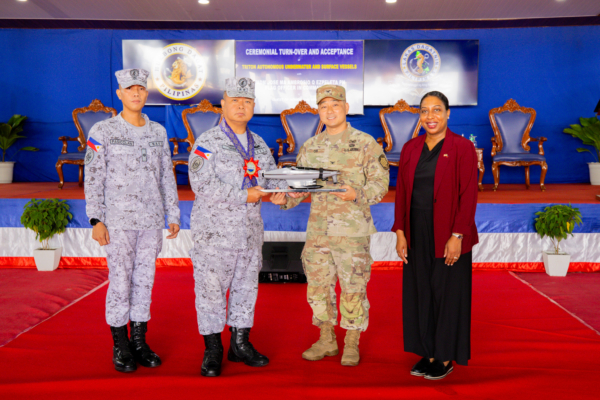
The United States government recently handed over four Triton Autonomous Unmanned Surface Vessels (Triton AUSVs) to the Philippine military, aiming to enhance the Philippines’ maritime situational awareness and maritime monitoring capabilities, further advancing the modernization of the US-Philippine alliance.
According to a statement released by the US Embassy in the Philippines on Tuesday (June 23), the equipment, valued at approximately 754 million Philippine pesos (about 13 million US dollars), highlights Washington’s commitment to the security of its ally, the Philippines.
The turnover ceremony took place at the Subic Naval Base of the Philippine Navy, where Bridgette Walker, the Charge d’Affaires ad interim of the US Embassy in the Philippines, Senior US Defense Official Colonel Daniel Oh, and representatives from the Philippine Navy were present.
The Triton system, developed by the US-based Ocean Aero company, is powered by solar energy and can operate continuously for up to 30 days without the need for crew intervention. It has both surface navigation and underwater submergence capabilities, with on-board communication systems including anti-jamming radio mesh network, enabling the gathering of surface and underwater data for tasks such as intelligence gathering, surveillance, and reconnaissance.
This system can provide real-time information for vast maritime areas, helping the military improve tactical and operational decision-making. Given its long endurance, autonomous operation, and cost-effective deployment, unmanned maritime systems have become crucial tools for enhancing maritime surveillance capabilities for multiple countries in recent years.
During the handover ceremony, Walker emphasized that the future of maritime security depends not only on the quantity of platforms but also on capabilities, speed, and coverage. She highlighted the vast and competitive nature of the Indo-Pacific region, with the Philippines being situated at its core, facing challenges such as illegal fishing, “gray zone” activities, and threats to freedom of navigation. Addressing these challenges requires continuous and long-term maritime surveillance capabilities, which cannot be achieved solely through a single ship or aircraft.
Walker pointed out that the Triton system will help the Philippine Navy expand its monitoring range of critical waterways, filling the existing gap in maritime surveillance capabilities.
Colonel Daniel Oh stated that this delivery reflects the achievements of US-Philippine defense cooperation, contributing to enhancing Philippine maritime surveillance capabilities and regional deterrence. He mentioned that the US will assist the Philippines in integrating, utilizing, and providing logistical support for the relevant systems to ensure the new capabilities can be effectively utilized in actual missions.
Ocean Aero is a US-based marine autonomous systems technology company headquartered in San Diego, California, focusing on the development of autonomous underwater systems. Its flagship product, the Triton system, can navigate on the ocean surface and submerge underwater for missions. The system can be utilized in areas such as ocean monitoring, intelligence, surveillance, and reconnaissance (ISR), maritime situational awareness, maritime security, and marine scientific research, providing technical support for underwater monitoring and anti-submarine missions.
This delivery comes at a time when tensions between the Philippines and China over the South China Sea dispute have escalated again. Recently, China set up a floating facility near Scarborough Shoal (known as Huangyan Island to the Philippines), prompting the Philippines to express dissatisfaction and lodge diplomatic protests. The Philippine government stated last week that China has removed the facility, while the Chinese side claimed it was used for scientific research.
Additionally, Chinese authorities have announced sanctions against Philippine Defense Minister Gilberto Teodoro, further exacerbating bilateral tensions.
As longstanding treaty allies, the US and the Philippines have been strengthening military cooperation in recent years. In mid-June, the two countries conducted joint maritime exercises in the South China Sea, involving operations by the Coast Guard and air forces to enhance their joint combat capabilities.
The South China Sea is one of the world’s most important maritime trade routes, with approximately $3 trillion worth of international trade passing through the waters each year. China claims sovereignty over most of the South China Sea, but a 2016 Permanent Court of Arbitration ruling based on the United Nations Convention on the Law of the Sea found China’s claims lacked legal basis.
However, Chinese authorities have consistently refused to acknowledge the ruling. The Philippine Department of Foreign Affairs has reiterated multiple times that the arbitration ruling holds legal weight.
(This article referenced relevant reports from Reuters)