
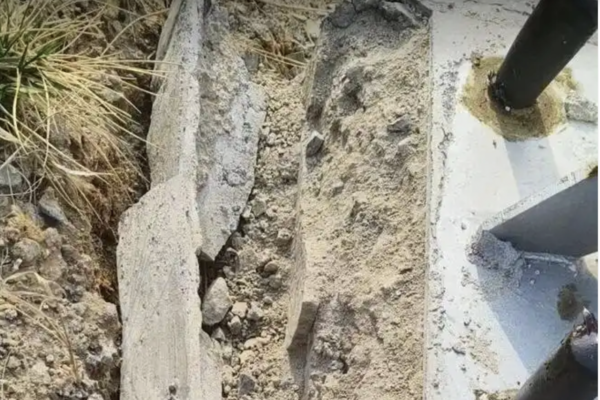
In recent days, serious construction quality issues were exposed in the key project “Beidou High-precision Major New Infrastructure Smart Monitoring System” of the Chinese Communist Party. Along the Shandong Jiwei Expressway, many monitoring equipment bases were not constructed according to the design drawings; some bases were filled with a large amount of rubble inside and only covered with a thin layer of cement mortar on the outside. The contractor had previously promised to complete rectification, but many problems still exist, sparking doubts from the public about the construction quality and the use of funds.
According to reports from media such as “Yangcheng Evening News” and “Elephant News,” the project was approved by the National Development and Reform Commission of China in 2023, with a total investment of nearly 300 million yuan (RMB). Among this, 45 million yuan of central budget funds were allocated, and it was undertaken by Shandong Expressway Information Group. Shandong Expressway Information Group is a subsidiary of Shandong Expressway Group, one of the Fortune Global 500 companies, with assets exceeding 1.8 trillion yuan and operating and managing 9,240 kilometers of expressways.
According to the construction plan, the construction party was required to install a total of 5,000 sets of Beidou monitoring terminals at various locations such as slopes, roadbeds, and bridges within the jurisdiction of the expressway in Shandong Province. The entire Jiwei Expressway was included in the key monitoring range.
The design drawings specified that the equipment on the slope platforms should have a 20 cm high, C30 strength grade concrete integral base with a burial depth of no less than 60 cm underground, and the gaps must be strictly filled with cement mortar. C30 concrete can withstand a pressure of 300 kg per square centimeter – equivalent to the weight of a small car, which is the basic safety threshold in the construction industry.
Recently, an anonymous insider reported to the “Yangcheng Evening News” that the construction quality of the Beidou high-precision monitoring project under construction on the Jiwei Expressway severely failed to meet the standard, with many construction sites not following the official design drawings, posing significant quality risks.
After receiving the tip-off, journalists from the media visited the Jiwei Expressway in May to conduct on-site inspections. In the vicinity of Dongbaoshan in Zichuan District, Zibo City, there were scattered remnants of demolished monitoring equipment bases. These concrete remnants were of extremely poor quality, with a large amount of rubble impurities mixed inside, far from meeting the basic standards for construction foundation strength.
In the surrounding areas of Shanzuaitou Village in Zichuan District, the exposed construction problems were even more blatant. Multiple monitoring equipment bases were not constructed with standard procedures for overall reinforced concrete pouring. Instead, construction personnel directly filled the bases with large pieces of rubble, only thinly covering the surface with a layer of cement mortar to disguise and deceive compliance.
After identifying the relevant quality issues, journalists officially reported all problems to the project contractor, Shandong Expressway Information Group, in late May. They were told that all issues would be “completely rectified by June 10.” However, on June 13, the journalists revisited the sections of the expressway involved. With a hammer in hand, a light tap caused the concrete to crack and become loose; a gentle push with a hand, and it crumbled to pieces. The so-called “complete rectification” was just a superficial cover-up, making the base look flat on the surface but still filled with debris inside.
Continuing along the Jiwei Expressway, unchecked areas presented the same problems. The concrete crumbled with a touch, turned into powder with a hammer strike, filled with rubble, and camouflaged with a thin mortar layer. The quality status remained no different from before the rectification.
The report stated that this was not a matter of a construction team’s technical failure but a systemic falsification.
On June 12, a representative of Shandong Expressway Information Group stated, “The construction of the 5,000 sets of equipment is ongoing, and indeed, there was a part in the middle that did not meet the quality requirements.”
When asked, “The design drawings clearly require C30, how do you explain that?” the representative said, “It should be C10 or C15, definitely not C30.”
The report indicated that the contractor claimed it was C10 or C15, not the C30 as required by the design drawings – resulting in the compressive strength of the bases being halved or even two-thirds less. This was not a technical disagreement but a disregard for the design specifications.
Industry professionals in the construction sector interpreted that C30 concrete is commonly used in infrastructure projects, with fixed compressive standards capable of meeting the weight-bearing and weathering resistance requirements of outdoor equipment bases, ensuring the long-term stable operation of monitoring equipment. Combined with on-site image data analysis, the substandard strength of the bases and the significant deviation from the design drawing standards were typical cases of construction not following the drawings and failing to meet quality standards.
This project has formed a vicious cycle: report once, rectify a bit, yet the problems persist. Repeated dismantling and reworking, repeated cosmetics, all consuming national financial resources. The 300 million yuan turned into rubble filling; the 45 million central funds turned into surface plastering; the 5,000 sets of equipment turned into 5,000 hidden dangers.