
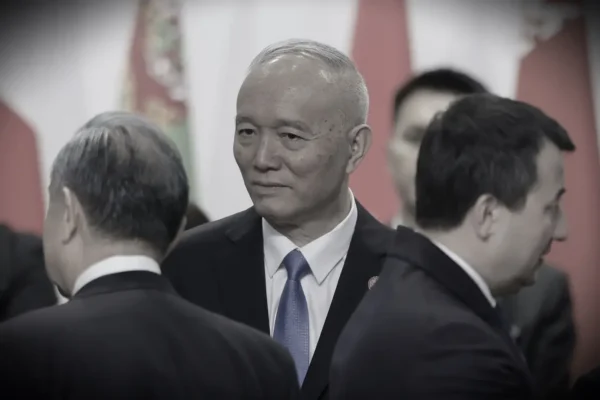
The political situation in China is quietly undergoing changes.
On June 15th, the National Party Building Work Symposium of the Chinese Communist Party was held in Beijing. Cai Qi, a member of the Politburo Standing Committee and Secretary of the Central Secretariat, attended the meeting and delivered a speech, along with Li Xi, a member of the Politburo Standing Committee and Secretary of the Central Commission for Discipline Inspection. Apart from the Minister of the Organization Department, Shi Taifeng, who chaired the meeting, other attendees included Liu Jinguo, Secretary of the Central Commission for Discipline Inspection.
This “National Party Building Work Symposium” is being held for the first time. Xi Jinping has put forward a series of so-called ideologies. At this meeting, a new party building ideology proposed by Xi was introduced for the first time, emphasizing it as an “important political task for the present and future periods,” while also requiring to “read the original texts, understand the principles, know the causes and reasons,” which blatantly signals another cult-style brainwashing movement.
Just a week after returning from North Korea, Cai Qi convened this party building meeting, which is highly unusual.
In early June, Cai Qi also took on the additional role of the President of the Central Party School, leading many to speculate about the expansion of his power. However, this statement is not entirely accurate, as Cai Qi has simply gained more direct control over the practical power of the Central Party School.
After the 19th National Congress of the Communist Party of China in 2017, the position of President of the Central Party School was held by Chen Xi, a member of the Political Bureau and Minister of the Organization Department at the time, which was considered a lower-ranking appointment. After the 20th National Congress of the Chinese Communist Party in 2022, Chen Xi served as the President in the capacity of an ordinary party member, indicating a more significant downgrade. Now, with a member of the Political Bureau once again appointed as the President of the Central Party School, it clearly signifies increased importance and implies forthcoming new initiatives.
During Xi Jinping’s visit to North Korea on June 8-9, revealing the new trend of cadre development in the Chinese Communist Party.
On the evening of June 8, during a large-scale cultural performance, Xi Jinping and Kim Jong-un were followed by officials applauding in unison, with coordinated movements as if being directed by an invisible rhythm.
On June 9, Xi Jinping visited the Central Party Cadres School of the Workers’ Party of Korea (the North Korean Central Party School). According to public reports, there has been no precedent for senior Chinese officials visiting the North Korean Central Party School, including when Liu Yunshan, the former President of the Central Party School of the Chinese Communist Party, visited North Korea in 2015.
Videos circulating on the internet show Xi Jinping visiting the North Korean Central Party School, pointing at Cai Qi and reportedly telling Kim Jong-un that Cai Qi had just been appointed as the President of the Central Party School. Cai Qi’s face revealed a rare smile. He appeared extremely flattering and humble before Kim Jong-un, nodding and gesturing in agreement. This Cai Qi in front of Kim Jong-un appeared entirely different from the stern-faced Cai Qi seen on domestic television.
Cai Qi had never visited North Korea before. The atmosphere created by Kim Jong-un made Cai Qi feel somewhat at home.
Comparing the Central Party School in Beijing, it is the highest institution where Communist Party officials are trained and educated. For over forty years, there have been ongoing training programs each year teaching Party members and officials how to uphold the Communist Party’s rule. Since Xi Jinping came to power, he personally addresses Party and state leaders annually at the Central Party School, cautioning against being “two-faced.”
However, Communist Party schools at all levels are akin to training grounds for corrupt officials. Many officials who have fallen from grace in recent years have undergone training at Party schools, leading netizens to jokingly refer to the Central Party School as the school with the highest crime rate in the world. Moreover, many officials who have been ousted were accused of violating political norms, disloyalty, “wrongly discussing the Central leadership,” or illegally reading political banned books.
The official magazine “Seeking Truth” recently published an article criticizing the Party for having “many problems of unclear recognition and weak action in adhering to Party leadership, as well as issues of weakening, diluting, and lightening the implementation of Party leadership.” It denounced issues such as wavering Party members’ beliefs, corruption, and hedonism.
This indicates that Xi Jinping and Cai Qi are very dissatisfied with the performance of the officials. Both Xi and Cai belong to a generation of leaders who experienced the political fervor of the Cultural Revolution.
Xi Jinping recently replied to elderly Party members, emphasizing the transmission of the so-called “red genes,” seeking a return to the ideological consciousness and worship of the supreme leader from the Mao Zedong era. The official Chinese media recently arranged a visit by the British Ambassador to China to Yan’an and Liangjiahe, exposing Xi Jinping’s nostalgia for the old times.
The situation in North Korea is closer to the Mao era of the Chinese Communist Party. As the newly appointed President of the Central Party School of the CCP, Cai Qi may have considered during his visit to North Korea how to reform the Central Party School upon his return to China, not only to further strengthen political norms and loyalty education superficially but also to ensure that officials’ attitudes towards Xi Jinping reach a fervent emotional state similar to how North Korean officials (and citizens) become emotional and even weep upon seeing Kim Jong-un.
Chinese students sponsored to study in North Korea in the past mainly focused on learning the Korean language and engaging in cultural exchange, rather than being specifically groomed for official positions. Cai Qi is now directly bringing back the experience of grooming cadres at the North Korean Central Party School to Beijing for practical use. This means that Chinese officials will be subjected to such influences.
According to public reports and testimonies from defectors, the greatest commonality among North Korean officials is absolute loyalty to the supreme leader, strict adherence to discipline, and ideological indoctrination. Compared to Chinese officials, North Korea emphasizes personal direct loyalty and public displays of allegiance to the leader, leaving very little personal autonomy.
North Korea employs a system of “guilt by association,” often punishing officials for three generations and utilizing terrifying methods such as “firing squad executions.” Actions that lead to punishment include criticizing the leader, contacts with foreign countries, reminiscing about “unification” or past policies, engaging in factional activities, failure to meet economic, agricultural, or military targets, and even minor offenses like dozing off in the presence of Kim Jong-un or general corrupt actions, and more.
North Korea emphasizes the supremacy of the party and the leader over the law more so than the Chinese Communist Party. Public trials for officials are rare, with most cases being handled internally or executed directly. In recent years, the Xi Jinping administration has increasingly favored handling officials internally, resorting to secret executions.
Against this backdrop, Cai Qi is now convening meetings with Li Xi, Secretary of the Central Commission for Discipline Inspection, and Liu Jinguo, Deputy Secretary of the Central Commission for Discipline Inspection, adopting a stance that suggests officials could be targeted under the guise of anti-corruption if they fail to meet expectations.
Of course, Cai Qi aims to emulate North Korea by beginning cadre development from the source. Once these trained officials are dispersed nationwide, the Chinese populace will also be affected.
Xi Jinping’s governance emphasizes reverting to the Mao Zedong-era “Maple Bridge Experience” of inciting the masses to struggle amongst themselves. With an existing high internet firewall, the authorities have recently escalated efforts to crack down on internet users circumventing censorship, signaling a regression. If China adopts a comprehensive, tight-knit system similar to North Korea, focusing on stringent political constraints, the entire bureaucracy will perceive it as a disaster, leading to only two possible outcomes: increased attempts to flee or insurgency among officials. The public will also react against the “North Koreanization,” hastening the collapse of the Chinese Communist Party!
These years of selective anti-corruption under Xi have left officials in a state of passivity. If the authorities choose to actively prevent passivity and enforce more stringent North Korean-style political control, the entire bureaucratic system will view it as a calamity, resulting in either a rush to flee or revolt. Eventually, the Chinese Communist Party will collapse!
(This article was first published by Epoch Times)