
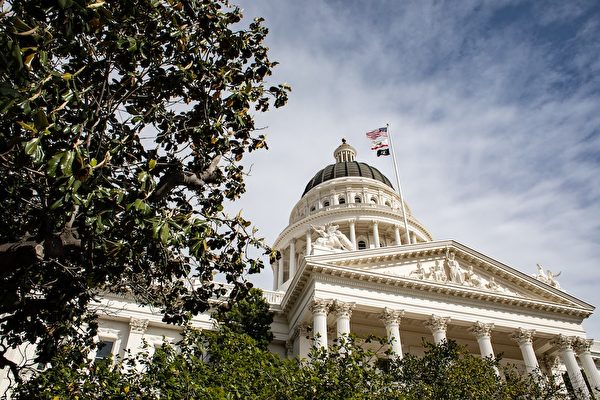
Under the absolute dominance of the Democratic Party, the California 2026-27 budget (AB109 bill) was finally passed on the statutory deadline of June 15. However, faced with the high budget of $355.9 billion, Republican senators and assembly members apparently had a lot to say.
On the 15th, Vice Chairman of the Senate Budget Committee, and 6th District Republican Senator Roger Niello, expressed that AB109 was a “framework” budget rushed to avoid a payday stoppage tomorrow. The Senate (10 Republicans) passed it by 28:9 with 3 abstaining votes, and the Assembly (19 Republicans) passed it by 60:19.
“California’s budget has nearly doubled in less than a decade, and when ordinary families struggle to afford housing, gasoline, groceries, and medical expenses, it is clear that California’s financial accounting system has problems,” Niello said. “The budget relies on new tax revenues and borrowing to balance, and requires working families to pay more for underperforming government projects.” On the same day, the parliament also passed SB122 (tax increase on digital software) and SB125 (tax increase on health care providers).
Senator Kelly Seyarto from the 32nd District spoke in the parliament: “Many taxes are ultimately borne by businesses, which often raise prices to offset losses or pay taxes. They talk big about reducing the cost of living, but their measures end up raising it.”
“What particularly troubles me is the additional $225 million to help the California Department of Transportation achieve ‘America’s Cleanest Fleet’ goal,” Seyarto said. “On top of the significant investment, the price of all-electric equipment is three times that of regular equipment, while its lifespan is halved; we have many overpasses, dangerous highways, and local roads in desperate need of repair funds.”
Despite ranking 49th in road construction and maintenance nationwide, Seyarto said, “They prioritize building ‘America’s Cleanest Fleet,’ which is simply absurd.”
“$1.9 million may seem trivial, but it is used to add 8 positions to the California Energy Commission (CEC) to continue advancing regulations and requirements for gasoline refineries,” Seyarto said. “In recent years, California has enacted one after another law aimed at suppressing refineries, leading to a decrease in the number of refineries in California, another example of our wasteful spending.”
According to the U.S. Energy Information Administration (EIA), in 2026, California has only 13 refineries left; in 1982, there were 43 operating refineries in California, 21 in 2006, and 18 in 2016.
With refineries closing or moving out, California is forced to rely on imported energy. Between November 25 and December 14, 2025, about 1.32 million barrels of gasoline and motor gasoline blend components (MGBC) were shipped to California ports, with over 1 million barrels coming from the Bahamas (transit), sourced from various countries around the world.
Senator Tony Strickland from the 36th District issued a statement opposing the temporary budget proposal on the 15th, “California’s problem is not insufficient income, but extravagance and waste.”
“The Democratic senators will leave a structural deficit for the next governor because they refuse to live within their means,” Strickland said. “Although they often talk about ‘affordability,’ their improper prioritizing in this budget is of no benefit to California families and businesses.”
“The budget neither suspends the collection of gasoline tax (increasing to $0.634 per gallon after July 1), nor repays the federal government’s billions of dollars in unemployment insurance debt, nor provides substantial additional funding for Proposition 36 (public safety),” Strickland said. “In fact, Democratic lawmakers prioritize $19 million for dental insurance for undocumented immigrants.”
He cited examples of wasteful spending including:
1) Giving $42.4 million to the California High-Speed Rail Authority (with a budget of $23.1 billion, seven times the budget 18 years ago).
2) Allocating $20 million to the Governor for the “Diaper Access Initiative”; reports indicate the state government purchases at $0.5 per piece while Target supermarket retails at $0.16 per piece.
3) Allocating an additional $10 million to the California Attorney General to increase the total budget for suing the federal government to $81 million.
4) Giving $5 million to the UCLA to support their “Voting Rights” project, to litigate against voting regulations in various states.
Assemblyman Carl DeMaio from the 75th District criticized the state budget as “reckless” on the 15th. He listed major factors in the budget that will lead to a significant increase in the cost of living:
1) Tax increases: Measures exceeding $3.5 billion in tax increases, including imposing new sales tax on computer software purchases, and continuing to raise payroll taxes for every employee in the state. DeMaio said, “Rather than cutting wasteful expenditures, politicians pass the budget to indirectly ‘squeeze’ every taxpayer and increase the difficulty of their employment.”
2) Rising health insurance premiums: Democratic lawmakers rejected Republican proposals to stabilize healthcare insurance premiums and instead imposed new healthcare insurance taxes, worsening the situation. DeMaio said, “Every family’s health insurance premium will rise by about $400— all to provide $13 billion worth of free medical services to illegal immigrants by Governor Newsom and California Democrats!”
3) “Absurd regulations and mandatory requirements are the main reasons for the high cost of living in California,” and the budget does not include any relevant reform measures. DeMaio said, “From fire insurance fees to affordable housing construction costs, emergency room visits, or even daily dining expenses, the state budget allows bureaucrats to continue exploiting useless and costly absurd regulations from every California resident.”
4) Rising oil prices: The state budget allows for another increase in fuel taxes, rejects regulatory reform measures aimed at lowering oil prices, “meaning ordinary drivers will see their annual cost of living increase by $1,747.20.”
Senator John Laird, a Democrat from the 17th District and Chairman of the Budget Committee, stated on the 15th that California cannot replace federal funding originally intended for healthcare, food assistance, and public education but can responsibly shrink it and provide additional funding, including delaying cuts to California’s Medicaid program for a year, while using additional revenues to balance over the next two years, reduce the structural deficit, and maintain ample reserves.
Although the new fiscal year budget may appear to balance revenue and spending despite tax increases, it also shows facing a $10.3 billion deficit in 2028-29 and a $9.6 billion deficit in 2029-30. ◇