
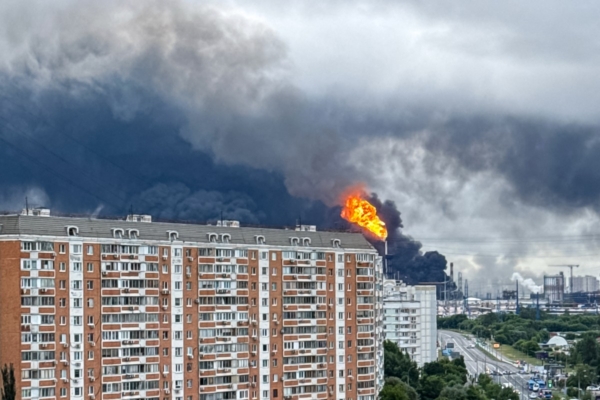
Ukraine is currently utilizing long-range drones to launch attacks on Russian oil refineries, resulting in limited fuel sales for the Russian side, soaring gasoline prices, and long queues forming at gas stations hundreds of miles away from the front lines. This has made the efforts of the Russian authorities to shield the public from the impacts of the ongoing four-year war more challenging.
This week, Ukrainian drones have repeatedly targeted a Moscow oil refinery that supplies over a third of the fuel to the Russian capital and its surrounding areas. The latest attack footage shared on social media on Thursday (June 18) showed a tank exploding, sending a massive fireball into the air with other parts of the refinery also engulfed in flames. These events have made it increasingly difficult for the Kremlin to maintain normal economic operations.
The Wall Street Journal reported on Saturday (June 20) that Russia is no longer disclosing official data on the processing of crude oil into fuel, and the duration for refineries to resume production after attacks is often unclear. External analysts estimate that the recent wave of attacks has led to a shutdown of over 20% of Russia’s refining capacity.
The International Energy Agency, headquartered in Paris, indicated in a report on Wednesday (June 17) that “this level of destruction is unprecedented in the history of Russian-Ukrainian conflicts.”
The most severely affected areas are those near the front lines, especially the Crimea Peninsula that Russia annexed from Ukraine in 2014.
In recent weeks, Ukrainian drones have targeted oil tanker trucks passing through other Ukrainian territories under occupation, leading to gasoline shortages in Crimea. Local authorities have implemented fuel rationing measures, including the use of QR codes where drivers must present a QR code to receive their allocated fuel quotas.
According to a report from the Russian independent media outlet The Bell this week, fuel purchase restrictions have expanded to 53 regions in Russia and occupied territories of Ukraine, reaching as far as the Arctic and Siberia. Many regulations prohibit drivers from purchasing more than one tank of fuel to prevent hoarding.
On Saturday, Ukrainian President Zelensky stated that Ukrainian drones had attacked an oil refinery in the Khanty-Mansi Autonomous Okrug in western Siberia, expressing gratitude for the special operations carried out by the Ukrainian military. He mentioned that “these operations have touched Khanty-Mansi. The target of this strike is also an oil refining facility. It is more than 2000 kilometers away from our border. This is very effective.”
Earlier, the governor of the Khanty-Mansi Autonomous Okrug had mentioned that Russian air defense forces repelled a drone attack on an oil refinery in the region.
Russian President Putin has made little comment on the fuel shortage issue. Following a meeting on Friday (June 19) specifically discussing the fuel market, the Russian cabinet stated that efforts are underway to ensure stable fuel supply.
Disgruntled Russian drivers have taken to social media to complain about the long wait times at gas stations. In a video shared this week on Telegram, a woman mentioned that she and her husband, along with their pet dog, waited for two and a half hours to refuel on the toll road between Moscow and St. Petersburg.
“Currently, people are willing to pay any price for gasoline,” a driver from Crimea said in a video shared on the Russian car enthusiasts’ Telegram channel on June 3.
Last year, similar drone attacks on refineries forced some regions of Russia to implement fuel rationing measures, but the attacks suddenly ceased in October.
According to Vladimir Milov, a former Russian deputy energy minister, with Ukraine targeting Russia’s largest and most modern refineries (which produce high octane gasoline using Western equipment that is difficult to replace), the recent attacks have become more effective.
“These 10 to 15 refineries are a very narrow and fragile target,” said Milov, currently living abroad as an opposition politician. “In short, if you attack them, it will lead to a crisis.”
Russia has also previously targeted Ukraine’s energy infrastructure. Last winter, Russia launched airstrikes on Ukrainian power grids and thermal power plants, leaving many Ukrainians without heating. Subsequently, the rapid advancement of Ukrainian drone technology has halted Russian attacks, despite Russia’s military being significantly larger than Ukraine’s.
In recent months, Ukraine has been using drones to target Russian petroleum export terminals in an attempt to prevent Russia from profiting from the surge in oil prices due to the US-Iran conflict, marking a bold move. However, the effectiveness of these actions has been mixed as Russia’s oil export volumes remain stable.