
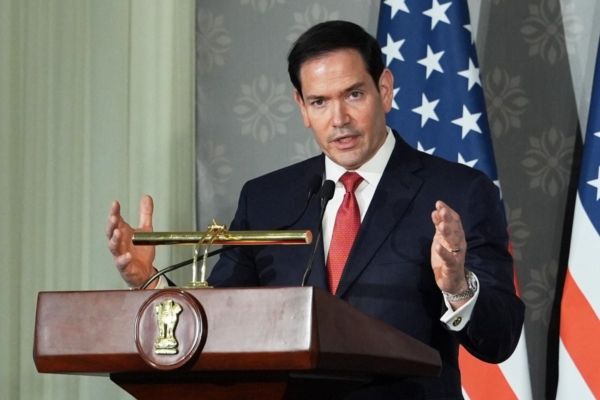
The US military is making efforts to maintain peace and security in the Strait of Hormuz. During a recent phone conference, US Secretary of State Marco Rubio informed the Indian Foreign Minister that all commercial ships attempting to transit this crucial waterway should unconditionally “immediately comply with US military instructions”.
According to the US State Department, Rubio had a phone call with Indian Foreign Minister Subrahmanyam Jaishankar on Friday (June 12). Just days ago, the US Central Command (CENTCOM) accused the oil tanker “Settebello”, flying the flag of Palau, of attempting to transport Iranian oil, in violation of the US military blockade of Iranian ports.
The US Central Command stated that in the Gulf of Oman, “due to the failure of the crew to comply with US military instructions, a US military aircraft launched a precision-guided weapon at the ship’s bridge.” The Indian Minister of Shipping confirmed on Thursday (June 11) that three Indian sailors onboard were unfortunately killed in the US attack.
The deadly attack has sparked dissatisfaction on the Indian side. On Friday, India stated that Jason Meeks, the Acting Chargé d’Affaires of the US Embassy in India, had been summoned to the Indian Foreign Ministry. India expressed “strong protest” to the US and deep concern over the US military’s use of “lethal and destructive force” against civilian shipping.
US State Department Principal Deputy Spokesperson Tommy Pigott issued an official briefing on Saturday (June 13), stating: “Secretary of State Marco Rubio spoke with Indian Foreign Minister Subrahmanyam Jaishankar yesterday. The two officials discussed the recent events in the Strait of Hormuz.”
Pigott added, “The Secretary emphasized that as the US military strives to maintain peace and security in the strait, all commercial ships should immediately comply with US military instructions. He also stressed that the US will not tolerate any violation of US sanctions or illegal transportation of Iranian oil.”
The Strait of Hormuz is the most critical chokepoint for global oil maritime transportation, with about one-fifth of the world’s oil passing through it. Since the end of February this year when the US launched Operation Epic Fury, Iran has been disrupting the free passage through the strait and imposing fees on passing vessels.
To cut off Iran’s economic and military lifeline, the US government officially imposed a strict comprehensive military blockade on all Iranian ports and coastal areas on April 13. According to statistics from the US Central Command as of early June, the US military has forcibly immobilized 8 “non-compliant commercial ships” (including the attacked oil tanker “Settebello”) in the relevant waters, ordered 134 compliant vessels to turn back or change course, and only allowed 42 vessels carrying international humanitarian supplies to pass through. (Note: The latest immobilization figures have accumulated to 9 ships as of Saturday).