
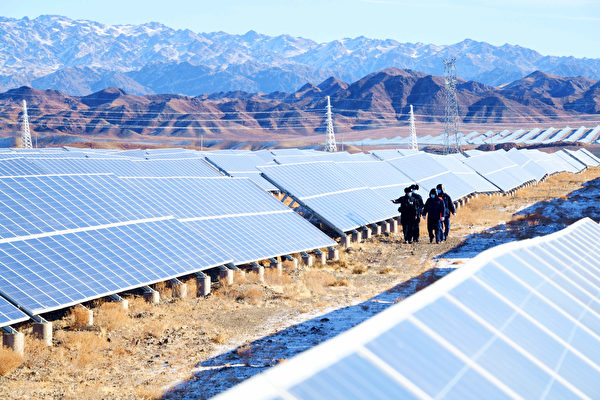
Under the so-called promotion of the new energy policy by the Chinese Communist Party, the new energy industry in China has experienced explosive expansion in recent years. State-owned enterprises rushed in all at once, leading to a capacity growth far exceeding domestic and international market demands. This resulted in intense competition within the industry, prompting many state-owned enterprises to hastily sell off their stakes in new energy, eager to escape the situation.
Analysis suggests that this is a typical operating model of Chinese state-owned enterprises, reflecting the dim prospects of the current popular industry trends.
According to statistics from PreVision Energy reported by Chinese media Sina on June 16, in just the first half of 2026, there were 37 new energy company equity transactions, with state-owned entities accounting for 65% of the transferors, and transactions involving controlling interests making up 60%.
In this wave of equity sales, major state-owned enterprises such as State Grid, Southern Power Grid, China Power Construction, and China General Nuclear Power Corporation have attracted significant attention by being included in the list of sellers.
For instance, Shanghai Electric sold a 47.4% stake in an energy storage joint venture for a nominal price of 1 Chinese yuan in February. Three Gorges Group also transferred a 49% stake in a new energy company in Henan for 1 yuan.
China General Nuclear Power Corporation sold 90% stake in a Sichuan photovoltaic company, while State Grid divested all stakes in three new energy subsidiaries in Shanxi, Jilin, and Shandong.
Analysts believe that this situation typically indicates that the company’s net assets are close to zero, or project liabilities exceed assets, and the acquirer will need to bear subsequent debts and investment obligations.
In other words, what these companies are selling is not the value of the equity itself, but transferring future burdens and risks.
The main players in this liquidation wave are state-owned enterprises, and they are selling at extremely low prices, indicating their urgency to extricate themselves from this mess.
The main characteristics of the 37 transactions include being mostly loss-making projects, with transfers primarily involving full clearance of stakes or controlling interest transfers, and significant disparities between transfer prices and book values.
State Grid’s transfer of State Grid E-commerce (Shanxi) New Energy, for example, had a net loss of 14.82 million yuan in 2025. State Grid ZhiLian (Jilin) New Energy had a net loss of 6.87 million yuan in 2025.
Among the 37 transactions, 14 involved full transfers of 100% equity, accounting for 38% of the overall total; 22 transactions involved stakes of over 50%, making up 60% of the whole.
Furthermore, State Grid transferred a 49% stake in Datang Chongqing Shizhu New Energy, with a transfer floor price of 49.3878 million yuan, while the asset evaluation value was only 26.759 million yuan. This implies that early investments have drastically shrunk or turned into liabilities.
Responding to the above situation, veteran media figure Mike Li told Epoch Times, “This is a typical mode of operation for state-owned enterprises.”
Mike analyzed, “If state-owned enterprises discover a new hot project, they will capitalize on the funding advantage of state-owned enterprises and market dominance to rush in.” However, the issue is that these state-owned enterprises “often turn a burgeoning industry into one with excess capacity and declining market prices in a very short time.” This operating method in the industry is “extremely similar to the wind power investment boom from over a decade ago.”
Analysts believe that while the reasons for this wave of sell-offs include the request from the State-owned Assets Supervision and Administration Commission of the State Council to dispose of non-primary, non-efficient assets and withdraw funds to invest in the so-called “15th Five-Year Plan” projects, the deeper reason is that companies hope to quickly rid themselves of assets dragging the company down and reduce risks.
Since 2025, the industry has entered a severe “overcapacity and structural adjustment period,” triggering intense price wars, business closures, and a wave of equity sell-offs.
Within various new energy industries in mainland China, the photovoltaic sector is the hardest hit by overcapacity.
Due to blind expansion in previous years, the entire industry chain (silicon materials, silicon wafers, battery cells, modules) faced severe overcapacity, leading to widespread losses across the industry and a significant reduction in investment in the manufacturing sector.
A finance report by Sina on April 14 revealed that since 2025, over 100 new energy companies have been listed for transfer in Beijing, Shanghai, Guangdong, and other regions, with 90% being state-owned enterprises.
Data from the China Energy Network shows that during 2025, over 50 photovoltaic-related companies were forced to exit the market; and in the silicon material segment alone, planned or forced removal of outdated capacity reached as high as 600,000 tons. The price of silicon materials, which hit a peak of 300,000 yuan per ton in 2022, plummeted to below 40,000 yuan per ton by the end of 2025.
Among China’s new energy sectors, the photovoltaic situation is the most severe, facing its lowest point since 2008, with widespread losses, layoffs, production stoppages, bankruptcies, and asset sales.
As reported by Sina Finance, due to industry overcapacity and intense competition, the top 20 major photovoltaic companies collectively reported losses exceeding 60 billion yuan in 2024.
According to statistics from the China Photovoltaic Industry Association, in 2024, out of 121 listed photovoltaic companies, 39 were in the red, accounting for nearly a third of the industry as a whole.
In 2024, over 100 photovoltaic companies went bankrupt; in the first half of 2025 alone, over 50 companies closed down; and in the first half of 2026, 13 photovoltaic companies were listed as debtors, involving amounts exceeding 2.3 billion yuan.
An article on the WeChat public account “Black Eagle Photovoltaic” analyzed that the photovoltaic industry is undergoing a brutal reshuffle. Since 2026, the industry has entered a critical phase, with more than half of photovoltaic enterprises expected to be eliminated in the future, including collapses of many cross-industry photovoltaic enterprises.
In the past two years, the solar energy industry has seen layoffs of over 200,000 workers, bankruptcies of over 220 prominent companies, over 100 enterprises listed as debtors, and hundreds of legal cases being processed, with hundreds or even thousands of small and medium-sized enterprises likely to be dragged into the situation.
Mike introduced, “From 2005 to 2015, under the leadership of the Chinese Communist Party’s policy, with state-owned enterprises taking the lead and local governments attracting investments, a swarm of ventures rushed into the wind power sector. At that time, one could often see on the roads in certain regions of China that heavy trucks were transporting wind turbine components measuring dozens of meters in length.”
According to statistics from the National Energy Administration of the Chinese Communist Party and the Wind Energy Professional Committee (CWEA) of the Renewable Energy Society of the CCP, China’s wind power installed capacity experienced explosive growth in a short period of time, with national wind power capacity reaching only about 1 GW in 2005, surpassing 40 GW by 2010, and exceeding 140 GW by 2015, surpassing the United States to become the world’s largest wind power market.
Mike emphasized that the rapid and blind expansion of the wind power market has brought about a serious issue: “Many wind farms were built in remote areas, mainly concentrated in western regions such as Xinjiang, Inner Mongolia, and Gansu, while the regions with the highest electricity demand are in the east.”
This has led to a situation where “wind turbines are built, but cannot transmit electricity, the grid’s consumption capacity is insufficient, a large amount of wind energy is wasted, and wind turbine units are abandoned, etc.” According to Mike, the industry refers to this as “curtailed wind power.”
The reason why state-owned enterprises have zealously invested in new energy projects is mainly due to the direction of the CCP’s policies. Mike analyzed that local governments, in pursuit of GDP and achievements, expedited the approval of wind power projects, further inflating this wave. Approving projects rapidly leads to inadequate wind resource assessments, resulting in massive redundant constructions. Therefore, after a large number of businesses entered the wind power market, within a few short years, there was a massive surplus of wind power capacity. Many companies, due to severe losses, were forced to merge, close down, and exit the market.
Mike stressed that the current development model of emerging industries like new energy vehicles in China is almost identical to the wind power boom of the past years. “If this model continues, there is a high likelihood of a similar wind power collapse happening in the future.”