
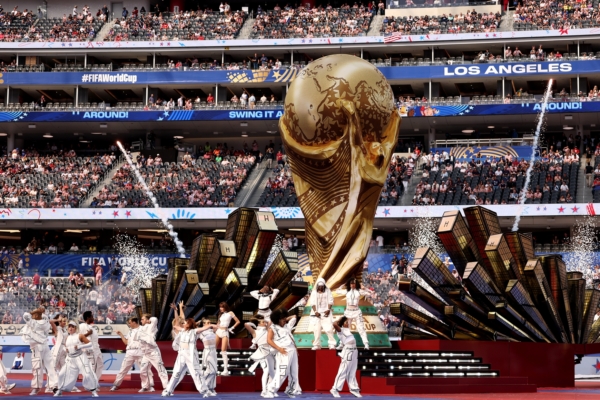
The FIFA World Cup soccer tournament is bringing a wave of tourism to the 16 host cities in the United States, Canada, and Mexico, especially to Los Angeles.
According to Trip.com booking data, trip bookings in the 16 cities have increased by 70% compared to previous years. During the group stage, international trip bookings to host cities have increased by nearly 70%, and even during the knockout stage, the growth rate remains around 40%.
The “2026 Summer Travel Report” by travel platform FORA shows that travel bookings this summer are almost double compared to the same period last year, with both domestic and international travel showing year-on-year growth. Los Angeles has particularly benefited from this year’s World Cup, with travel bookings to the city quadrupling during the USA vs. Paraguay match on June 12. So far, Los Angeles has the highest volume of travel bookings among the 11 host cities in the US.
Ticket sales for the matches are also unprecedentedly high. Five matches are breaking attendance records in World Cup history, namely: France vs. Senegal on June 16, USA vs. Paraguay on June 12, USA vs. Australia on June 19, Ghana vs. Panama on June 17, and the final on July 19. The match between USA and Paraguay in Los Angeles sold over 70,000 tickets.
Contrary to the American Hotel and Lodging Association’s (AHLA) earlier prediction of soft demand due to travel constraints and rising costs, the current enthusiasm far exceeds expectations.
Rosanna Maietta, the President and CEO of AHLA, told ABC News, “Industry experts expect a last-minute surge in bookings before each match, and we believe the attendance at sports venues will be quite substantial.”
Short-term rental platform Airbnb stated that search volumes for destination cities have significantly increased, up 80% from a year ago, with Philadelphia and Miami showing the highest actual booking growth. Before the tournament started, the total number of homes listed on the platform in host cities surpassed 100,000 for the first time since October last year.
The three host cities in Mexico are among the most benefited by the World Cup. These cities, which usually struggle to attract international tourists, have seen significant growth in restaurant bookings during the group stage: over 40 times in Monterrey, over 10 times in Guadalajara, and over 150% in Mexico City. Analysts attribute this to the influx of Japanese, Korean, and Australian fans attending the matches.
In Dallas, restaurant bookings during the group stage witnessed a staggering growth of over 1,400%.
The 19th-ranked Japanese national football team, placed in the “Group of Death” F group, managed to draw with the 8th-ranked Dutch team despite being behind in the scoreline during the group stage thanks to the unwavering support of their fans.
Japanese fans have shown the most enthusiasm and loyalty in this tournament. During the group stage, trips by Japanese fans to host cities increased by 250% year-on-year, more than double the increase seen in European countries. In the knockout stage, Japanese fan bookings saw a 100% increase, ranking at the top among all countries.
Dallas saw the highest flight bookings for Japanese fans during the group stage, while Los Angeles is set to become the most popular destination for Japanese fans during the knockout stage.
This World Cup has seen teams facing challenges with training and match locations far apart, with some teams traveling internationally between each game. This also poses a challenge for spectators, but it does not dampen the enthusiasm of die-hard fans.
Data shows that over 30% of Japanese fans choose to travel to multiple host cities during the group stage, displaying the highest level of loyalty. Japanese team cities include Dallas, Los Angeles, Monterrey, and Mexico City.
A joint study by FIFA and the World Trade Organization indicates that this World Cup is expected to generate a $410 billion increase in global GDP and create 824,000 job opportunities, with the US expecting a $170 billion increase and creating 185,000 jobs.
In Los Angeles County alone, the World Cup matches are expected to bring nearly $600 million in economic growth, providing close to $250 million in income to employees. In New York, FIFA projects the World Cup will attract over 1.2 million visitors, contributing to a $3.3 billion economic boost.
Haim Israel, Managing Director and Global Strategist at BofA Global Research, estimated in an interview with the Southern California News Group that over 6 billion people worldwide will watch this tournament, with 6 million attending in person, and 1.5 billion watching the full game.
“We have always considered this (World Cup) as an economic event, but it is not. It is an emotional event,” Israel said. ◇