
【Epoch Times June 17, 2026】An 18-year-old boy in Chongqing was chased by fishery law enforcement personnel while fishing, and tragically drowned after jumping into the river, with no assistance provided by the law enforcement officers on the shore. After the incident, the family of the victim and a large number of people took to the streets to demand justice, only to be met with a violent crackdown by the police, leading to the confiscation of the body and the arrest of many individuals. This incident is the latest case in a series of ongoing group protests in China.
On the afternoon of June 8th, around 4 p.m., an 18-year-old boy in Kaizhou District of Chongqing was fishing below a regulating dam when he was chased by several fishery law enforcement officers, ultimately resulting in him drowning after jumping into the river, with no rescue attempt made by the officers.
According to witness Zhao Junfeng (pseudonym) described to Epoch Times, after the boy fell into the water, the fishery law enforcement officers, fearing repercussions, filmed the incident with their phones. “Six minutes passed, and no one went to rescue him. He sank, and only then did the fishery officers realize the severity of the situation and started making calls for help.”
He said, “Rescue personnel arrived at the scene with delayed actions, and the boy’s body was not recovered until 9 p.m. that night. When they retrieved the body, it was already stiff.”
Zhao Junfeng expressed, “When we saw the fishery enforcement officers coming, that guy didn’t run with us, he just went straight into the middle of the river. His fishing friends next to him called out to him, but he didn’t hear them, probably out of fear of being caught by the officers.”
He recalled that there were over a hundred fishing friends at the scene, some of whom wanted to rescue the boy by hooking him with fishing rods and pulling him in. However, these friends were chased away by the fishery law enforcement officers, and eventually, they all ran onto the grass dam. He said, “If we didn’t run, we would have been caught by them and fined or had our fishing equipment confiscated.”
Local resident Zhou Tao (pseudonym) told reporters, “That drowned youth was only 18 years old, still a student. The fishery department is definitely responsible for this, after all, a life was lost, and the family members have come out to protest.”
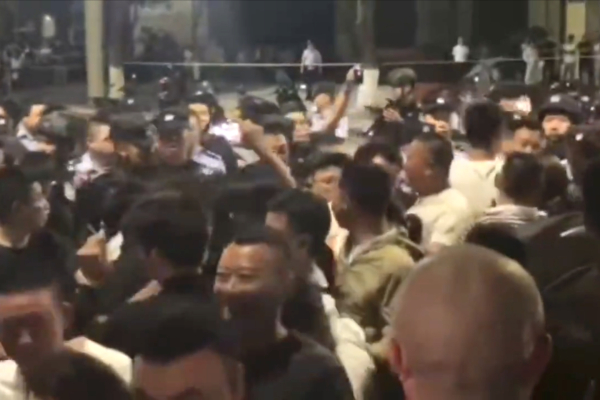
On the night of the tragedy, the family of the deceased and a large number of people gathered spontaneously, but instead of a government response, they faced police repression.
Zhao Junfeng described the chaotic situation that night. He recounted, after the boy drowned, a large number of family members, fishing friends, and citizens quickly gathered, expressing dissatisfaction with how the incident was handled.
He said, “Family members, us fishing friends, and the citizens protested together.” He believed that one of the key reasons for the heightened emotions among the people that night was the controversial approach taken by the police in handling the situation.
According to him, the protests were not limited to the fishery department’s entrance but extended to multiple areas. “We stirred up trouble at the Kaizhou Fishery Law Enforcement Department, the Kaizhou Traffic Police gate, and even at the entrance of the residential area.”
He estimated that there were many people gathered at the scene that night, “about a thousand people coming and going.”
Based on Zhao Junfeng’s knowledge, there was a clear disagreement in the handling of the boy’s body between the family and the authorities, as the family wanted a burial while the police insisted on cremation. He mentioned that the two sides could not reach an agreement and eventually a violent conflict erupted. “In the end, the body was taken away by the police.”
Zhao Junfeng also mentioned that while the family was demanding justice with the body, the police resorted to force. “The family was carrying the body to argue, but the police indiscriminately grabbed people, following suit by snatching the body and arresting over a dozen innocent individuals.”
When discussing the situation at the scene, Zhao Junfeng repeatedly emphasized the adversarial relationship between the police and the people, with many participants disagreeing with the police’s heavy-handed approach to enforcing the law. He said, “Everyone was united in their dissatisfaction with the compulsory measures taken by the police. In fact, we all know that the police have always been suppressing ordinary civilians.”
Zhao Junfeng stated that although he was not arrested, he was besieged by the police. “I wasn’t arrested but was surrounded; we all ran away afterward.” He further described the law enforcement at the scene as very aggressive. “The police were too violent; that night was chaotic, and they even fought with the police.”
According to his account, as the situation escalated, the police began a widespread roundup of people at the scene. “Later, the police started grabbing civilians in all directions.” He admitted that emotions were running high at the time, “I almost laid a hand on the police.”
Regarding the dissemination of videos and information related to the event, Zhao Junfeng said the police strictly controlled online communication. He said, “The police wouldn’t let us share videos.”
Even when some related content was posted, it drew police attention. “Whenever I shared a video, the police would call me.” This situation made it challenging for many to continue spreading images and eyewitness accounts on the internet.
Zhao Junfeng revealed that the deceased boy was not alone in the local community and came from a financially stable family. “That boy had an older brother who runs a barbecue restaurant, selling breakfast in the morning and barbecue in the evening.” He also mentioned that the boy had a girlfriend before his death, and they had plans to meet. “But she never got to see him; he was gone before that.”
After news of the boy’s drowning spread, many local young people spontaneously came to mourn. Zhao Junfeng said that the boy had a lively personality, which earned him popularity among the local youth.
Another local resident, Lin Ruizhe (pseudonym), told Epoch Times that the drowning of the 18-year-old boy had sparked public anger in the area, with approximately thousands protesting. “But protesting is futile; we can’t win against the government, it just goes to show how dark the government is.”
“I heard the government offered 180,000 yuan in compensation, but the family didn’t agree, but what can they do if they disagree? This issue can no longer be found on Douyin (a popular social media platform); I can’t upload my videos anymore. Once you do, the police will immediately come looking for you.” Lin Ruizhe said.
What angered the local people was the authorities’ response to the spontaneous civil rights action, not engaging in dialogue but instead controlling and deleting posts, leading to the continuous removal of related videos on the internet. In reality, this tragedy was not accidental; it was rooted in years of dissatisfaction with law enforcement in the area.
The downstream area below the regulating dam in Kaizhou District, Chongqing, has long been a fishing spot for local residents. However, the authorities, citing fishing bans, have prohibited fishing and continue to send fishery law enforcement officers to drive away fishing enthusiasts and confiscate fishing equipment, leading to frequent conflicts between the officials and the public, leaving the locals deeply dissatisfied with the government’s enforcement.
Zhao Junfeng mentioned that in previous encounters, fishing enthusiasts faced penalties such as breaking fishing rods and fines of a thousand yuan when caught by fishery enforcement.
The drowning of the teenage boy in Chongqing is just a microcosm of the wave of group protests in various parts of China.
A blogger “Yesterday,” who has long been following collective protests in China, once compiled the “Top Ten Group Protests in Mainland China in 2025,” including demonstrations against bullying in Jiangyou, Sichuan, students’ deaths in Pucheng, Shaanxi, and Hualong, Xuchang Middle School in Henan, and the medical incident involving “Little Luoxi” in Ningbo. These events cover protests in different areas, such as schools, healthcare, labor, and land rights.
Chinese human rights activist Li Ming (pseudonym) told Epoch Times that these collective protests are not spontaneous social conflicts but rather a result of the long-term suppression of social expression and the blockage of normal channels for grievances under the single-party rule of the Chinese Communist Party. Many issues that start as specific cases lack public explanations and effective responses, leading to escalating emotions that ultimately culminate in collective actions.