
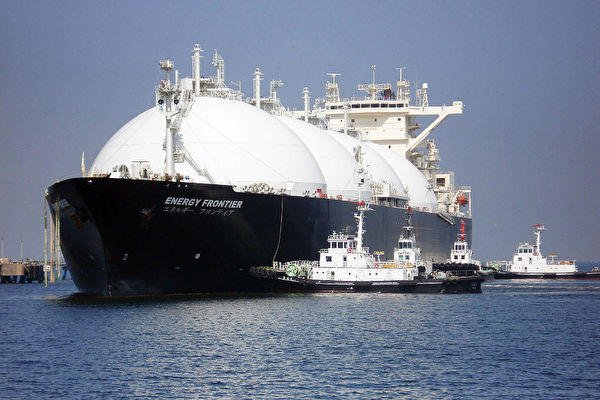
In light of geopolitical risks threatening Japan’s energy transport, there are reports on Monday (June 15) indicating that the Japanese government is planning to restart domestic liquefied natural gas (LNG) carrier construction business. Japanese shipbuilding companies are expected to collaborate with South Korea with the goal of resuming production around 2035 and achieving a scale of building 3 to 5 ships annually.
In the 1980s and 1990s, Japanese shipbuilding companies dominated the global LNG carrier market. However, facing the low-cost advantages of South Korea and China, Japanese shipbuilders gradually lost market share and ceased the delivery and construction of LNG carriers since 2019.
Currently, Japan’s Imabari Shipbuilding, Kawasaki Heavy Industries, and Namura Shipbuilding plan to share expertise and support skilled welders in order to revive LNG carrier construction. The plan is expected to utilize Kawasaki Heavy Industries’ Sakai Shipyard in Kagawa Prefecture. Apart from Imabari Shipbuilding and Kawasaki Heavy Industries, Mitsubishi Heavy Industries has also been involved in LNG carrier construction in the past.
With Japan relying on imported liquefied natural gas for up to 98% of its consumption, these LNG carriers are crucial for Japan’s energy security as they serve not only as fuel for power generation but also supply natural gas to households.
Therefore, the Higashi Someno government has listed the shipbuilding industry as one of the 17 priority development areas, and the revival of LNG carrier construction is a key pillar of this strategy. The Japanese government plans to incorporate this project into the forthcoming public-private investment roadmap of the “Growth Strategy Council of Japan”.
However, considering that domestically produced LNG carriers may still lag behind in price competitiveness compared to South Korea and China, the Japanese government is contemplating offering subsidies to potential buyers (shipowners) to bridge the price gap and support the shipbuilding project.
In the future, other shipbuilding companies are also expected to join this initiative. Currently, there are approximately 100 LNG carriers supplying natural gas to Japan, and considering these vessels have a lifespan of around 20 years, Japan needs to build steadily 3 to 5 ships annually to maintain the required transportation volume for imports.
Nevertheless, the halt in LNG carrier construction in Japan for over five years has led to the loss of the supply chain necessary to support this industry. Moreover, the industry trend is now focused on enhancing loading efficiency with the “Membrane” tank technology, an expertise which Japanese shipyards generally lack.
Therefore, Japan is considering seeking assistance from South Korea, which possesses rich experience and technology, and is also exploring collaboration with French companies that hold relevant technological patents.
Currently, South Korea accounts for about 70% of global LNG carrier orders but is facing a shortage of labor, creating an opportunity for the Chinese shipbuilding industry. Thus, the cooperation between Japan and Korea is expected to help South Korea maintain its leading position in the field.
Some individuals in the South Korean shipbuilding industry believe that cooperation with Japan will be a strategic move to counterbalance the Chinese shipbuilding industry. Japan, being the world’s third-largest maritime nation with strong ship orders, presents significant opportunities for mutual cooperation and benefit.
Lee Eun-chang, a researcher at the Korea Institute for Industrial Economics and Trade (KIET), stated, “With China securing a large number of shipbuilding orders, other shipbuilding powerhouses like South Korea and Japan need to collaborate for balance. South Korea has a technological edge in high-value vessels like LNG carriers, while Japan is competitive in standard design and equipment, allowing both sides to leverage their strengths for mutual success.”
(Reference: Reports by “Nikkei” and “Chosun Ilbo”)