
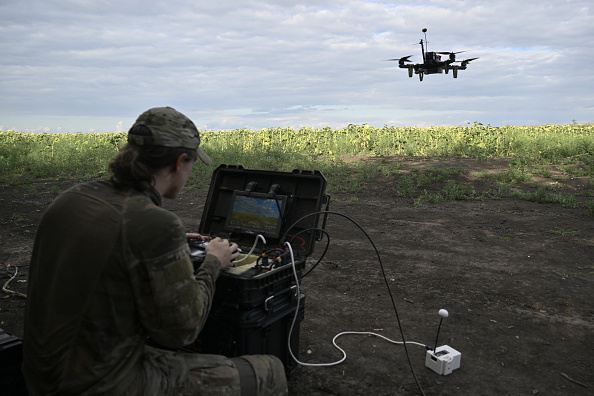
After being occupied by Russian forces for four years, the Ukrainian “Azov Battalion” has regrouped and returned to its homeland in Mariupol, launching drones back into the skies above the city.
Last week, the “1st Azov Corps” affiliated with the Ukrainian National Guard targeted the Mariupol strategic port’s substation, maintenance facilities, and a sanctioned ship, causing a power outage in the port.
This operation not only signifies the symbolic return of the Azov forces to their “homeland” but also marks an escalation in Ukraine’s “medium-range strike” strategy.
The operation demonstrated the progress the Azov forces have made in drone technology.
One of the main weapons of the Azov forces is the “Hornet” drone produced by the US defense technology company Perennial Autonomy, equipped with AI-assisted functions.
Analysts say that Azov operators have installed Starlink satellite internet terminals on these drones to extend their original range of about 100 kilometers.
The Azov forces claim that their drones can currently carry out missions up to approximately 160 kilometers from the front line.
Pro-Russian military blogger Romanov stated that the “Hornet” drones can fly freely over the R-150 highway near Mariupol, searching for targets mainly including fuel trucks and other military vehicles.
He believes that in the next six months to a year, Russian forces may encounter fully automated “Hornets” or other drones that are difficult to disrupt electronically. These drones may loiter in specific areas until neural networks select their targets.
The Azov forces posted on social media, saying, “Currently, it’s from the air, but there will be more to come.”
George Barros from the Institute for the Study of War believes that the Ukrainian military is attempting to establish “kill zones” in Russian-held territory, targeting Russian logistics, assembly areas, and command centers located 30 to 120 kilometers behind the front lines. This strategy aims to force Russian forces to disperse vehicles, lengthen detour routes, reduce the pace of their offensive, and disrupt the land supply line linking Russia to Crimea.
Currently, the Azov forces have transformed from the fragmented remnants of the 2022 Azovstal defense battle into a powerful legion comprising tens of thousands of soldiers, six brigades, a special forces unit, and a dedicated drone squadron.
Olena Kryzhanivska, a defense analyst at the Canadian Global Affairs Institute, stated that the Azov forces, now officially part of the National Guard, are seen as a top combat force in Ukraine and one of the most advanced formations in terms of drone warfare.
Arsen Dmytryk, Chief of Staff of the 1st Azov Corps, told Reuters that recapturing Mariupol, located 120 kilometers behind the front line, is a “long-term plan.”
Dmytryk, who was once captured by Russian forces and later released, said, “Even if it takes 20 years to plan, wait, and prepare, we will do it. But when the time is right, we must be ready. I believe we will retake Mariupol; it’s only a matter of time.”
Over 700 Azov soldiers are still held captive by Russia, with 250 of them accused and convicted by Russia of committing so-called “war crimes,” a move that the Azov forces consider a violation of the Geneva Conventions.
Kyiv has made the comprehensive exchange of prisoners a key aspect of potential peace agreements.
Commander Denys Prokopenko emphasized that securing the release of his comrades is his “top-priority, as well as an honor.”
Kyiv and other major cities frequently hold rallies calling for “Free Azov,” reflecting the heroic status of the unit within Ukrainian society.
The Azov forces stated that they are working diligently every day to bring soldiers home, including setting up “prisoner bartering chips” involving captured enemy soldiers and initiating international advocacy efforts on the issue of prisoners of war.
The Azov forces hope that these efforts will expedite the return of members who have been imprisoned for five years.
Ukrainian military accuses Russia of systematically excluding Azov members from prisoner exchange lists, resulting in a very low release rate for Azov members. With the increase in domestic drone production in Ukraine, this campaign targeting Russian logistics is expected to further expand.