
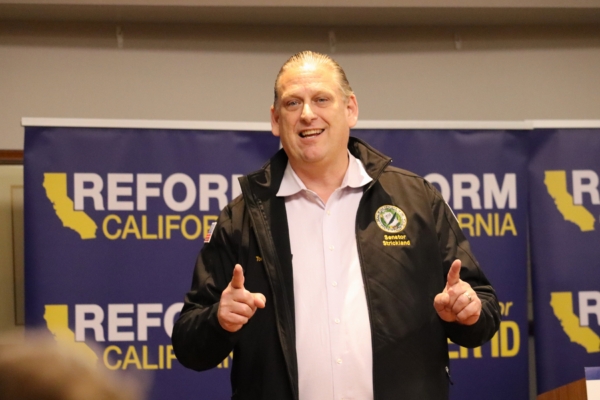
On June 18th, Republican Senator Tony Strickland from the 36th District criticized the majority party’s support for the SB122 and SB125 state budget tax package bills, which will impact every small business owner using digital tools and increase healthcare costs for families.
The California Senate and Assembly approved Governor Newsom’s proposed $355.9 billion budget for the 2026-27 fiscal year on the 15th and 16th of June, an increase of $30.9 billion from the previous year, reaching a historic high. However, with no substantial growth in California’s revenue, tax increases are necessary to achieve budget balance.
Strickland criticized, “Majority party lawmakers have an uncontrollable urge for government spending. Despite record-high tax revenue, they passed two large-scale tax bills that will take money out of the pockets of hardworking families across California.”
“SB122 will impact all businesses using digital tools, with particularly severe consequences for small family-run shops. SB125 will result in a family of four enrolled in a healthcare plan paying an additional $400 annually,” Strickland said. “They talked big about solving the ‘crisis of excessive burdens’, but the voting records of Democratic senators tell a completely different story.”
He said, “Tax bills could be the ‘last straw that breaks the camel’s back’, forcing businesses to move out of California, damaging our economy.”
SB122, known as “Taxation”, is the accompanying measure for the 2026-27 California budget, taxing telephones, computers, and software used by businesses. The Senate passed the bill with a vote of 27:9 and 4 abstentions, while the Assembly passed it with a vote of 56:20 and 3 abstentions; both exceeding the two-thirds threshold for tax increases. Democratic members hold an absolute majority in both houses of the California Legislature.
Some provisions of the bill include: 1) starting from January 1, 2027, taxing pre-written software delivered through e-commerce with sales and use taxes, covering physical storage media, electronic transmission, and remote access of computer software; 2) prohibiting the establishment of any agreements between buyers and sellers of digital products using electronic transmission or remote means to avoid sales and use taxes levied on digital products directly or indirectly. Additionally, adjustments will be made to the tax credits limit for businesses.
SB122 is expected to generate a net income of $1.4 billion for the General Fund in California for the 2026-27 fiscal year, including:
1) By expanding the sales and use tax on pre-written software, it is projected to increase tax revenue by $450 million for the fiscal year 2026-27, with an annual increase of $900 million thereafter; local jurisdictions are estimated to gain $560 million in the half-year period of 2026-27, with an annual increase of $1.1 billion thereafter;
2) After setting the maximum limit for temporary corporate tax credits, an increase of $1 billion in tax revenue is expected for the fiscal year 2026-27, with subsequent increases of $3.3 billion in 2027-28 and over $4.5 billion in 2028-29. Additionally, reducing annual franchise taxes will result in a $100 million reduction in state tax revenue.
On the 18th, SB125 passed the Senate with a vote of 27:9 and 4 abstentions, and the Assembly with a vote of 57:20 and 2 abstentions. The bill aims to ensure that the taxation complies with federal uniform tax requirements, while being unaffected by California’s Proposition 35’s limit of an annual tax cap of $36 million for non-California Medicaid expenditures. California generates net income of $7-$8 billion annually from the current MCO tax (Managed Care Organization tax), most of which is used to offset California’s Medicaid (Medi-Cal) expenses, including costs for undocumented immigrants.
On July 4, 2025, the federal government enacted House Bill 1 restricting California’s ability to use MCO tax to pay for a portion of federal Medicaid costs. Indeed, states will lose a vital means of collecting Medicaid funds; almost all states will need to limit eligibility for coverage, benefits, or the amount paid to Medicaid providers. However, for the federal government, this will reduce expenditures by about $225.7 billion over the next 10 years.
In 2024, California voters passed Proposition 35, which mandates a permanent MCO tax starting from January 2027 to fund programs such as low-income Medicaid. However, California still requires federal approval to levy this tax.
The SB125 bill states that the legislature believes that levying MCO tax based on the number of enrollees is a non-federal funding source to both maintain and enhance California Medicaid and maximize non-federal funding participation; and that the MCO tax minimizes demands to reduce California Medicaid. The bill notes that California requires at least $20 billion annually in non-federal funding; although there are provisions for tax revenue, the “Medi-Cal Stability Fund” can still receive cash flow loans from the General Fund. ◇